x

 Sculpture BronzeSculptureModern Sculpture
 1956
1956 52.0 x 80.0 cm
 The Hepworth Wakefield
Huile sur toile peinte à la main, avec cadre et dimensions personnalisés, réalisée sur commande par nos artistes. ( Commander l'impression Télécharger l'image haute résolution)
Choisissez parmi nos formats prédéfinis qui respectent les proportions originales de l’œuvre.

Vous pouvez saisir vos propres dimensions pour l'adapter à un cadre ou à un espace spécifique. Si la taille sélectionnée ne correspond pas aux proportions de l'image d'origine, nous recadrerons l'œuvre ou prolongerons la peinture avec des éléments peints à la main supplémentaires. Une maquette numérique vous sera envoyée pour approbation avant le début de la production.
Veuillez noter que l'aperçu à l'écran ne reflète pas le recadrage ou l'extension réels. Seule la maquette montrera fidèlement la composition finale.
Bien que des tailles personnalisées soient disponibles, nous vous recommandons de sélectionner une dimension dans la liste prédéfinie afin de préserver les proportions d'origine.
Livraison dans le monde entier () en 3 à 4 semaines au lieu des 5 semaines habituelles. (18 août). Aucun compromis sur la qualité.


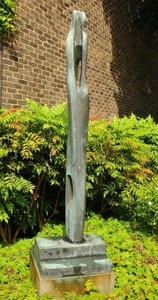
Curved Forms (Pavan)
Format de la reproduction
Barbara Hepworth (1903–1975) stands as one of the most influential figures in British sculpture of the mid-20th century, a pioneer who championed abstraction and sought to capture the essence of organic forms—particularly those found in nature. Her oeuvre is characterized by monumental sculptures crafted from materials like bronze, stone, and alabaster, yet “Curved Forms (Pavan),” created in 1956, exemplifies her distinctive approach: metallized plaster cast on aluminum armature.
Inspired by the graceful Pavan dance—a stately court dance of Elizabethan England—Hepworth’s sculpture transcends mere imitation. Instead, it embodies her profound fascination with movement and transformation. As Hepworth herself eloquently described, she aimed to “capture ‘the spiritual inner life’ of art,” striving not just for visual representation but for conveying a sense of dynamism and interconnectedness.
Hepworth's method was revolutionary for its time. Rejecting the traditional modeling techniques favored by many sculptors, she opted for a process that prioritized resistance—the interaction between sculptor and material. She constructed an aluminum armature – a skeletal framework – providing structural support while allowing her to manipulate the plaster surface with precision.
"Curved Forms (Pavan)" isn't merely a beautiful object; it’s laden with symbolic significance. The three interconnected ovoids represent Hepworth’s belief in the fundamental unity of existence—the idea that all things are interdependent and constantly evolving. Their flowing curves mirror the movement of water or wind, symbolizing fluidity and adaptability.
Hepworth's aesthetic vision was rooted in a deep appreciation for natural forms and a desire to express their underlying principles. She sought to distill the essence of organic shapes into simplified geometric forms, creating sculptures that evoke contemplation and invite viewers to consider the relationship between form and space.
"Curved Forms (Pavan)" resides in The Hepworth Wakefield’s collection, a testament to Hepworth's enduring influence on modern sculpture. Its placement alongside other works by Hepworth underscores her commitment to exploring themes of spirituality and materiality—a legacy that continues to inspire artists and collectors alike.
The sculpture’s distinctive monochromatic surface – achieved through careful polishing – enhances its visual impact, emphasizing the texture and contours of the form while creating a serene atmosphere. As Hepworth herself noted, “Curved Forms (Pavan), Version II” embodies "the spiritual inner life" of art—a profound statement that encapsulates her artistic philosophy.

L'œuvre de Hepworth a évolué au fil des ans, passant d'abstractions influencées par le cubisme et le surréalisme à des formes plus organiques et abstraites. Son séjour en France dans les années 1930, où elle a rencontré des artistes comme Brancusi et Arp, a été déterminant pour son développement artistique. Elle s’est intéressée aux formes naturelles, notamment celles trouvées dans la mer et le paysage de Cornouailles, où elle a vécu pendant une grande partie de sa carrière.

1903 - 1975 , Royaume-Uni

Discover the sophisticated world of metal art. From industrial grace to contemporary sculpture, our expert guide explores how premium metallic masterpieces elevate luxury interiors for discerning collectors seeking timeless elegance and investment-grade artistry.

Explore the profound history of sculpture, from classical realism to modern abstraction. Discover the mastery of form, texture, and medium through an expert art-historical lens designed for discerning collectors and enthusiasts.
Elevate your collection with our expert guide to bronze sculpture. Discover the mastery of lost-wax casting, the artistry of patination, and professional insights for acquiring timeless metal masterpieces that define sophisticated interiors.


Restez informé(e) des dernières actualités artistiques, des offres exclusives et des idées de décoration.
Parlez-nous de votre projet et nos experts en art vous proposeront 3 suggestions d'œuvres personnalisées.
Laissez-nous sélectionner 3 œuvres rien que pour vous – Gratuit !


 Envoyer
 Partager
 Détails de l'œuvre

 Télécharger
 Articles similaires
 Diaporama
 Lire la suite




































 L'option verre n'est disponible que pour les dimensions inférieures à 110 cm.