x

Huile sur toile peinte à la main, avec cadre et dimensions personnalisés, réalisée sur commande par nos artistes. ( Commander l'impression Télécharger l'image haute résolution)
Choisissez parmi nos formats prédéfinis qui respectent les proportions originales de l’œuvre.

Vous pouvez saisir vos propres dimensions pour l'adapter à un cadre ou à un espace spécifique. Si la taille sélectionnée ne correspond pas aux proportions de l'image d'origine, nous recadrerons l'œuvre ou prolongerons la peinture avec des éléments peints à la main supplémentaires. Une maquette numérique vous sera envoyée pour approbation avant le début de la production.
Veuillez noter que l'aperçu à l'écran ne reflète pas le recadrage ou l'extension réels. Seule la maquette montrera fidèlement la composition finale.
Bien que des tailles personnalisées soient disponibles, nous vous recommandons de sélectionner une dimension dans la liste prédéfinie afin de préserver les proportions d'origine.
Livraison dans le monde entier () en 3 à 4 semaines au lieu des 5 semaines habituelles. (15 août). Aucun compromis sur la qualité.


Torso
Format de la reproduction
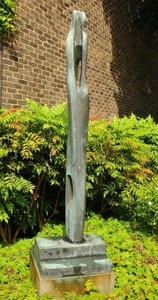
Barbara Hepworth's “Torso,” created in 1928, isn’t merely a depiction of the human form; it’s an embodiment of movement and quiet contemplation. This remarkable sculpture, rendered in the rich, dark tones of mahogany wood, immediately draws the viewer into its world – a world where form and space intertwine with a profound sense of stillness. Hepworth, a pivotal figure in the development of modern sculpture, masterfully eschews traditional representation, opting instead to capture an essence, a feeling, rather than a literal likeness. The piece speaks volumes about her pioneering approach to abstraction, prioritizing the inherent qualities of materials and the interplay between positive and negative space.
Hepworth’s technique is characterized by subtractive carving – a painstaking process of carefully removing material from a solid block of wood to reveal the desired shape. This method, demanding immense skill and patience, allows her to coax forth organic forms that seem to grow naturally from the raw material. Notice the subtle variations in texture across the surface; these aren’t simply cosmetic details but rather evidence of the sculptor's hand, each ridge and curve a testament to the physical act of creation. The choice of mahogany is particularly significant. Its deep, resonant color provides a dramatic backdrop for the sculpted form, while its grain adds layers of visual complexity – hints of light and shadow that dance across the surface. The smooth, polished finish further enhances the tactile quality of the piece, inviting viewers to imagine running their hands along its contours.
“Torso” emerged during a period of intense artistic experimentation and a rejection of academic traditions. Hepworth was deeply influenced by movements like Abstraction-Création, which sought to explore the fundamental qualities of form and material. Her work reflects this spirit of innovation, moving away from representational art towards a more conceptual approach. The sculpture’s emphasis on geometric shapes and its exploration of negative space align with the broader trends of early 20th-century modernism, where artists were increasingly interested in reducing forms to their essential elements. Hepworth's time spent studying Italian Renaissance sculpture also informed her work, particularly her understanding of classical anatomy, which she then reinterpreted through a distinctly modernist lens.
While “Torso” avoids overt symbolism, it possesses a powerful emotional resonance. The pose itself – a relaxed yet alert stance – suggests a state of contemplative awareness. The smooth curves and flowing lines evoke a sense of grace and fluidity, while the solidity of the wood grounds the form in the physical world. There’s an inherent vulnerability in the exposed torso, inviting viewers to contemplate themes of beauty, strength, and mortality. It's not a celebration of physicality but rather an exploration of the human condition – a quiet meditation on the essence of being. The sculpture’s timeless quality speaks to its ability to connect with viewers across generations, offering a moment of stillness in our increasingly frenetic world.
A high-quality reproduction of “Torso” can bring the spirit of this iconic work into any space. Consider framing it within a simple, elegant setting to allow the sculpture’s form and texture to take center stage. The rich tones of the wood will complement a wide range of interior design styles, from minimalist modern to classic contemporary. When selecting a reproduction, prioritize materials that accurately capture the depth and nuance of Hepworth's original work – archival-quality prints on textured paper are ideal for achieving a truly authentic effect.

L'œuvre de Hepworth a évolué au fil des ans, passant d'abstractions influencées par le cubisme et le surréalisme à des formes plus organiques et abstraites. Son séjour en France dans les années 1930, où elle a rencontré des artistes comme Brancusi et Arp, a été déterminant pour son développement artistique. Elle s’est intéressée aux formes naturelles, notamment celles trouvées dans la mer et le paysage de Cornouailles, où elle a vécu pendant une grande partie de sa carrière.

1903 - 1975 , Royaume-Uni

Explore the profound history of sculpture, from classical realism to modern abstraction. Discover the mastery of form, texture, and medium through an expert art-historical lens designed for discerning collectors and enthusiasts.


Restez informé(e) des dernières actualités artistiques, des offres exclusives et des idées de décoration.
Parlez-nous de votre projet et nos experts en art vous proposeront 3 suggestions d'œuvres personnalisées.
Laissez-nous sélectionner 3 œuvres rien que pour vous – Gratuit !


 Envoyer
 Partager
 Détails de l'œuvre

 Télécharger
 Articles similaires
 Diaporama


 Lire la suite




































 L'option verre n'est disponible que pour les dimensions inférieures à 110 cm.