x

Acquérez une image numérique haute résolution et optimisée, d'une qualité bien supérieure à l'aperçu en ligne.
Chaque fichier est méticuleusement préparé par nos spécialistes internes à l'aide d'outils avancés et d'une retouche manuelle experte. Nous garantissons que chaque image possède une clarté exceptionnelle, une précision des couleurs irréprochable et un niveau de détail fin.
Le fichier final est livré par e-mail sous 72 heures, optimisé pour une utilisation immédiate dans des contextes professionnels, éditoriaux et d'impression. Il offre la même qualité de confiance que celle utilisée par les plus grands studios de création, éditeurs et galeries.
Téléchargez un fichier haute résolution pour votre usage personnel, l'impression et vos projets créatifs. ( Commander l'impression Commander la reproduction peinte à la main)
En choisissant Most-Famous-Paintings.com, vous n'obtenez pas seulement une simple image : vous recevez une œuvre numérique sublimée avec professionnalisme, conçue avec précision et accompagnée d'une garantie de satisfaction. Voici tout ce qui accompagne automatiquement votre commande :

Votre fichier d'image numérique haute résolution vous sera envoyé par e-mail sous 72 heures après votre commande — prêt à un usage immédiat.

Votre œuvre d'art bénéficie d'une optimisation professionnelle grâce à des outils d'IA avancés et une retouche manuelle, garantissant un niveau maximal de détail, de clarté et de fidélité chromatique.

Vous avez accidentellement supprimé ou perdu votre fichier ? Pas d'inquiétude — nous vous le renverrons gratuitement, quand vous le souhaitez.

Profitez de votre œuvre d'art instantanément sans frais de douane ni de livraison — les téléchargements numériques sont toujours exonérés de taxes.

Nous garantissons que votre image numérique reproduit les couleurs de l'original aussi fidèlement que possible grâce à des outils professionnels et une gestion rigoureuse des couleurs.

Si vous n'êtes pas satisfait de votre image numérique, nous la retoucherons ou vous rembourserons 100% sous 60 jours — sans poser de questions.

Pas satisfait ? Obtenez un remboursement intégral dans les 60 jours suivant la réception de votre fichier numérique — sans aucune question posée.

Achetez 3 images, économisez 10% - Achetez 5, économisez 15% - Achetez 10+, économisez 20%. Idéal pour les projets créatifs, les galeries et les agences.
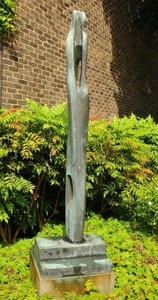
Dame Barbara Hepworth's "Wave," created in 1943 during a pivotal period of artistic and personal transformation, is more than just a sculpture; it’s a profound meditation on movement, form, and the elemental power of nature. Born amidst the turmoil of World War II, Hepworth sought refuge and inspiration in the rugged Cornish coastline, a landscape that profoundly shaped her evolving aesthetic. “Wave” embodies this connection, capturing not merely the visual appearance of a breaking wave but its very essence – the dynamic tension between potential energy and released force, the suggestion of ceaseless motion frozen in stone.
The sculpture itself is remarkably understated in its execution. Crafted primarily from wood, meticulously polished to a luminous sheen, it’s a deceptively simple form: a gently curving line extending outwards from a central, circular core. This isn't an attempt at literal representation; rather, Hepworth employed a reductive approach, stripping away extraneous detail to reveal the underlying structure and rhythm of the subject. The wood, chosen for its warmth and inherent grain, provides a tactile counterpoint to the smooth, almost ethereal quality of the polished surface. The subtle variations in tone within the wood itself – hints of amber, ochre, and grey – subtly mimic the shifting hues of the sea under different lighting conditions.
“Wave” firmly establishes Hepworth as a key figure within the burgeoning movement of Modern sculpture. Rejecting traditional representational approaches, she embraced abstraction, prioritizing the exploration of form, texture, and spatial relationships. Influenced by Cubism and Surrealism, Hepworth sought to capture not just what something *looked* like but how it *felt*, translating internal experiences into tangible three-dimensional forms. This approach aligns with the broader modernist ethos of breaking away from established conventions and forging new paths in artistic expression.
The sculpture’s design reflects a conscious engagement with geometric principles, yet it avoids rigid formality. The curve is organic and flowing, suggesting the unpredictable nature of water – its capacity to both crash against the shore with violent force and gently lap at the sand. Hepworth's use of negative space—the areas surrounding and between the form—is equally crucial, creating a sense of lightness and airiness that further emphasizes the sculpture’s dynamic quality. It is this careful balance between positive and negative forms that gives “Wave” its remarkable visual power.
Beyond its purely formal qualities, "Wave" carries significant symbolic weight. Created during a time of global conflict and uncertainty, the sculpture can be interpreted as an emblem of resilience – a testament to the enduring strength and adaptability of nature. The wave itself represents constant change, ceaseless movement, and the cyclical rhythms of life and death. The polished surface reflects light, suggesting hope and renewal, while the underlying structure hints at the potential for transformation.
Hepworth’s personal experiences also informed the sculpture's meaning. Following her divorce from John Skeaping in 1933, she sought solace and creative rejuvenation in Cornwall, a landscape that offered both beauty and emotional depth. “Wave” can be seen as an expression of this journey – a celebration of freedom, independence, and the power to overcome adversity. The work’s inherent dynamism mirrors Hepworth's own evolving artistic practice, reflecting her willingness to experiment with new materials and techniques.
Reproductions of “Wave” offer a compelling opportunity to bring this iconic sculpture into your home or office. The meticulous detail captured in high-quality reproductions allows you to appreciate Hepworth’s masterful use of form, texture, and space. Consider placing a reproduction within a light-filled room to maximize its reflective qualities, creating a focal point that draws the eye and evokes a sense of tranquility.
“Wave”’s understated elegance makes it exceptionally versatile for interior design. Its clean lines and subtle color palette complement a wide range of styles, from minimalist modern spaces to more traditional settings. The sculpture's inherent dynamism adds visual interest and energy to any room, serving as a constant reminder of the beauty and power of the natural world.

L'œuvre de Hepworth a évolué au fil des ans, passant d'abstractions influencées par le cubisme et le surréalisme à des formes plus organiques et abstraites. Son séjour en France dans les années 1930, où elle a rencontré des artistes comme Brancusi et Arp, a été déterminant pour son développement artistique. Elle s’est intéressée aux formes naturelles, notamment celles trouvées dans la mer et le paysage de Cornouailles, où elle a vécu pendant une grande partie de sa carrière.

1903 - 1975 , Royaume-Uni


Restez informé(e) des dernières actualités artistiques, des offres exclusives et des idées de décoration.
Parlez-nous de votre projet et nos experts en art vous proposeront 3 suggestions d'œuvres personnalisées.
Laissez-nous sélectionner 3 œuvres rien que pour vous – Gratuit !


 Envoyer
 Partager
 Détails de l'œuvre

 Télécharger
 Articles similaires
 Diaporama


 Lire la suite