


x

Acquérez une image numérique haute résolution et optimisée, d'une qualité bien supérieure à l'aperçu en ligne.
Chaque fichier est méticuleusement préparé par nos spécialistes internes à l'aide d'outils avancés et d'une retouche manuelle experte. Nous garantissons que chaque image possède une clarté exceptionnelle, une précision des couleurs irréprochable et un niveau de détail fin.
Le fichier final est livré par e-mail sous 72 heures, optimisé pour une utilisation immédiate dans des contextes professionnels, éditoriaux et d'impression. Il offre la même qualité de confiance que celle utilisée par les plus grands studios de création, éditeurs et galeries.
Téléchargez un fichier haute résolution pour votre usage personnel, l'impression et vos projets créatifs. ( Commander l'impression Commander la reproduction peinte à la main)
En choisissant Most-Famous-Paintings.com, vous n'obtenez pas seulement une simple image : vous recevez une œuvre numérique sublimée avec professionnalisme, conçue avec précision et accompagnée d'une garantie de satisfaction. Voici tout ce qui accompagne automatiquement votre commande :

Votre fichier d'image numérique haute résolution vous sera envoyé par e-mail sous 72 heures après votre commande — prêt à un usage immédiat.

Votre œuvre d'art bénéficie d'une optimisation professionnelle grâce à des outils d'IA avancés et une retouche manuelle, garantissant un niveau maximal de détail, de clarté et de fidélité chromatique.

Vous avez accidentellement supprimé ou perdu votre fichier ? Pas d'inquiétude — nous vous le renverrons gratuitement, quand vous le souhaitez.

Profitez de votre œuvre d'art instantanément sans frais de douane ni de livraison — les téléchargements numériques sont toujours exonérés de taxes.

Nous garantissons que votre image numérique reproduit les couleurs de l'original aussi fidèlement que possible grâce à des outils professionnels et une gestion rigoureuse des couleurs.

Si vous n'êtes pas satisfait de votre image numérique, nous la retoucherons ou vous rembourserons 100% sous 60 jours — sans poser de questions.

Pas satisfait ? Obtenez un remboursement intégral dans les 60 jours suivant la réception de votre fichier numérique — sans aucune question posée.

Achetez 3 images, économisez 10% - Achetez 5, économisez 15% - Achetez 10+, économisez 20%. Idéal pour les projets créatifs, les galeries et les agences.
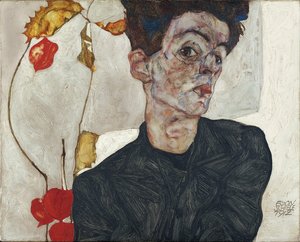
Egon Schiele's "Untitled (2996)," a haunting depiction of a woman seated on the ground, is more than just a portrait; it’s a raw and intensely personal exploration of vulnerability, anxiety, and the precariousness of existence. Painted in 1918, tragically near the end of his life, this work embodies the core tenets of Schiele's Expressionist style – a deliberate distortion of form, an emphasis on emotional intensity, and a willingness to confront uncomfortable truths about the human condition. The painting’s power lies not in its precise representation but in its evocative atmosphere, a palpable sense of unease that draws the viewer into the woman’s internal world.

The subject, shrouded in a dark, enveloping garment, occupies the lower half of the canvas. Her posture – slumped and seemingly defeated – immediately conveys distress. Her face, though partially obscured, holds an expression of profound sorrow or perhaps even resignation. The background is deliberately blurred, populated by indistinct figures that serve to isolate the central figure and amplify her solitude. Schiele’s signature technique—bold, gestural lines—dominates the composition. He employs a thick impasto application of paint, creating a textured surface that adds to the painting's visceral impact. The lines themselves are not merely descriptive; they actively communicate emotion, conveying the woman’s inner turmoil with an almost violent energy.
To understand “Untitled (2996),” it’s crucial to consider Schiele's deeply troubled life. Born in 1890 into a family marked by illness and loss, he experienced the early deaths of his father (from syphilis) and sister, events that profoundly shaped his artistic vision. His father’s descent into madness and subsequent death cast a long shadow over Schiele’s psyche, fueling an obsession with mortality and the fragility of human existence – themes repeatedly explored in his work. The painting can be interpreted as a direct reflection of this personal trauma, a visual manifestation of grief, isolation, and the struggle to find meaning in the face of overwhelming loss.
Furthermore, Schiele’s artistic development was heavily influenced by Gustav Klimt, a prominent figure in the Viennese Secession movement. However, while Klimt often depicted idealized beauty, Schiele relentlessly pursued an unflinching portrayal of human vulnerability and psychological distress. His work stands as a stark contrast to Klimt's polished surfaces, prioritizing emotional honesty over aesthetic perfection.
The woman’s dark clothing can be seen as symbolic of concealment, perhaps representing a hidden pain or a desire for anonymity. The ground she sits upon—a simple, unadorned surface—suggests a lack of support or stability. However, it's the expressive lines that truly carry the weight of meaning in this painting. Schiele’s use of jagged, broken lines creates a sense of unease and instability, mirroring the woman’s emotional state. The lines aren’t simply outlining forms; they are actively shaping the viewer’s perception, drawing attention to the subject's vulnerability and projecting her inner turmoil outward.
"Untitled (2996)" is a profoundly moving work that offers a rare glimpse into the tormented soul of Egon Schiele. It’s a testament to his courage in confronting difficult emotions and his willingness to expose the darker aspects of human experience. Reproductions of this painting, available through Most-Famous-Paintings.com, allow viewers to connect with this powerful artwork on a deeper level, appreciating its raw emotional intensity and enduring relevance. Consider commissioning a hand-painted reproduction to bring this evocative image into your home or office – a tangible reminder of the complexities of human emotion and the beauty found within vulnerability.

1890 - 1918 , Croatie


Restez informé(e) des dernières actualités artistiques, des offres exclusives et des idées de décoration.
Parlez-nous de votre projet et nos experts en art vous proposeront 3 suggestions d'œuvres personnalisées.
Laissez-nous sélectionner 3 œuvres rien que pour vous – Gratuit !


 Aperçu en situation
 Envoyer
 Partager
 Détails de l'œuvre

 Télécharger
 Articles similaires
 Radiographie
 Diaporama
 Lire la suite


