


x


 Preview
 Commander la reproduction Acheter l'image haute résolution
 Partager
 Détails de l'œuvre
 Ajouter aux favoris
 Télécharger
 Articles similaires
 Radiographie
 Diaporama
Impression giclée ou sur toile de qualité musée, avec une production rapide et des finitions au choix.





























Choisissez parmi nos formats prédéfinis qui respectent les proportions originales de l’œuvre.

Vous pouvez saisir vos propres dimensions pour vous adapter à un cadre ou à un espace spécifique. Si la taille sélectionnée ne correspond pas aux proportions de l'image originale, nous recadrerons l'œuvre ou étendrons l'image avec une bordure en miroir ou une couleur unie. Une maquette numérique vous sera envoyée pour approbation avant le début de la production.
Veuillez noter que l'aperçu à l'écran ne reflète pas le recadrage ou l'extension réelle. Seule la maquette montrera avec précision la composition finale.
Bien que des tailles personnalisées soient disponibles, nous vous recommandons de choisir une dimension dans la liste prédéfinie afin de préserver les proportions originales.
Livraison dans le monde entier () en 2 semaines au lieu des 4/5 semaines habituelles. (24 juillet)


Green Tree
Format de reproduction
Fernand Léger’s “Green Tree,” painted in 1944, is more than just a depiction of a tree; it's a potent visual distillation of the anxieties and fascinations that defined the early 20th century. This seemingly simple image – a vibrant green tree with a deliberately anthropomorphic face, bathed in the glow of a yellow sun – unfolds as a complex meditation on modernity’s impact on humanity and the natural world. Léger, a key figure in the Cubist movement, was deeply concerned with representing the burgeoning industrial landscape, and “Green Tree” embodies this preoccupation with striking clarity.
Created during a period of immense social and technological upheaval, “Green Tree” is firmly rooted in Léger's artistic philosophy. He rejected purely abstract art, believing it detached from reality. Instead, he sought to capture the essence of modern life – the dynamism of machines, the angularity of urban landscapes, and the impact on human form – through a style he termed "Tubism," later evolving into “Concrete Art.” This approach involved breaking down objects into their fundamental geometric shapes, reassembling them in new configurations, and emphasizing the mechanical aspects of the world. Léger was profoundly influenced by the rise of industrialization and its effect on the human psyche, reflecting this concern through his art.
"Green Tree" is not a comfortable image; it’s deliberately provocative and emotionally charged. Léger wasn’t interested in creating pretty pictures; he wanted to confront viewers with the realities of modern life, prompting reflection on humanity's relationship with technology and nature. The painting’s enduring appeal lies in its ability to tap into universal anxieties about change, displacement, and the loss of innocence. Léger’s influence extends far beyond Cubism, shaping the course of 20th-century art and inspiring generations of artists to explore the possibilities of abstraction while remaining connected to the observable world.
Artist: Fernand Léger Date: 1944 Movement: Cubism, Concrete Art

1881 - 1955 , France

Plongez dans le monde fascinant des 10 plus célèbres peintures dominées par le vert olive sombre. Découvrez Monet, Van Gogh et Cézanne… Retrouvez l'histoire de ces chefs-d'œuvre et trouvez votre reproduction d'art idéale sur !
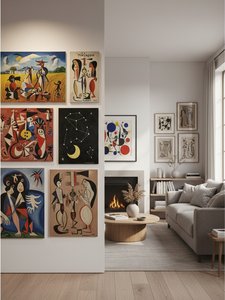
Plongez dans l'univers vibrant de Joan Miró ! Découvrez les 25 œuvres majeures du maître catalan, explorant le surréalisme et ses formes abstraites. Reproductions de qualité muséale & inspiration déco sur Most-Famous-Paintings.com.
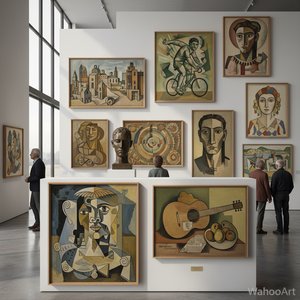
Plongez au cœur du cubisme avec ! Découvrez les 10 chefs-d'œuvre de Picasso, Braque et autres artistes révolutionnaires. Reproductions d'art haute qualité pour une décoration intérieure unique. Explorez la collection sur

Plongez au cœur du cubisme avec Most-Famous-Paintings ! Découvrez 10 chefs-d'œuvre révolutionnaires de Picasso, Braque et autres artistes majeurs. Explorez l'histoire, les techniques et les couleurs vibrantes de ce mouvement artistique unique. Retrouvez ces œuvres en reproduction sur Most-Famous-Paintings.com.

Plongez au cœur du cubisme avec les 10 portraits emblématiques de Picasso, Braque et Gris. Découvrez l'histoire, la technique & l'impact de ces chefs-d'œuvre. Reproductions d'art de qualité musée sur Most-Famous-Paintings.com !


Restez informé(e) des dernières actualités artistiques, des offres exclusives et des idées de décoration.
Parlez-nous de votre projet et nos experts en art vous proposeront 3 suggestions d'œuvres personnalisées.
Laissez-nous sélectionner 3 œuvres rien que pour vous – Gratuit !


 Partager


 Afficher la suite







 L'option verre n'est disponible que pour les dimensions inférieures à 110 cm.


