


x

Impressions giclées ou sur toile de qualité musée, avec une production rapide et des finitions au choix. ( Commander la reproduction peinte à la main Télécharger l'image haute résolution)





























Choisissez parmi nos formats prédéfinis qui respectent les proportions originales de l’œuvre.

Vous pouvez saisir vos propres dimensions pour vous adapter à un cadre ou à un espace spécifique. Si la taille sélectionnée ne correspond pas aux proportions de l'image originale, nous recadrerons l'œuvre ou étendrons l'image avec une bordure en miroir ou une couleur unie. Une maquette numérique vous sera envoyée pour approbation avant le début de la production.
Veuillez noter que l'aperçu à l'écran ne reflète pas le recadrage ou l'extension réelle. Seule la maquette montrera avec précision la composition finale.
Bien que des tailles personnalisées soient disponibles, nous vous recommandons de choisir une dimension dans la liste prédéfinie afin de préserver les proportions originales.
Livraison dans le monde entier () en 2 semaines au lieu des 4/5 semaines habituelles. (18 août)


Three figures and three portraits Study
Format de la reproduction
Fernand Léger’s “Three Figures and Three Portraits Study” isn't merely a painting; it’s a manifesto of artistic engagement with the burgeoning industrial landscape of the early 20th century. Born Joseph Fernand Henri Léger in Argentan, Normandy, in 1881, Léger possessed an innate fascination for form—a preoccupation that would define his entire oeuvre and propel him to become one of the most influential artists of his generation.
Unlike many artists who sought refuge from realism within pure abstraction, Léger championed a method he termed “constructive painting.” He believed in retaining visual references to the tangible world while simultaneously stripping away superfluous detail. This approach is brilliantly exemplified in "Three Figures and Three Portraits Study," where six individuals are depicted amidst scattered bottles and bowls—objects that serve as both compositional anchors and symbolic representations of everyday life.
Léger’s distinctive style is characterized by bold geometric shapes – cubes, cylinders, spheres – arranged with meticulous precision. However, these forms aren't presented in a sterile manner; they are overlaid with textured surfaces achieved through a technique known as “impasto.” Thick layers of paint create palpable physicality, conveying the energy and dynamism of industrial processes while simultaneously hinting at underlying organic rhythms.
"Three Figures and Three Portraits Study" emerged during a period of profound societal transformation—the dawn of the machine age. Léger witnessed firsthand the rapid urbanization and mechanization sweeping across Europe, fueled by advancements in engineering and manufacturing. His artwork reflects this zeitgeist, capturing not only the visual aesthetic but also the psychological impact of confronting the relentless march of progress.
The bottles scattered throughout the composition aren’t simply decorative elements; they symbolize containment—the bottled-up anxieties and aspirations of humanity amidst an increasingly complex world. Similarly, the figures themselves embody a tension between human presence and mechanical influence. Léger deliberately disrupts traditional notions of portraiture, presenting faces as fragmented geometric shapes, suggesting that identity itself is subject to constant reconfiguration.
Despite its abstract style, “Three Figures and Three Portraits Study” possesses a remarkable emotional resonance. The painting exudes a subtle vibrancy—a quiet assertion of vitality—that speaks to Léger’s belief in the transformative power of art. It invites viewers to contemplate not only the visual spectacle but also the deeper questions about human experience within the context of an evolving world.

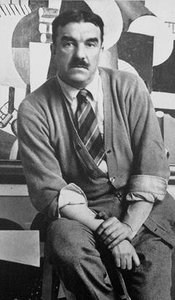
1881 - 1955 , France

Explore the profound impact of Minimalism and Geometric Abstraction. From Mondrian to Malevich, discover how stripping art to its essential forms revolutionized modern aesthetics through our expert-led historical guide.

Master the complexities of Geometric Abstraction. Our expert guide explores the evolution from Cubist deconstruction to Bauhaus precision, decoding the power of shape and form. Perfect for art students seeking deep historical context and academic insight into modern masterpieces.


Restez informé(e) des dernières actualités artistiques, des offres exclusives et des idées de décoration.
Parlez-nous de votre projet et nos experts en art vous proposeront 3 suggestions d'œuvres personnalisées.
Laissez-nous sélectionner 3 œuvres rien que pour vous – Gratuit !


 Aperçu en situation
 Envoyer
 Partager
 Détails de l'œuvre

 Télécharger
 Articles similaires
 Radiographie
 Diaporama

 Lire la suite







 L'option verre n'est disponible que pour les dimensions inférieures à 110 cm.


