Sell Your Art
Liste de souhaits Mon panier Cart
PreviewPreview AR previewAR preview Switch to hand made Painting Switch to hand made PaintingSwitch to Image Switch to Image PartagerPartager
Détails de l'œuvreDétails de l'œuvre Ajouter aux favoris Ajouter aux favoris TéléchargerTélécharger Articles similairesArticles similaires RadiographieRadiographie DiaporamaDiaporama

untitled (1612)

Fernand Léger (1881-1955) was a French painter and sculptor who pioneered "tubism," a form of cubism emphasizing cylindrical shapes, reflecting the influence of industrial machinery on his artistic vision.

Explorez l'art de Fernand Léger (1881-1955), un pionnier du Cubisme et du 'Tubisme'. Découvrez ses peintures audacieuses et figuratives célébrant la vie moderne, les machines et la forme humaine. Un précurseur du Pop Art !

Giclée / Impression d'art

Impression giclée ou sur toile de qualité musée, avec une production rapide et des finitions au choix. (Switch to hand made Painting Switch to hand made PaintingSwitch to Image Switch to Image)

P118B $10
P118H $10
P118W $10
P438Z $10
P508JH $12
P508YH $12
P805H $10
P805Z $10
P919BZ $10
P919G $10
P919XJ $10
P959ZH $10
P968JZ $12
W106C $8
W218G $10
W218JH $8
W218Y $10
W307PJ $10
W316G $10
W316PJ $8
W316Y $10
W398PJ $8
W4111J $10
W500HY $15
W500JH $15
W692G $12
W849H $8
W940BG $15
W953PJ $8

Standard
custom
CM
INCH

Choisissez parmi nos formats prédéfinis qui respectent les proportions originales de l’œuvre.

largeur
hauteur

Vous pouvez saisir vos propres dimensions pour vous adapter à un cadre ou à un espace spécifique. Si la taille sélectionnée ne correspond pas aux proportions de l'image originale, nous recadrerons l'œuvre ou étendrons l'image avec une bordure en miroir ou une couleur unie. Une maquette numérique vous sera envoyée pour approbation avant le début de la production.
Veuillez noter que l'aperçu à l'écran ne reflète pas le recadrage ou l'extension réelle. Seule la maquette montrera avec précision la composition finale.
Bien que des tailles personnalisées soient disponibles, nous vous recommandons de choisir une dimension dans la liste prédéfinie afin de préserver les proportions originales.

Livraison dans le monde entier () en 2 semaines au lieu des 4/5 semaines habituelles. (30 juillet)

why_choose_icon
Livraison express gratuite dans le monde entier
why_choose_icon
Toile de lin de haute qualité
why_choose_icon
Assurance transport complète
why_choose_icon
Garantie de remboursement des frais de douane
why_choose_icon
Garantie de fidélité des couleurs
why_choose_icon
Politique de retour de 60 jours (uniquement en cas de défaut)
why_choose_icon
Garantie de remboursement à 100%
why_choose_icon
Réduction sur les achats groupés

Prix total

$ 68

reproduction

untitled (1612)

Giclée / Impression d'art

Format de reproduction

-

Prix total final

$ 68

En bref

  • Medium: Painting
  • Artist: Fernand Léger
  • Artistic style: Abstract Expressionism
  • Notable elements or techniques: Tubism, Simplified forms
  • Year: 1881
  • Title: The image is a painting of a group of people in various positions...
  • Location: Private Collection

Quiz d'art

Chaque question ne comporte qu'une seule bonne réponse.

Question 1:
What artistic movement is Fernand Léger primarily associated with?
Question 2:
Fernand Léger’s style is characterized by:
Question 3:
The image depicts a scene featuring numerous figures engaged in what activity?
Question 4:
What technique did Léger employ to simplify the depiction of modern subjects?
Question 5:
Fernand Léger is considered a precursor to which artistic genre?

Description de l'œuvre

A Life Forged in Form: The World of Fernand Léger

Fernand Léger’s “untitled (1612)” isn't merely a painting; it’s a crystallized snapshot of the anxieties and aspirations simmering beneath the surface of early 20th-century Europe. Born Joseph Fernand Henri Léger in Argentan, Normandy, in 1881—a region defined by its agricultural traditions—Léger possessed an inherent understanding of physicality that would profoundly influence his artistic trajectory. Initially drawn to architecture, he swiftly abandoned it for painting after relocating to Paris around 1900, establishing himself as a vital participant in the burgeoning Parisian avant-garde movement. Unlike many artists of his era who sought refuge in pure abstraction, Léger championed an approach that actively wrestled with modernity—its relentless pace, its geometric precision, and its pervasive presence within daily life—transforming these elements into a uniquely expressive visual language.
  • Tubism: Léger’s breakthrough came with “Tubism,” a radical cubist style characterized by simplified tubular forms that echoed the architecture of industrial cities. This technique deliberately rejected illusionistic representation, prioritizing instead the conveyance of structural information and conveying a sense of movement through repetitive geometric shapes.
  • Early Influences: Léger’s artistic sensibilities were shaped by influences ranging from Cézanne's exploration of volume to Picasso’s pioneering cubist experiments. However, he swiftly moved beyond these precedents, forging his own distinctive path toward stylistic innovation.
The painting itself depicts a group of figures—approximately twelve individuals—engaged in seemingly disparate activities. They sprawl across the canvas, some reclining horizontally, others standing upright, creating a dynamic composition that defies conventional spatial conventions. Léger’s masterful use of color—bold reds and yellows dominate the palette—amplifies the emotional impact of the scene, conveying both energy and unease. The figures are rendered in a simplified, stylized manner, emphasizing geometric forms rather than anatomical detail. This stylistic choice wasn't simply aesthetic; it served as a deliberate commentary on the dehumanizing effects of industrialization, presenting humanity as fragmented yet interconnected within a larger mechanical framework. Symbolism and Context: Léger’s “untitled (1612)” speaks to the broader cultural anxieties surrounding the transition from rural tradition to urban modernity. The tubular forms symbolize the dominance of machinery and the erosion of organic shapes, reflecting concerns about societal transformation and the loss of human connection. Simultaneously, the painting embodies a defiant optimism—a belief in the transformative potential of art to grapple with complex issues and inspire viewers to embrace the challenges of an evolving world. Technique: Léger’s technique involved layering paint onto canvas in multiple thin coats, achieving remarkable textural depth despite his simplified forms. He meticulously crafted each tubular element, ensuring its precise geometric accuracy while simultaneously conveying a palpable sense of movement and vibration. This painstaking attention to detail underscores Léger's commitment to capturing the essence of modern experience—a feat accomplished with breathtaking stylistic brilliance.
  • Legacy: Léger’s influence extends far beyond his own lifetime, foreshadowing developments in Pop Art decades later. His willingness to engage directly with contemporary concerns and his embrace of abstraction as a tool for social commentary cemented his position as one of the most important artists of the modernist era.
Ultimately, “untitled (1612)” transcends mere visual representation; it’s an invitation to contemplate the relationship between humanity and technology—a dialogue that continues to resonate powerfully with audiences today. It stands as a testament to Léger's unwavering conviction that art could illuminate the complexities of the modern condition while simultaneously fostering a spirit of innovation and embracing the transformative power of form itself.

Biographie de l'artiste

jeune vie et formation

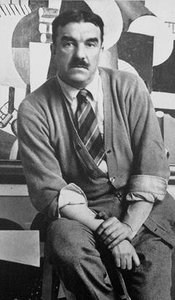
fernand léger, peintre, sculpteur et cinéaste français, est né le 4 février 1881 à Argentan, Orne, en Normandie inférieure. Son père élevait du bétail, et léger a initialement été formé à l'architecture de 1897 à 1899. Il s’est ensuite installé à Paris en 1900, se débrouillant comme dessinateur architectural.

développement artistique

Le travail précoce de léger a été influencé par l'impressionnisme, comme le montrent le jardin de ma mère (mon jardin) (1905). Après avoir fréquenté l'école des beaux-arts et l’académie Julian, il a commencé à travailler sérieusement comme peintre à 25 ans. Son style s'est développé en une forme personnelle de cubisme, que les critiques ont qualifié de "tubisme" pour son accent sur les formes cylindriques.

cubisme et le groupe des Puteaux

En 1910, léger a exposé au Salon d’automne aux côtés de jean metzinger et henri le fauconnier. Il a rejoint le groupe des Puteaux, également connu sous le nom de section d’or (la section dorée), avec d'autres artistes tels que francis picabia et marcel duchamp.

guerre et son influence sur le travail de léger

Les expériences de léger à la Première Guerre mondiale ont eu un impact significatif sur son œuvre. Pendant son séjour au front, il a produit des croquis d'artillerie, d'avions et de soldats. Sa peinture soldier avec un tuyau (1916) reflète cette période.

œuvre ultérieure et héritage

L'œuvre post-guerre de léger, caractérisée par des formes machine-like élégantes, le lia à la tradition de la peinture figurative française. Ses paysages animés de 1921 ont présenté des figures et des animaux dans des formes harmonieuses et rationalisées. œuvres clés: musées présentant l'œuvre de léger:
Fernand Léger

Fernand Léger

1881 - 1955 , France

En bref

  • Artistes Influents:
    • Cézanne
    • Impressionnisme
  • Date De Décès: 1955
  • Date De Naissance: 4 février 1881
  • Influences Artistiques: ['Pop Art']
  • Lieu De Naissance: Argentan, France
  • Mouvement Artistique: Cubisme, Tubisme
  • Nationalité: Française
  • Nom Complet: Fernand Léger
  • Oeuvres Notables:
    • La Grande Parade
    • Machine Élément
    • Femme assise
    • Paysages animés
Explorez des œuvres d'art classées par thèmes, styles et caractéristiques.