x

Impressions giclées ou sur toile de qualité musée, avec une production rapide et des finitions au choix. ( Commander la reproduction peinte à la main Télécharger l'image haute résolution)





























Choisissez parmi nos formats prédéfinis qui respectent les proportions originales de l’œuvre.

Vous pouvez saisir vos propres dimensions pour vous adapter à un cadre ou à un espace spécifique. Si la taille sélectionnée ne correspond pas aux proportions de l'image originale, nous recadrerons l'œuvre ou étendrons l'image avec une bordure en miroir ou une couleur unie. Une maquette numérique vous sera envoyée pour approbation avant le début de la production.
Veuillez noter que l'aperçu à l'écran ne reflète pas le recadrage ou l'extension réelle. Seule la maquette montrera avec précision la composition finale.
Bien que des tailles personnalisées soient disponibles, nous vous recommandons de choisir une dimension dans la liste prédéfinie afin de préserver les proportions originales.
Livraison dans le monde entier () en 2 semaines au lieu des 4/5 semaines habituelles. (13 août)


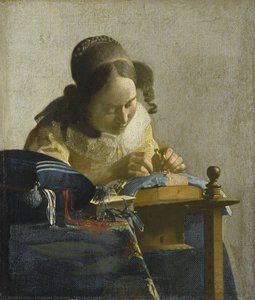
The Lacemaker
Format de la reproduction
Johannes Vermeer’s “The Lacemaker,” completed around 1669–1670, stands as one of the most iconic images of Delft during the Dutch Golden Age—a testament to meticulous observation and a profound understanding of human emotion. Held in the Louvre Museum, Paris, this diminutive painting (approximately 24.5 cm × 21 cm) transcends its modest dimensions to deliver an experience of serene beauty that continues to captivate audiences centuries later.
A Window into Delft Society
Delft, Vermeer’s hometown, was a thriving center for textile production and skilled craftsmanship. “The Lacemaker” captures this atmosphere perfectly, portraying a young woman diligently engaged in the painstaking art of bobbin lace making—a craft considered both respectable and intellectually stimulating for women during the period. The scene unfolds within a modestly furnished room dominated by a table draped with a richly patterned cloth – crimson and black – providing a vibrant counterpoint to the pale hues of the woman’s attire.
Technical Brilliance: Vermeer's Signature Style
Vermeer’s mastery lies in his masterful use of light—a technique he termed “luminosity.” The soft, diffused illumination emanating from a window on the right casts gentle shadows across the table and illuminates the woman’s face with an ethereal glow. This subtle manipulation of light is characteristic of Vermeer's distinctive style, which prioritizes realism achieved through careful attention to detail and atmospheric perspective. He employed glazing—thin layers of translucent paint—to create depth and luminosity, capturing the textures of fabric and porcelain with remarkable accuracy.
Symbolism and Emotion: Beyond Mere Representation
More than just a depiction of domestic activity, “The Lacemaker” speaks to themes of quiet contemplation and feminine virtue. The woman’s posture exudes composure and grace as she focuses intently on her task—a gesture that symbolizes diligence and perseverance. The inclusion of a mirror reflects her image back at the viewer, fostering a sense of intimacy and inviting us into this private moment. Vermeer skillfully conveys emotion through subtle expressions and gestures, elevating the painting beyond mere visual representation.
A Legacy of Artistic Perfection
"The Lacemaker" exemplifies the pinnacle of Dutch Baroque art—a genre that sought to portray human experience with psychological depth and artistic finesse. Its enduring appeal stems from its ability to evoke feelings of tranquility, beauty, and understated elegance. It remains a celebrated masterpiece, admired by artists and connoisseurs alike for its technical brilliance and profound emotional resonance.

Frans van Mieris l'Ancien était un peintre d’allégories et de scènes de genre néerlandais du Siècle d’or, connu pour ses détails méticuleux et son style raffiné. Né à Leyde au sein de la famille Van Mieris, il a rapidement démontré une aptitude pour le dessin plutôt que de suivre les traces de son père, orfèvre. Une formation précoce auprès d'Abraham Toorenvliet, suivie d’un enseignement par Gerrit Dou, a façonné ses fondations artistiques.

1635 - 1681 , Pays-Bas

Plongez au cœur de l'Âge d'Or néerlandais ! Découvrez 10 chefs-d'œuvre intemporels de Rembrandt, Vermeer et autres maîtres hollandais. Explorez leur histoire, technique & trouvez l'inspiration déco sur
Explorez l'Âge d'Or néerlandais : découvrez les maîtres baroques (Rembrandt, Fabritius) et leur révolution artistique. Analyse approfondie, contexte historique et héritage durable. Un voyage au cœur de la peinture du XVIIe siècle.

Plongez dans l'univers fascinant des 10 plus beaux tableaux noirs de l'histoire de l'art. Découvrez les artistes célèbres, leurs techniques et le symbolisme puissant de ces chefs-d'œuvre intemporels. Inspirez votre décoration intérieure avec !

Plongez dans l'univers fascinant des 10 plus beaux tableaux noirs de l'histoire de l'art. Découvrez les secrets de Goya, Manet, Rothko et autres maîtres. Inspirez votre décoration intérieure avec !
Plongez dans l'univers fascinant des 10 plus beaux tableaux dominés par le noir. Découvrez les histoires, techniques et symbolisme de chefs-d'œuvre intemporels. Reproductions d'art de qualité musée sur !


Restez informé(e) des dernières actualités artistiques, des offres exclusives et des idées de décoration.
Parlez-nous de votre projet et nos experts en art vous proposeront 3 suggestions d'œuvres personnalisées.
Laissez-nous sélectionner 3 œuvres rien que pour vous – Gratuit !


 Aperçu en situation
 Envoyer
 Partager
 Détails de l'œuvre

 Télécharger
 Articles similaires
 Radiographie
 Diaporama


 Lire la suite







 L'option verre n'est disponible que pour les dimensions inférieures à 110 cm.