x


 Commander l'impression Acheter l'image haute résolution
 Partager
 Détails de l'œuvre
 Ajouter aux favoris
 Télécharger
 Articles similaires
 Radiographie
 Diaporama
 Acrylique sur toileDécoration muraleNeoclassical Portraiture
 1782
1782 75.0 x 62.0 cm
 La Frick Collection
Huile sur toile peinte à la main, avec cadre et dimensions personnalisés, réalisée sur commande par nos artistes.





























Choisissez parmi nos formats prédéfinis qui respectent les proportions originales de l’œuvre.

Vous pouvez saisir vos propres dimensions pour l'adapter à un cadre ou à un espace spécifique. Si la taille sélectionnée ne correspond pas aux proportions de l'image d'origine, nous recadrerons l'œuvre ou prolongerons la peinture avec des éléments peints à la main supplémentaires. Une maquette numérique vous sera envoyée pour approbation avant le début de la production.
Veuillez noter que l'aperçu à l'écran ne reflète pas le recadrage ou l'extension réels. Seule la maquette montrera fidèlement la composition finale.
Bien que des tailles personnalisées soient disponibles, nous vous recommandons de sélectionner une dimension dans la liste prédéfinie afin de préserver les proportions d'origine.
Livraison dans le monde entier () en 3 à 4 semaines au lieu des 5 semaines habituelles. (18 juillet). Aucune concession sur la qualité.


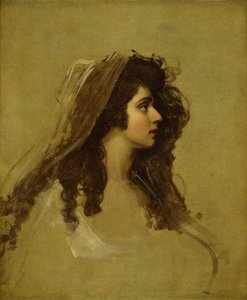
Lady Hamilton as
Format de reproduction
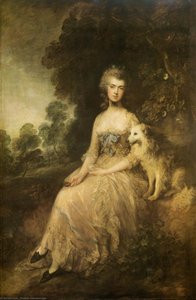
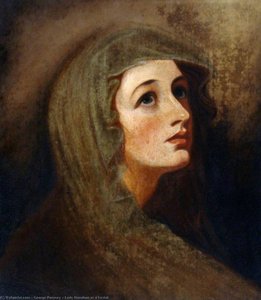
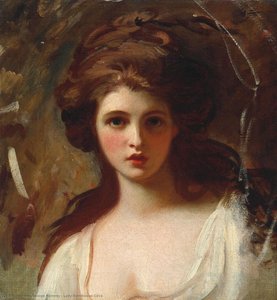
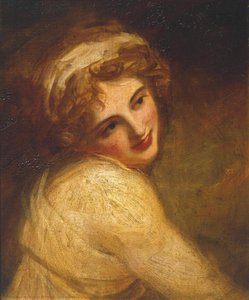
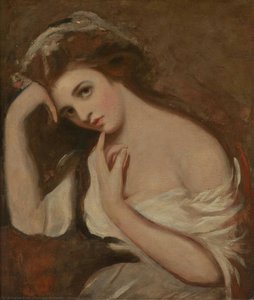
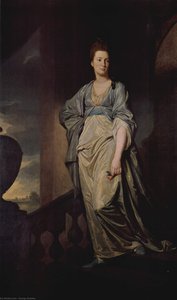
George Romney’s “Lady Hamilton as Circe,” painted in 1792, is more than just a portrait; it's an exquisitely crafted tableau vivant—a frozen moment brimming with narrative and psychological depth. This captivating work, now housed within the collections of the Frick Collection, offers a glimpse into the life of Emma Hart, later Lady Hamilton, a woman whose beauty, ambition, and scandalous affair with Lord Nelson captivated Regency England. Romney’s masterful handling of light, texture, and gesture transforms a simple sitting arrangement into a richly layered scene, inviting viewers to contemplate the complexities of her character.
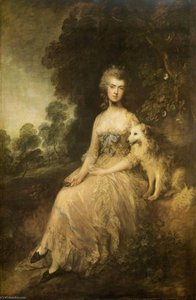
The painting depicts Emma seated in an opulent chaise lounge, a small dog nestled at her feet—a deliberate reference to Homer's *Odyssey*, where Circe, the sorceress queen of the island of Aeaea, is often accompanied by her faithful hound. Romney’s choice of subject matter immediately establishes this allegorical framework, suggesting that Emma, like the mythical Circe, possesses a potent and alluring power. Her pose—relaxed yet alert, hand gently resting on the dog's head—conveys an air of quiet confidence and subtle command. The rich crimson velvet of her dress, contrasted against the muted tones of the background, draws immediate attention to her figure, emphasizing her beauty and drawing the eye into her gaze.
Romney’s technique is characterized by its remarkable realism and sensitivity. He eschewed the overly polished surfaces favored by some of his contemporaries, opting instead for a looser, more expressive brushstroke that captures the nuances of Emma's features—the delicate curve of her lips, the subtle play of light on her skin, the intelligent sparkle in her eyes. Note particularly how Romney renders the texture of the velvet fabric and the fur of the dog, demonstrating his meticulous attention to detail. The use of sfumato, a technique borrowed from Leonardo da Vinci, creates an atmospheric haze around Emma’s figure, softening the edges and lending the scene a dreamlike quality.
The background is deliberately ambiguous, suggesting a lavish interior—likely a room within Sir William Hamilton's residence in Naples. The presence of a partially visible clock and a glimpse of a tree hint at the passage of time and the exotic setting of Emma’s life. However, Romney skillfully avoids providing any specific details, allowing the viewer to project their own interpretations onto the scene. This deliberate vagueness contributes to the painting's enduring mystique, prompting us to consider not just what we see but also what lies beneath the surface.
Beyond its aesthetic qualities, “Lady Hamilton as Circe” is laden with symbolic meaning. The reference to Circe—a sorceress known for her ability to transform men into animals—underscores Emma’s own transformative power and her capacity to exert influence over those around her. Her affair with Lord Nelson was a closely guarded secret, fraught with social scandal and political intrigue. Romney's painting captures this duality—Emma as both a captivating beauty and a woman entangled in a dangerous game of desire and ambition.
The inclusion of the dog is particularly significant. In Greek mythology, dogs were often associated with loyalty, fidelity, and protection. Here, it serves as a visual reminder of Emma’s unwavering devotion to Sir William Hamilton, despite his infidelity. It also subtly hints at her own vulnerability—a loyal companion in a world of shifting alliances and treacherous relationships.
“Lady Hamilton as Circe” remains one of Romney's most celebrated works, admired for its exquisite beauty, psychological insight, and masterful technique. It offers a compelling portrait of a remarkable woman—a dancer, actress, mistress, and ultimately, a figure of enduring fascination. Reproductions of this painting continue to captivate art lovers and collectors alike, offering a window into the glamorous and scandalous world of Regency England. Its timeless appeal lies in its ability to evoke both admiration and intrigue, prompting us to contemplate the complexities of human desire, ambition, and the power of image.


1734 - 1802 , Royaume-Uni

Plongez dans l'univers de Georges Braque avec les 25 œuvres incontournables du cubisme. Découvrez l'histoire, les techniques et l'impact de ce maître de l'art moderne. Reproductions d'art exceptionnelles sur Most-Famous-Paintings.com.
Plongez dans l'univers lumineux de Georges Seurat ! Découvrez les 25 œuvres majeures du pointillisme, de 'Un dimanche après-midi à l'Île de la Grande Jatte' aux 'Poseuses'. Reproductions d'art exceptionnelles et inspiration déco sur Most-Famous-Paintings.com.

Plongez au cœur du Metropolitan Museum of Art avec notre sélection des 25 œuvres les plus emblématiques. Découvrez l'histoire de Van Gogh, Monet et d'autres maîtres, et trouvez l'inspiration pour une décoration intérieure raffinée. Reproductions de qualité muséale sur Most-Famous-Paintings.com.

Découvrez les 10 portraits les plus emblématiques de l'histoire de l'art : Mona Lisa, Van Gogh, Rembrandt… Explorez leur histoire, techniques et émotions. Reproductions de tableaux haute qualité sur Most-Famous-Paintings.com.

Plongez au cœur du DIA Detroit ! Découvrez les 25 chefs-d'œuvre de Van Gogh, Monet et Rembrandt. Explorez l'histoire fascinante de ces tableaux célèbres et trouvez l'inspiration déco sur Most-Famous-Paintings.com.


Restez informé(e) des dernières actualités artistiques, des offres exclusives et des idées de décoration.
Parlez-nous de votre projet et nos experts en art vous proposeront 3 suggestions d'œuvres personnalisées.
Laissez-nous sélectionner 3 œuvres rien que pour vous – Gratuit !


 Partager

 Afficher la suite







 L'option verre n'est disponible que pour les dimensions inférieures à 110 cm.