x

Impressions giclées ou sur toile de qualité musée, avec une production rapide et des finitions au choix. ( Commander la reproduction peinte à la main Télécharger l'image haute résolution)





























Choisissez parmi nos formats prédéfinis qui respectent les proportions originales de l’œuvre.

Vous pouvez saisir vos propres dimensions pour vous adapter à un cadre ou à un espace spécifique. Si la taille sélectionnée ne correspond pas aux proportions de l'image originale, nous recadrerons l'œuvre ou étendrons l'image avec une bordure en miroir ou une couleur unie. Une maquette numérique vous sera envoyée pour approbation avant le début de la production.
Veuillez noter que l'aperçu à l'écran ne reflète pas le recadrage ou l'extension réelle. Seule la maquette montrera avec précision la composition finale.
Bien que des tailles personnalisées soient disponibles, nous vous recommandons de choisir une dimension dans la liste prédéfinie afin de préserver les proportions originales.
Livraison dans le monde entier () en 2 semaines au lieu des 4/5 semaines habituelles. (17 août)


Ebauche
Format de la reproduction
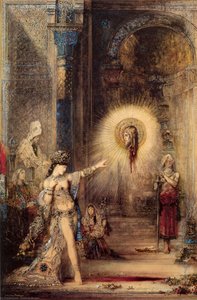
Gustave Moreau's Ebauche (Sketch) offers a captivating entry point into the intensely personal and symbolic world of one of Symbolism’s most significant figures. Painted during a pivotal period in his career, this black-and-white cityscape transcends mere representation; it becomes a carefully constructed evocation of mood, memory, and perhaps even a fragment of the subconscious. The artwork immediately arrests the viewer with its dramatic contrast – the stark monochrome punctuated by an arresting orange sky that seems to bleed into the scene, creating a palpable sense of unease and mystery. Moreau’s skill lies not in depicting reality as it appears, but in conjuring a world born from his own rich imagination.
Born in Paris in 1826, Gustave Moreau was a product of the intellectual ferment that characterized mid-19th century France. While trained in the traditional academic style at the École des Beaux-Arts – a path followed by many aspiring artists of his time – Moreau swiftly rejected the prevailing Realist and Impressionist movements. He sought instead to align himself with the burgeoning Symbolist aesthetic, a movement driven by a desire to explore subjective experience, mythology, religion, and the darker recesses of the human psyche. Moreau’s work is characterized by its meticulous detail, often incorporating elements drawn from Byzantine mosaics, Renaissance art, and Orientalist imagery – a deliberate strategy to create a layered, dreamlike effect. The painting's composition, with its prominent buildings and solitary boat, suggests themes of isolation, contemplation, and perhaps even the struggle between order and chaos.
The monochromatic palette of Ebauche is crucial to its impact. Moreau’s masterful control over black and white allows him to manipulate tone and texture with remarkable precision, creating a sense of depth and atmosphere that would be impossible in a fully colored work. The orange sky isn't merely a decorative element; it acts as a focal point, intensifying the drama and contributing to the painting’s unsettling mood. The artist’s technique – likely utilizing charcoal and possibly incorporating subtle washes of pigment – reveals a painstaking attention to detail, evident in the meticulously rendered architectural forms and the delicate rendering of the boat's reflection. The surface texture itself contributes to the artwork’s overall effect, inviting close inspection and encouraging viewers to lose themselves in its intricate details.
Moreau frequently drew upon mythological and religious imagery in his work, often reinterpreting these narratives through a distinctly personal lens. While the precise symbolism of *Ebauche* remains open to interpretation, the presence of buildings – structures that can represent both civilization and confinement – alongside the solitary boat suggests themes of journey, transition, and perhaps even the search for meaning within a complex world. The orange sky itself could be interpreted as representing passion, danger, or the divine—a potent symbol frequently employed by Moreau to evoke emotional intensity. This artwork stands as a testament to Moreau’s ability to transform simple scenes into profound meditations on the human condition.

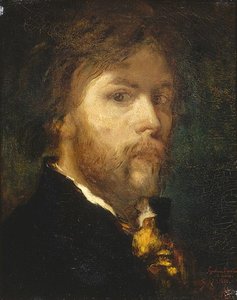
1826 - 1898 , France

Explore the evocative world of Symbolist painting. Discover how masters like Gustave Moreau rejected realism to capture dreams, myths, and the subconscious through fine art history and expert analysis.

Explore the profound artistry of black and white photography. From the chemistry of gelatin silver to the chiaroscuro of the Old Masters, discover how monochrome captures the eternal essence of light, form, and emotion for the discerning art collector.


Restez informé(e) des dernières actualités artistiques, des offres exclusives et des idées de décoration.
Parlez-nous de votre projet et nos experts en art vous proposeront 3 suggestions d'œuvres personnalisées.
Laissez-nous sélectionner 3 œuvres rien que pour vous – Gratuit !


 Aperçu en situation
 Envoyer
 Partager
 Détails de l'œuvre

 Télécharger
 Articles similaires
 Radiographie
 Diaporama

 Lire la suite







 L'option verre n'est disponible que pour les dimensions inférieures à 110 cm.