


x

Huile sur toile peinte à la main, avec cadre et dimensions personnalisés, réalisée sur commande par nos artistes. ( Commander l'impression Télécharger l'image haute résolution)





























Choisissez parmi nos formats prédéfinis qui respectent les proportions originales de l’œuvre.

Vous pouvez saisir vos propres dimensions pour l'adapter à un cadre ou à un espace spécifique. Si la taille sélectionnée ne correspond pas aux proportions de l'image d'origine, nous recadrerons l'œuvre ou prolongerons la peinture avec des éléments peints à la main supplémentaires. Une maquette numérique vous sera envoyée pour approbation avant le début de la production.
Veuillez noter que l'aperçu à l'écran ne reflète pas le recadrage ou l'extension réels. Seule la maquette montrera fidèlement la composition finale.
Bien que des tailles personnalisées soient disponibles, nous vous recommandons de sélectionner une dimension dans la liste prédéfinie afin de préserver les proportions d'origine.
Livraison dans le monde entier () en 3 à 4 semaines au lieu des 5 semaines habituelles. (14 août). Aucun compromis sur la qualité.


Roman Ruins
Format de la reproduction
Hubert Robert (1733 – 1808), a Parisian painter whose career spanned the turbulent decades preceding and during the French Revolution, stands as an emblem of Romanticism's fascination with ruins—not merely as physical remnants of grandeur past but as symbols of time’s relentless march and the sublime power of nature. His artwork transcends mere representation; it strives to evoke emotion and contemplation, capturing a fleeting moment of ethereal beauty amidst crumbling stone.
Robert's canvases frequently depict landscapes dominated by ruined villas and temples—sites once celebrated for their opulent splendor now overgrown with vegetation and imbued with an air of melancholy. These scenes aren’t haphazard assemblages of stones; they are carefully constructed compositions designed to convey a profound sense of atmosphere. Consider “Roman Ruins,” where a majestic archway frames a vista of crumbling walls, verdant foliage, and figures engaged in quiet contemplation. This juxtaposition—the monumental architecture against the tranquil wilderness—immediately establishes a dialogue between history and nature.
Robert’s artistic approach aligns perfectly with the Romantic capriccio style – a genre characterized by spontaneous landscapes infused with imaginative elements. Unlike Neoclassical paintings that prioritized rational order and idealized forms, Robert embraced irregularity and emotion. He skillfully blended observation with fantasy, creating scenes that felt both grounded in reality and transcendentally beautiful. The artist’s loose brushwork—visible paint strokes—contribute to the overall impression of dynamism and immediacy.
Robert employed oil paints on canvas as his medium, allowing him to achieve remarkable tonal range and textural depth. He meticulously rendered light and shadow, capturing the subtle nuances of sunlight filtering through foliage—a technique that exemplifies Romanticism’s preoccupation with sensory experience. The artist's attention to detail is evident in the depiction of crumbling stone surfaces, moss-covered walls, and individual leaves, creating a palpable sense of realism alongside an overarching feeling of grandeur.
"Roman Ruins" speaks volumes about Romantic ideals. The decaying edifice represents not just physical deterioration but also the inevitable passage of time—a reminder that even the most magnificent creations are ultimately vulnerable to oblivion. Yet, amidst this decay flourishes life—represented by abundant vegetation and human figures—suggesting themes of regeneration and resilience. Robert’s paintings tap into the sublime – a feeling of awe inspired by confronting overwhelming beauty or terror—provoking contemplation on humanity's place within the vastness of nature and history.
Ultimately, Hubert Robert’s “Roman Ruins” achieves its emotional resonance through a masterful blend of visual elements. The warm color palette – ochres, browns, golds – evokes antiquity and warmth, while the dramatic lighting illuminates the central archway and casts shadows within the ruins. The composition draws the viewer inward, fostering a sense of intimacy with the scene and encouraging reflection on its profound symbolism. It’s a painting that lingers in the memory long after viewing—a testament to Robert's ability to transform observation into evocative art.

Hubert Robert fut un peintre français célébré pour ses paysages évocateurs et ses peintures de *capriccio* – des représentations pittoresques semi-fictives de ruines en Italie et en France. Il est considéré comme une figure essentielle reliant les périodes rococo et néoclassique, anticipant des aspects du romantisme avec sa fascination pour la décomposition, l'histoire et les reconstructions imaginatives.
Nicolas Robert, le père de Hubert, était au service de François-Joseph de Choiseul, marquis de Stainville. Robert reçut une éducation jésuite au Collège de Navarre en 1751. Il étudia ensuite la sculpture avec Michel-Ange Slodtz, qui l'encouragea à se consacrer à la peinture. Cette formation précoce lui inculqua une solide base en dessin et en perspective, des éléments cruciaux qui définiraient plus tard son style artistique.
Son séjour à Rome façonna profondément sa vision artistique. La juxtaposition des ruines antiques romaines avec la vie contemporaine suscita son intérêt pour représenter la décomposition aux côtés de la vitalité, un thème récurrent tout au long de sa carrière.
Le succès parisien de Robert provenait de sa capacité à capturer à la fois la grandeur de l'Antiquité classique et la vitalité de la vie contemporaine. Ses œuvres résonnaient auprès d’un public fasciné par l’histoire, l’archéologie et le pittoresque.
L’héritage de Hubert Robert réside dans sa capacité unique à mélanger la rigueur historique avec une vision imaginative. Il a ouvert un genre de peinture qui célébrait à la fois la beauté de la décomposition et le pouvoir durable de la créativité humaine. Son œuvre continue d'inspirer les artistes et de captiver le public, consolidant ainsi sa place en tant que figure significative dans l’art du XVIIIe siècle.

1733 - 1808 , France

Explore the captivating world of Hubert Robert, master of Romantic landscape painting & 'capriccio' ruins. Discover his historical context, artistic innovations, and collecting insights with Most-Famous-Paintings.

Plongez dans l'émotion du Romantisme avec les 10 plus beaux paysages de Friedrich, Turner & Delacroix. Découvrez leur histoire et trouvez l'inspiration déco idéale sur Most-Famous-Paintings.com !

Explorez l'univers fascinant du sublime et du pittoresque dans la peinture romantique. Analyse approfondie de Friedrich, Kandinsky et des maîtres de ce mouvement artistique majeur. Découvrez l'émotion et la nature comme jamais auparavant.
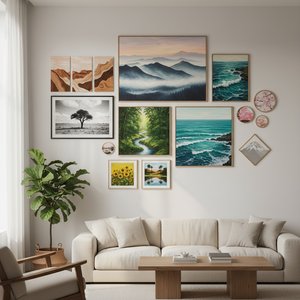
Découvrez les 10 plus beaux paysages de l'histoire de l'art : Monet, Van Gogh et bien d'autres. Explorez leur technique unique et trouvez l'inspiration pour votre décoration intérieure avec Most-Famous-Paintings.com. Œuvres exceptionnelles à découvrir !

Explore the emotional depth of Romantic landscape painting (18th-19th century). Discover key artists like Friedrich & Cole, and the concepts of the sublime. Expert insights for art lovers & collectors.


Restez informé(e) des dernières actualités artistiques, des offres exclusives et des idées de décoration.
Parlez-nous de votre projet et nos experts en art vous proposeront 3 suggestions d'œuvres personnalisées.
Laissez-nous sélectionner 3 œuvres rien que pour vous – Gratuit !


 Aperçu en situation
 Envoyer
 Partager
 Détails de l'œuvre

 Télécharger
 Articles similaires
 Radiographie
 Diaporama


 Lire la suite







 L'option verre n'est disponible que pour les dimensions inférieures à 110 cm.


