x

Huile sur toile peinte à la main, avec cadre et dimensions personnalisés, réalisée sur commande par nos artistes. ( Commander l'impression Télécharger l'image haute résolution)





























Choisissez parmi nos formats prédéfinis qui respectent les proportions originales de l’œuvre.

Vous pouvez saisir vos propres dimensions pour l'adapter à un cadre ou à un espace spécifique. Si la taille sélectionnée ne correspond pas aux proportions de l'image d'origine, nous recadrerons l'œuvre ou prolongerons la peinture avec des éléments peints à la main supplémentaires. Une maquette numérique vous sera envoyée pour approbation avant le début de la production.
Veuillez noter que l'aperçu à l'écran ne reflète pas le recadrage ou l'extension réels. Seule la maquette montrera fidèlement la composition finale.
Bien que des tailles personnalisées soient disponibles, nous vous recommandons de sélectionner une dimension dans la liste prédéfinie afin de préserver les proportions d'origine.
Livraison dans le monde entier () en 3 à 4 semaines au lieu des 5 semaines habituelles. (19 août). Aucun compromis sur la qualité.


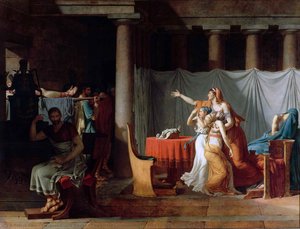
Napoleon in His Study
Format de la reproduction
Jacques Louis David’s “Napoleon in His Study,” completed in 1812, stands as a cornerstone of Neoclassicism—a movement that sought to recapture the grandeur and moral seriousness of ancient Greece and Rome. More than just an aesthetically pleasing depiction, this monumental canvas offers a profound glimpse into the mind of Napoleon Bonaparte himself, encapsulating his ambition, intellect, and the weighty responsibilities borne by the Emperor who reshaped Europe.
Artistic Context: The late 18th century witnessed a dramatic shift away from the opulent Baroque style towards Neoclassicism. Artists like David rejected Rococo’s frivolity, favoring instead clarity, restraint, and idealized forms rooted in classical ideals. David's meticulous draftsmanship—a hallmark of his oeuvre—was driven by an unwavering belief in portraying truth through beauty, mirroring the philosophical currents of Enlightenment thinkers who championed reason and virtue.
Symbolism: Beyond its formal elements, “Napoleon in His Study” is laden with symbolic significance. Napoleon's posture exudes confidence and authority, reflecting his unwavering conviction in his own destiny. The book he holds represents not merely erudition but also strategic thinking—a crucial component of his military prowess. Even the seemingly insignificant vase positioned centrally may symbolize the Emperor’s patronage of culture and art, underscoring his desire to elevate France to its former glory.
Technique: David's meticulous attention to detail is evident in every brushstroke—from the subtle folds of Napoleon’s uniform to the texture of the desk surface. He achieved this level of realism through painstaking preparatory sketches and a methodical layering process, ensuring that each element contributes to the overall impression of grandeur and solemn contemplation. The painting exemplifies the Neoclassical commitment to accuracy and emotional resonance.
Legacy: “Napoleon in His Study” continues to inspire artists and scholars alike. It serves as a testament to David’s artistic genius and his ability to capture the spirit of an era—a pivotal moment in European history marked by revolution, ambition, and the enduring fascination with idealized leadership. Its influence can be seen in countless subsequent portraits and artworks that strive for similar levels of psychological insight and stylistic elegance.


1748 - 1800 , France

Explore the life & art of Jacques-Louis David, leading Neoclassical painter of the French Revolution. Discover iconic works like 'The Death of Marat' and his lasting impact on art history. Expert analysis & high-quality reproductions at Most-Famous-Paintings.

Explore the captivating world of Anne-Louis Girodet, a pivotal figure bridging Neoclassicism & Romanticism. Discover his masterpieces and unique artistic vision with Most-Famous-Paintings.

Explore the captivating world of Neoclassical portraiture! Discover the power & ideals behind masterpieces by David, Girodet & more. Expert analysis, custom reproductions & art appraisal at Most-Famous-Paintings.

Explore the profound tension between Neoclassicism's rational order and Romanticism's emotional depth. An expert journey through the masters of art history, from David to Delacroix, perfect for collectors and enthusiasts seeking a deeper understanding of artistic evolution.

Explorez l'épanouissement artistique du XVIIIe siècle : néoclassicisme, rococo et les maîtres comme David ou Ingres. Découvrez les mutations culturelles de l'époque des Lumières avec Most-Famous-Paintings.


Restez informé(e) des dernières actualités artistiques, des offres exclusives et des idées de décoration.
Parlez-nous de votre projet et nos experts en art vous proposeront 3 suggestions d'œuvres personnalisées.
Laissez-nous sélectionner 3 œuvres rien que pour vous – Gratuit !


 Aperçu en situation
 Envoyer
 Partager
 Détails de l'œuvre

 Télécharger
 Articles similaires
 Radiographie
 Diaporama

 Lire la suite







 L'option verre n'est disponible que pour les dimensions inférieures à 110 cm.