


x

 Oil On CanvasWallArtBaroque
 1789
1789 70.0 x 60.0 cm
 Galerie nationale d’Écosse
Acquérez une image numérique haute résolution et optimisée, d'une qualité bien supérieure à l'aperçu en ligne.
Chaque fichier est méticuleusement préparé par nos spécialistes internes à l'aide d'outils avancés et d'une retouche manuelle experte. Nous garantissons que chaque image possède une clarté exceptionnelle, une précision des couleurs irréprochable et un niveau de détail fin.
Le fichier final est livré par e-mail sous 72 heures, optimisé pour une utilisation immédiate dans des contextes professionnels, éditoriaux et d'impression. Il offre la même qualité de confiance que celle utilisée par les plus grands studios de création, éditeurs et galeries.
Téléchargez un fichier haute résolution pour votre usage personnel, l'impression et vos projets créatifs. ( Commander l'impression Commander la reproduction peinte à la main)
En choisissant Most-Famous-Paintings.com, vous n'obtenez pas seulement une simple image : vous recevez une œuvre numérique sublimée avec professionnalisme, conçue avec précision et accompagnée d'une garantie de satisfaction. Voici tout ce qui accompagne automatiquement votre commande :

Votre fichier d'image numérique haute résolution vous sera envoyé par e-mail sous 72 heures après votre commande — prêt à un usage immédiat.

Votre œuvre d'art bénéficie d'une optimisation professionnelle grâce à des outils d'IA avancés et une retouche manuelle, garantissant un niveau maximal de détail, de clarté et de fidélité chromatique.

Vous avez accidentellement supprimé ou perdu votre fichier ? Pas d'inquiétude — nous vous le renverrons gratuitement, quand vous le souhaitez.

Profitez de votre œuvre d'art instantanément sans frais de douane ni de livraison — les téléchargements numériques sont toujours exonérés de taxes.

Nous garantissons que votre image numérique reproduit les couleurs de l'original aussi fidèlement que possible grâce à des outils professionnels et une gestion rigoureuse des couleurs.

Si vous n'êtes pas satisfait de votre image numérique, nous la retoucherons ou vous rembourserons 100% sous 60 jours — sans poser de questions.

Pas satisfait ? Obtenez un remboursement intégral dans les 60 jours suivant la réception de votre fichier numérique — sans aucune question posée.

Achetez 3 images, économisez 10% - Achetez 5, économisez 15% - Achetez 10+, économisez 20%. Idéal pour les projets créatifs, les galeries et les agences.
John Opie's 1789 “Self-Portrait” isn’t merely a likeness; it’s a carefully constructed window into the soul of a burgeoning artistic talent. Painted in oil on canvas, this oval composition immediately commands attention with its dramatic chiaroscuro – a masterful manipulation of light and shadow that plunges the viewer into an atmosphere of profound introspection. The portrait depicts Opie himself, not as a triumphant figure, but as a contemplative man, his gaze fixed directly upon the observer, inviting us to share in his thoughts and emotions. The choice of this particular pose—a slight turn of the head, a subtle furrowing of the brow—suggests a mind wrestling with ideas, a quiet intensity that belies the young artist’s burgeoning fame.
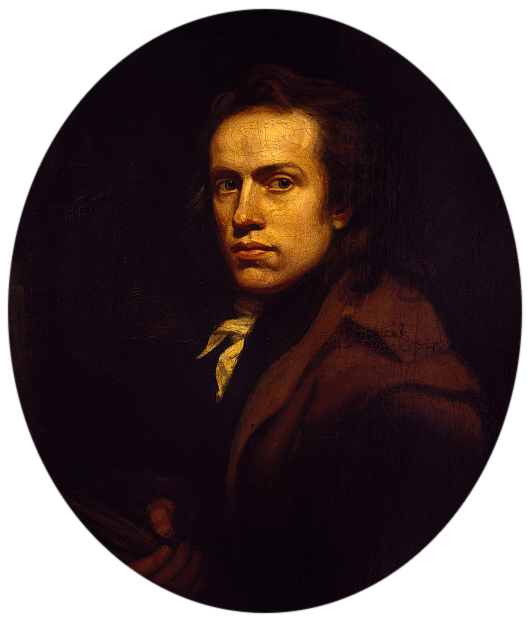
Opie’s style is deeply rooted in the Baroque tradition, a movement known for its theatricality, emotional intensity, and dramatic use of light. The influence of Caravaggio and Rembrandt—artists who were masters of chiaroscuro—is readily apparent in Opie's work. The stark contrast between the illuminated areas of the face and clothing and the deep shadows that envelop the background creates a sense of depth and volume, drawing our attention to the central figure. This technique wasn’t simply aesthetic; it was a deliberate choice to convey a powerful emotional state – here, a blend of seriousness, intelligence, and perhaps even melancholy. Born in Trevellas, Cornwall, Opie's artistic sensibility was profoundly shaped by his Cornish heritage, evident in the ruggedness of his features and the earthy tones that dominate the palette.
Beyond the dramatic lighting, a closer examination reveals Opie’s meticulous attention to detail. The artist skillfully employs lines to define the contours of the face, clothing, and hair, creating a sense of solidity and form. The layering of paint—a technique known as impasto—adds texture to the surface, particularly in the rendering of the fabric draped over his shoulders and the delicate details of his hands. Note the subtle variations in color and tone that suggest the play of light on different surfaces. This careful observation and execution demonstrate Opie’s commitment to realism, a hallmark of his style.
The portrait transcends a simple likeness; it's a symbolic representation of the artist’s inner world. The direct gaze invites engagement, suggesting that Opie is not simply presenting himself but offering an invitation to share in his thoughts. The serious expression—a hallmark of many self-portraits from this period—hints at intelligence, introspection, and perhaps even a touch of melancholy. Considering the historical context – the late 18th century was a time of intellectual ferment and social change – Opie’s portrait can be interpreted as an exploration of identity in a rapidly evolving world. The choice to depict himself alone reinforces this sense of internal reflection, suggesting that the artist is grappling with profound questions about his place in society and his role as a creative force.


1761 - 1807 , Royaume-Uni


Restez informé(e) des dernières actualités artistiques, des offres exclusives et des idées de décoration.
Parlez-nous de votre projet et nos experts en art vous proposeront 3 suggestions d'œuvres personnalisées.
Laissez-nous sélectionner 3 œuvres rien que pour vous – Gratuit !


 Aperçu en situation
 Envoyer
 Partager
 Détails de l'œuvre

 Télécharger
 Articles similaires
 Radiographie
 Diaporama
 Lire la suite


