


x

 Oil On CanvasWallArtNeo-Classicism
 1754
1754 91.0 x 71.0 cm
Huile sur toile peinte à la main, avec cadre et dimensions personnalisés, réalisée sur commande par nos artistes. ( Passer au tirage Passer à l'image)





























Choisissez parmi nos formats prédéfinis qui respectent les proportions originales de l’œuvre.

Vous pouvez saisir vos propres dimensions pour l'adapter à un cadre ou à un espace spécifique. Si la taille sélectionnée ne correspond pas aux proportions de l'image d'origine, nous recadrerons l'œuvre ou prolongerons la peinture avec des éléments peints à la main supplémentaires. Une maquette numérique vous sera envoyée pour approbation avant le début de la production.
Veuillez noter que l'aperçu à l'écran ne reflète pas le recadrage ou l'extension réels. Seule la maquette montrera fidèlement la composition finale.
Bien que des tailles personnalisées soient disponibles, nous vous recommandons de sélectionner une dimension dans la liste prédéfinie afin de préserver les proportions d'origine.
Livraison dans le monde entier () en 3 à 4 semaines au lieu des 5 semaines habituelles. (8 août). Aucun compromis sur la qualité.


Charles Pelham
Format de la reproduction
To stand before John Singleton Copley's Charles Pelham is to step directly into the refined, ordered world of mid-eighteenth-century Boston society. This portrait, executed in 1754, transcends a mere likeness; it is a meticulously crafted document of status, intellect, and burgeoning American aspiration. The subject himself, depicted with an air of composed authority, commands attention through his very bearing. Observe the crisp white shirt, its delicate ruffles catching the light, contrasting beautifully with the formality suggested by his wig. Copley captures not just the man's features—the distinct mustache lending a touch of masculine gravity—but the entire atmosphere surrounding him, inviting the viewer into an intimate, yet grandly staged moment.
Artistically, Charles Pelham stands as a quintessential example of Neo-Classicism. This style, which championed the ideals of clarity, balance, and rational order drawn from the glories of ancient Greece and Rome, finds its perfect expression here. Copley eschews dramatic excess for an elegant restraint. The composition itself is a masterclass in equilibrium; while the main subject occupies a central focus, the inclusion of figures on the left and another presence near the center-left prevents any single area from feeling static. These supporting elements, along with the object resting upon a surface—perhaps a book or sheaf of papers—ground the portrait in tangible reality, suggesting scholarly pursuits or mercantile success. The clean lines and balanced arrangement are hallmarks of an era that valued Enlightenment ideals.
The technical brilliance evident in this oil on canvas work is breathtaking. Copley’s handling of paint allows for incredible textural differentiation; one can almost feel the weight of the fabric, the sheen of polished wood, or the soft texture of skin. His ability to render detail with such precision speaks volumes about his skill as a portraitist. For those considering bringing this historical elegance into a modern space, understanding this technique is key. A high-quality reproduction allows one to appreciate Copley’s masterful layering and subtle tonal shifts without the prohibitive cost or fragility of an original masterwork.
Beyond the visible elements, the painting whispers tales of its time. The formality of dress, the very act of commissioning such a portrait, speaks to the rising merchant class in colonial America—a group eager to solidify their place within established cultural narratives. The presence of multiple figures suggests a social circle, an interconnected web of influence that defined life in Boston during this pivotal period. It is a visual testament to ambition realized through patronage and refined taste. Owning or displaying a reproduction of Charles Pelham is not merely decorating; it is curating a piece of tangible history, invoking the sophisticated spirit of the Georgian era.


1738 - 1815 , Royaume-Uni

Plongez au cœur du Néoclassicisme avec les 10 chefs-d'œuvre incontournables de David, Ingres et autres maîtres. Découvrez l'histoire fascinante de ces tableaux célèbres et trouvez l'inspiration déco classique sur !

Plongez au cœur du Metropolitan Museum of Art avec notre sélection des 25 œuvres les plus emblématiques. Découvrez l'histoire de Van Gogh, Monet et d'autres maîtres, et trouvez l'inspiration pour une décoration intérieure raffinée. Reproductions de qualité muséale sur Most-Famous-Paintings.com.

Plongez dans l'univers de James Abbott McNeill Whistler : découvrez ses 25 œuvres les plus emblématiques, des nocturnes aux portraits saisissants. Explorez son esthétisme unique et trouvez l'inspiration déco avec Most-Famous-Paintings.com.
Plongez au cœur des 25 chefs-d'œuvre de la National Gallery of Art, Washington ! Découvrez l'histoire fascinante de Cézanne, Matisse, Picasso et bien d'autres. Trouvez l'inspiration déco et admirez les reproductions tableaux exceptionnelles sur Most-Famous-Paintings.com.

Plongez dans l'univers de Sir Joshua Reynolds ! Découvrez les 25 œuvres incontournables du maître anglais, ses portraits rococo et son héritage artistique. Inspirez votre décoration intérieure avec Most-Famous-Paintings.com : reproductions haute qualité & collectionneur d'art.


Restez informé(e) des dernières actualités artistiques, des offres exclusives et des idées de décoration.
Parlez-nous de votre projet et nos experts en art vous proposeront 3 suggestions d'œuvres personnalisées.
Laissez-nous sélectionner 3 œuvres rien que pour vous – Gratuit !


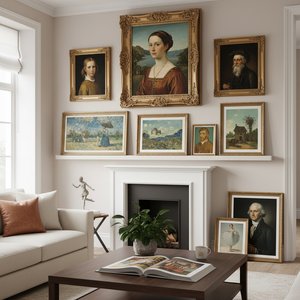
 Aperçu en situation
 Envoyer
 Partager
 Détails de l'œuvre

 Télécharger
 Articles similaires
 Radiographie
 Diaporama
 Lire la suite







 L'option verre n'est disponible que pour les dimensions inférieures à 110 cm.


