x

 Baroque
 25.0 x 34.0 cm
Acquérez une image numérique haute résolution et optimisée, d'une qualité bien supérieure à l'aperçu en ligne.
Chaque fichier est méticuleusement préparé par nos spécialistes internes à l'aide d'outils avancés et d'une retouche manuelle experte. Nous garantissons que chaque image possède une clarté exceptionnelle, une précision des couleurs irréprochable et un niveau de détail fin.
Le fichier final est livré par e-mail sous 72 heures, optimisé pour une utilisation immédiate dans des contextes professionnels, éditoriaux et d'impression. Il offre la même qualité de confiance que celle utilisée par les plus grands studios de création, éditeurs et galeries.
Téléchargez un fichier haute résolution pour votre usage personnel, l'impression et vos projets créatifs. ( Acheter l'impression Acheter la peinture faite à la main)
En choisissant Most-Famous-Paintings.com, vous n'obtenez pas seulement une simple image : vous recevez une œuvre numérique sublimée avec professionnalisme, conçue avec précision et accompagnée d'une garantie de satisfaction. Voici tout ce qui accompagne automatiquement votre commande :

Votre fichier d'image numérique haute résolution vous sera envoyé par e-mail sous 72 heures après votre commande — prêt à un usage immédiat.

Votre œuvre d'art bénéficie d'une optimisation professionnelle grâce à des outils d'IA avancés et une retouche manuelle, garantissant un niveau maximal de détail, de clarté et de fidélité chromatique.

Vous avez accidentellement supprimé ou perdu votre fichier ? Pas d'inquiétude — nous vous le renverrons gratuitement, quand vous le souhaitez.

Profitez de votre œuvre d'art instantanément sans frais de douane ni de livraison — les téléchargements numériques sont toujours exonérés de taxes.

Nous garantissons que votre image numérique reproduit les couleurs de l'original aussi fidèlement que possible grâce à des outils professionnels et une gestion rigoureuse des couleurs.

Si vous n'êtes pas satisfait de votre image numérique, nous la retoucherons ou vous rembourserons 100% sous 60 jours — sans poser de questions.

Pas satisfait ? Obtenez un remboursement intégral dans les 60 jours suivant la réception de votre fichier numérique — sans aucune question posée.

Achetez 3 images, économisez 10% - Achetez 5, économisez 15% - Achetez 10+, économisez 20%. Idéal pour les projets créatifs, les galeries et les agences.

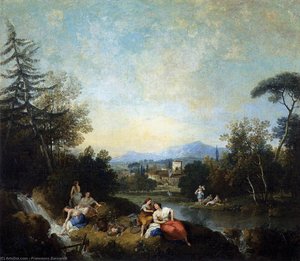
Michele Pagano (1697-1732) emerges from the vibrant, bustling artistic landscape of late Baroque Naples as a captivating figure – a landscape painter who skillfully blended classical influences with a distinctly local sensibility. His life, tragically cut short in his mid-thirties, nonetheless left behind a body of work that reveals a keen eye for detail, an understanding of atmospheric perspective, and a profound connection to the natural world. Pagano’s story is intertwined with the artistic lineage of Naples, beginning with his training under the esteemed Raimondo di Dominici, known as “il Maltese,” and later benefiting from the tutelage of Bernardo de Dominici – both masters who shaped the visual vocabulary of the city.
Di Dominici's influence instilled in Pagano a foundational knowledge of classical composition and technique. However, it was his subsequent association with Bernardo de Dominici that proved pivotal, exposing him to the work of Franz Joachim Beich, a German landscape painter whose style emphasized dramatic lighting and atmospheric effects. This exposure significantly broadened Pagano’s artistic horizons, equipping him with the tools necessary to develop his own unique voice. He quickly distinguished himself as a “vedutista,” a term denoting a landscape artist specializing in depictions of urban scenes and topographical views – a genre particularly favored in Naples during this period.
Pagano’s most celebrated works are his “vedute” – meticulously rendered depictions of Naples and its surrounding environs. These paintings aren't merely topographical records; they are imbued with a palpable sense of atmosphere, capturing the city’s energy, its light, and its inherent drama. He skillfully employed techniques such as aerial perspective—reducing detail and lightening colors in the distance—to create an illusion of depth and space. His compositions often feature grand vistas of the Bay of Naples, framed by imposing castles and churches, interwoven with bustling streets teeming with life.
Notable amongst his works are depictions of the Castel Nuovo (New Castle), the Duomo (Cathedral), and various views along the waterfront. These scenes aren’t idealized representations; Pagano doesn't shy away from portraying the city’s imperfections – its crumbling walls, its crowded streets, and its inherent chaos. Instead, he presents a nuanced portrait of Naples—a city of contrasts, beauty, and resilience. His ability to capture the interplay of light and shadow, particularly during the golden hours of dawn and dusk, is truly remarkable.
Despite his burgeoning success, Pagano’s life was tragically cut short at the age of thirty-five. Contemporary accounts suggest that he succumbed to complications arising from a treatment for venereal disease – a common affliction during the era, often involving the use of mercury. This grim detail adds a poignant layer to his biography, underscoring the precariousness of life in 18th-century Naples and the toll it could take on even the most talented artists.
The circumstances surrounding his death have fueled speculation about a possible familial connection to Francesco Pagano, a prominent painter from the 15th century. While this remains unconfirmed, it highlights the enduring legacy of the family name within the Neapolitan artistic community. His premature demise robbed the art world of a promising talent and left behind a relatively small but significant body of work that continues to fascinate and inspire.
Michele Pagano’s contribution to the development of Neapolitan landscape painting is undeniable. He stands as a key figure in the “veduta” genre, demonstrating a masterful command of technique and an exceptional ability to capture the essence of his subject matter. His work influenced subsequent generations of artists who followed in his footsteps, shaping the visual identity of Naples and contributing to the city’s rich artistic heritage.
Today, Pagano's paintings are housed in prominent museums throughout Italy, including the San Michele Museum in Bologna and Lucca, offering visitors a glimpse into the world of a talented artist whose life was tragically brief but whose legacy endures through his captivating landscapes. His art serves as a testament to the enduring power of observation, skill, and artistic vision.

1697 - 1732


Restez informé(e) des dernières actualités artistiques, des offres exclusives et des idées de décoration.
Parlez-nous de votre projet et nos experts en art vous proposeront 3 suggestions d'œuvres personnalisées.
Laissez-nous sélectionner 3 œuvres rien que pour vous – Gratuit !


 Aperçu en situation
 Envoyer
 Partager
 Détails de l'œuvre

 Télécharger
 Articles similaires
 Radiographie
 Diaporama
 Lire la suite