x

 Acrylic On CanvasWallArtColor Field Painting
 1959
1959 256.0 x 378.0 cm
 Musée Solomon R. Guggenheim
Acquérez une image numérique haute résolution et optimisée, d'une qualité bien supérieure à l'aperçu en ligne.
Chaque fichier est méticuleusement préparé par nos spécialistes internes à l'aide d'outils avancés et d'une retouche manuelle experte. Nous garantissons que chaque image possède une clarté exceptionnelle, une précision des couleurs irréprochable et un niveau de détail fin.
Le fichier final est livré par e-mail sous 72 heures, optimisé pour une utilisation immédiate dans des contextes professionnels, éditoriaux et d'impression. Il offre la même qualité de confiance que celle utilisée par les plus grands studios de création, éditeurs et galeries.
Téléchargez un fichier haute résolution pour votre usage personnel, l'impression et vos projets créatifs. ( Commander l'impression Commander la reproduction peinte à la main)
En choisissant Most-Famous-Paintings.com, vous n'obtenez pas seulement une simple image : vous recevez une œuvre numérique sublimée avec professionnalisme, conçue avec précision et accompagnée d'une garantie de satisfaction. Voici tout ce qui accompagne automatiquement votre commande :

Votre fichier d'image numérique haute résolution vous sera envoyé par e-mail sous 72 heures après votre commande — prêt à un usage immédiat.

Votre œuvre d'art bénéficie d'une optimisation professionnelle grâce à des outils d'IA avancés et une retouche manuelle, garantissant un niveau maximal de détail, de clarté et de fidélité chromatique.

Vous avez accidentellement supprimé ou perdu votre fichier ? Pas d'inquiétude — nous vous le renverrons gratuitement, quand vous le souhaitez.

Profitez de votre œuvre d'art instantanément sans frais de douane ni de livraison — les téléchargements numériques sont toujours exonérés de taxes.

Nous garantissons que votre image numérique reproduit les couleurs de l'original aussi fidèlement que possible grâce à des outils professionnels et une gestion rigoureuse des couleurs.

Si vous n'êtes pas satisfait de votre image numérique, nous la retoucherons ou vous rembourserons 100% sous 60 jours — sans poser de questions.

Pas satisfait ? Obtenez un remboursement intégral dans les 60 jours suivant la réception de votre fichier numérique — sans aucune question posée.

Achetez 3 images, économisez 10% - Achetez 5, économisez 15% - Achetez 10+, économisez 20%. Idéal pour les projets créatifs, les galeries et les agences.
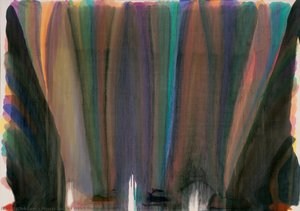
Morris Louis’s “Saraband,” painted in 1959, isn't merely a canvas adorned with color; it’s an immersive experience. This monumental work, measuring nearly 3 x 2.6 meters, immediately draws the viewer into its hazy depths – a realm where form dissolves and emotion takes precedence. Louis, a pivotal figure in Color Field painting, sought to move beyond traditional representation, aiming instead to capture the very essence of color itself. “Saraband” embodies this ambition, inviting contemplation and offering a profound connection through its atmospheric quality and subtle shifts in hue.
The genesis of this piece lies within Louis’s groundbreaking "veil" technique – a method he pioneered by pouring diluted acrylic paint directly onto unprimed canvas. This revolutionary approach allowed the paint to soak into the fabric, creating a luminous, almost ethereal surface that defies conventional brushstrokes. The absence of visible lines contributes significantly to the painting's dreamlike quality, fostering a sense of fluidity and movement reminiscent of a slow, graceful dance – hence the title itself, referencing the stately Spanish dance known for its melancholic beauty.
The color palette of “Saraband” is both complex and remarkably harmonious. Dominating the composition are washes of vibrant oranges, reds, yellows, greens, blues, and purples – a rich tapestry that seems to shift and evolve with every glance. These colors aren’t applied uniformly; instead, they bleed into one another, creating subtle gradations and transitions that suggest depth and movement. The warm beige or light brown background acts as a grounding element, providing a neutral stage for the explosion of color above. Notice how the cooler blues and greens recede slightly, while the warmer reds and yellows advance, subtly manipulating our perception of space within the painting.
Louis’s masterful control over the paint's flow is evident in the way the colors coalesce into vertical bands or columns. These aren’t sharply defined edges; rather, they dissolve at their boundaries, contributing to the overall sense of atmospheric depth and blurring the distinction between foreground and background. This deliberate ambiguity encourages the viewer to lose themselves within the painting, allowing their own emotions and associations to shape their interpretation.
“Saraband” is deliberately devoid of representational imagery – there are no figures or recognizable objects. Instead, its power lies in its ability to evoke a range of emotional responses. The title itself—a reference to a slow, melancholic dance—hints at themes of longing, nostalgia, and perhaps even loss. The flowing colors can be interpreted as representing the ebb and flow of emotions, mirroring the complexities of human experience. It’s a painting that invites introspection, prompting viewers to consider their own personal connections to color, movement, and feeling.
Furthermore, Louis's work during this period was deeply influenced by his interest in spirituality and the subconscious. He sought to create paintings that would bypass rational thought and directly engage with the viewer’s emotions. “Saraband” achieves this beautifully, offering a meditative experience that transcends mere visual pleasure.
Morris Louis was a key figure in the development of Color Field painting, an American movement that emerged in the mid-1950s. Artists like Louis, Barnett Newman, and Helen Frankenthaler sought to elevate color to the primary subject matter of their work, rejecting traditional forms and techniques. “Saraband” stands as a testament to this revolutionary approach, demonstrating Louis’s ability to create large-scale paintings that are both visually stunning and emotionally resonant. His innovative use of acrylic paint and his commitment to exploring the expressive potential of color have had a lasting impact on contemporary art.

1912 - 1962 , États-Unis d'Amérique


Restez informé(e) des dernières actualités artistiques, des offres exclusives et des idées de décoration.
Parlez-nous de votre projet et nos experts en art vous proposeront 3 suggestions d'œuvres personnalisées.
Laissez-nous sélectionner 3 œuvres rien que pour vous – Gratuit !


 Aperçu en situation
 Envoyer
 Partager
 Détails de l'œuvre

 Télécharger
 Articles similaires
 Radiographie
 Diaporama
 Lire la suite