x

Impressions giclées ou sur toile de qualité musée, avec une production rapide et des finitions au choix. ( Commander la reproduction peinte à la main Télécharger l'image haute résolution)





























Choisissez parmi nos formats prédéfinis qui respectent les proportions originales de l’œuvre.

Vous pouvez saisir vos propres dimensions pour vous adapter à un cadre ou à un espace spécifique. Si la taille sélectionnée ne correspond pas aux proportions de l'image originale, nous recadrerons l'œuvre ou étendrons l'image avec une bordure en miroir ou une couleur unie. Une maquette numérique vous sera envoyée pour approbation avant le début de la production.
Veuillez noter que l'aperçu à l'écran ne reflète pas le recadrage ou l'extension réelle. Seule la maquette montrera avec précision la composition finale.
Bien que des tailles personnalisées soient disponibles, nous vous recommandons de choisir une dimension dans la liste prédéfinie afin de préserver les proportions originales.
Livraison dans le monde entier () en 2 semaines au lieu des 4/5 semaines habituelles. (19 août)


Dans les bois
Format de la reproduction
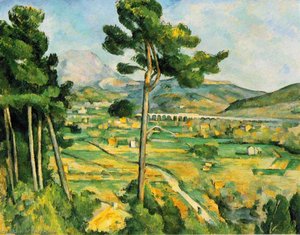
Paul Cézanne’s In the Woods stands as a cornerstone of Post-Impressionism, demonstrating Cézanne’s profound ability to distill the essence of nature into a powerfully expressive watercolor.
Created in 1900, this artwork isn’t merely a depiction of trees; it’s an embodiment of Cézanne’s revolutionary artistic vision—a deliberate departure from Impressionistic optical realism and a fervent exploration of form and color as conduits for emotion. The painting captures the serene stillness of a woodland scene bathed in autumnal hues, featuring trees rendered with meticulous detail yet imbued with an underlying dynamism.
Cézanne’s approach to watercolor distinguishes him from his contemporaries. Rather than striving for photographic accuracy, he prioritized conveying feeling and perception—a core principle of Post-Impressionism. He sought not just what the eye sees but how it *feels*. The artist's intention was to portray nature as an active force shaping itself through time.
Consider the composition: Cézanne eschews traditional perspective, flattening the space and presenting multiple viewpoints simultaneously. This technique—characteristic of Cézanne’s oeuvre—creates a sense of depth without relying on conventional linear recession. Instead, he uses overlapping planes of color to suggest volume and texture, inviting the viewer to engage in an imaginative process.
The watercolor medium itself contributes significantly to the painting’s aesthetic impact. Cézanne skillfully manipulates pigment layering—applying thin washes of color over thicker glazes—to achieve remarkable luminosity and tonal variation. This technique allows for subtle gradations of hue and shade, capturing the dappled light filtering through the foliage.
Observe the meticulous rendering of individual trees. Cézanne employs a hexagonal brushstroke pattern—a technique he famously described as “drawing with color”—to build up form and texture. These hexagonal strokes are densely packed together, creating an impressionistic surface that vibrates with energy. The artist’s masterful control over pigment placement ensures that each tree possesses its own distinct character.
In the Woods reflects Cézanne’s broader engagement with Symbolism and his fascination with capturing psychological states alongside visual representations.
Cézanne's work aligns perfectly with the movement’s core tenets—a rejection of academic conventions and a prioritization of subjective experience. Like many Symbolist painters, Cézanne sought to express inner emotions through imagery rooted in nature, mirroring the Romantic tradition’s preoccupation with sublime landscapes.
Today, In the Woods continues to resonate with audiences worldwide. Its understated beauty and masterful execution serve as an enduring testament to Cézanne’s artistic genius.
For those seeking inspiration or contemplating a decorative addition to their home—a high-quality reproduction of this iconic artwork—Most-Famous-Paintings offers exceptional prints that faithfully capture the painting’s luminous palette and textural richness. Explore more masterpieces by Cézanne and similar artists at John Singer Sargent: Study of a Fig Tree.
To delve deeper into the pigments utilized in art, visit The Art Media Pigment.


1839 - 1906 , France
Plongez dans l'univers de Paul Cézanne avec les 25 œuvres incontournables du maître post-impressionniste. Découvrez l'histoire, la technique et l'émotion derrière ses tableaux iconiques comme 'Les Baigneuses' ou 'Mont Sainte-Victoire'. Reproductions d'art haute qualité sur Most-Famous-Paintings.com.

Plongez dans l'univers fascinant des 10 chefs-d'œuvre de l'aquarelle qui ont marqué l'histoire de l'art. Découvrez Turner, Monet, Goya et bien d'autres ! Retrouvez ces œuvres emblématiques en reproductions exceptionnelles sur Most-Famous-Paintings.com.

Plongez dans l'univers coloré de Paul Klee ! Découvrez les 25 œuvres maîtresses du peintre suisse, figures clés de l'art abstrait et du Bauhaus. Inspirez votre décoration intérieure avec Most-Famous-Paintings.com – reproductions de qualité muséale & collection exclusive.

Explore the captivating world of watercolor painting! Discover its rich history, essential techniques, influential artists & collecting tips. A comprehensive guide for art enthusiasts from Most-Famous-Paintings.

Plongez dans l'univers vibrant de l'impressionnisme ! Découvrez les 10 chefs-d'œuvre de Monet, Renoir et autres maîtres qui ont révolutionné le paysage. Inspirez votre décoration intérieure avec Most-Famous-Paintings.com : reproductions tableaux de qualité muséale.


Restez informé(e) des dernières actualités artistiques, des offres exclusives et des idées de décoration.
Parlez-nous de votre projet et nos experts en art vous proposeront 3 suggestions d'œuvres personnalisées.
Laissez-nous sélectionner 3 œuvres rien que pour vous – Gratuit !


 Aperçu en situation
 Envoyer
 Partager
 Détails de l'œuvre

 Télécharger
 Articles similaires
 Radiographie
 Diaporama

 Lire la suite







 L'option verre n'est disponible que pour les dimensions inférieures à 110 cm.