x

Huile sur toile peinte à la main, avec cadre et dimensions personnalisés, réalisée sur commande par nos artistes. ( Commander l'impression Télécharger l'image haute résolution)





























Choisissez parmi nos formats prédéfinis qui respectent les proportions originales de l’œuvre.

Vous pouvez saisir vos propres dimensions pour l'adapter à un cadre ou à un espace spécifique. Si la taille sélectionnée ne correspond pas aux proportions de l'image d'origine, nous recadrerons l'œuvre ou prolongerons la peinture avec des éléments peints à la main supplémentaires. Une maquette numérique vous sera envoyée pour approbation avant le début de la production.
Veuillez noter que l'aperçu à l'écran ne reflète pas le recadrage ou l'extension réels. Seule la maquette montrera fidèlement la composition finale.
Bien que des tailles personnalisées soient disponibles, nous vous recommandons de sélectionner une dimension dans la liste prédéfinie afin de préserver les proportions d'origine.
Livraison dans le monde entier () en 3 à 4 semaines au lieu des 5 semaines habituelles. (18 août). Aucun compromis sur la qualité.


Flowerpots
Format de la reproduction
Paul Cézanne, born on January 19, 1839, in Aix-en-Provence, France, was a pivotal figure in the transition from late 19th-century Impressionism to early 20th-century Cubism. His father was a successful hatmaker who later became a banker, providing Cézanne with financial security that allowed him to pursue his artistic passions without immediate economic pressure. Initially intended to follow in his father’s footsteps and enter the legal profession, Cézanne eventually abandoned these plans to dedicate himself fully to art.
Early influences included Romanticism and the Barbizon school of landscape painting. He studied briefly at the Académie Suisse in Paris but largely developed his style independently. The works of Paul Gauguin and Georges Seurat, particularly their explorations of color and form, also played a significant role in shaping Cézanne’s artistic direction.
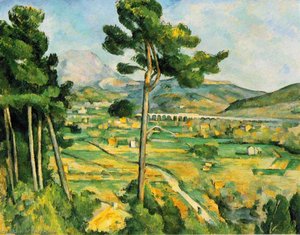
“Flowerpots” is a watercolor painting created in 1885 by Paul Cézanne and exemplifies the core tenets of the Post-Impressionist movement. Unlike Impressionists who sought to capture fleeting moments of light and atmosphere, Cézanne focused on conveying underlying structure and form—a radical departure from traditional artistic conventions.
The painting depicts a simple yet profound arrangement: several flower pots resting on a shelf. Cézanne meticulously rendered each pot with geometric shapes—cylinders and cubes—creating a sense of depth and dimensionality that defies the flatness characteristic of Impressionism. The artist’s use of color is subdued, favoring earthy tones that harmonize with the muted hues of the geranium blossoms.
Cézanne's innovative approach to painting profoundly impacted subsequent artistic movements. His insistence on depicting objects as they truly appear—rather than as perceived by the eye—laid the groundwork for Cubism, pioneered by Picasso and Georges Braque. Cézanne’s exploration of color theory and his pioneering use of tonal modulation – blending colors to create subtle gradations – anticipated techniques employed by artists like Vincent van Gogh.
Furthermore, Cézanne's unwavering dedication to capturing the essence of form influenced generations of painters who sought to express their vision of reality in a new way. His influence can be seen in the works of artists across Europe and America, cementing his legacy as one of the most influential figures in modern art.
“Flowerpots” is part of Cézanne’s extensive oeuvre and was showcased at several exhibitions during his lifetime. Notably, it resides within the collection of the Musée d'Orsay in Paris—a testament to its artistic merit and enduring appeal.
The museum’s holdings provide invaluable insight into Cézanne’s artistic development and contextualize his contribution to the broader landscape of Post-Impressionism. Visitors can explore other masterpieces by Impressionists and Post-Impressionists, fostering a deeper understanding of the artistic currents that shaped the late 19th century.
To delve deeper into Cézanne’s life and artistic journey, consult resources such as Wikipedia (https://en.wikipedia.org/wiki/Paul_C%C3%A9zanne) or biographical articles published by reputable art institutions.
Consider visiting the Musée Paul Valéry in Sète, France, to admire Cézanne’s landscapes and gain inspiration from his masterful depiction of the Mediterranean environment. Alternatively, explore reproductions of “Flowerpots” online at platforms like Most-Famous-Paintings.com (/art/list/?Filter=paul+cezanne,paul,cezanne) and Most-Famous-Paintings (/art/list/?Filter=8EWP3W-Paul-Cezanne-Study-of-an-Apple).


1839 - 1906 , France

Explore the profound evolution of Post-Impressionist landscapes. From Van Gogh's emotional brushwork to Cézanne's structural mastery, discover how these visionaries redefined art history through color and form in this expert guide for fine art enthusiasts.


Restez informé(e) des dernières actualités artistiques, des offres exclusives et des idées de décoration.
Parlez-nous de votre projet et nos experts en art vous proposeront 3 suggestions d'œuvres personnalisées.
Laissez-nous sélectionner 3 œuvres rien que pour vous – Gratuit !


 Aperçu en situation
 Envoyer
 Partager
 Détails de l'œuvre

 Télécharger
 Articles similaires
 Radiographie
 Diaporama

 Lire la suite







 L'option verre n'est disponible que pour les dimensions inférieures à 110 cm.