x


Huile sur toile peinte à la main, avec cadre et dimensions personnalisés, réalisée sur commande par nos artistes. ( Passer au tirage Passer à l'image)





























Choisissez parmi nos formats prédéfinis qui respectent les proportions originales de l’œuvre.

Vous pouvez saisir vos propres dimensions pour l'adapter à un cadre ou à un espace spécifique. Si la taille sélectionnée ne correspond pas aux proportions de l'image d'origine, nous recadrerons l'œuvre ou prolongerons la peinture avec des éléments peints à la main supplémentaires. Une maquette numérique vous sera envoyée pour approbation avant le début de la production.
Veuillez noter que l'aperçu à l'écran ne reflète pas le recadrage ou l'extension réels. Seule la maquette montrera fidèlement la composition finale.
Bien que des tailles personnalisées soient disponibles, nous vous recommandons de sélectionner une dimension dans la liste prédéfinie afin de préserver les proportions d'origine.
Livraison dans le monde entier () en 3 à 4 semaines au lieu des 5 semaines habituelles. (4 août). Aucun compromis sur la qualité.


Nature morte devant une commode
Format de la reproduction
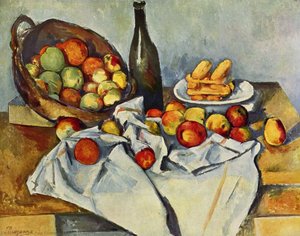
Paul Cézanne’s “Still Life in Front of a Chest of Drawers,” painted in 1887, stands as a pivotal moment in the transition from Impressionism to Cubism. It's more than just a depiction of fruit; it’s an audacious experiment in form and perspective that fundamentally reshaped artistic conventions and continues to inspire artists today.
Painted during Cézanne’s formative years, “Still Life” reflects the broader intellectual currents of its time—particularly Nietzsche's proclamation that "God is dead." Cézanne responded to this existential crisis by rejecting representational art as a means of capturing external reality. He sought instead to express inner truths through formal abstraction, asserting that art should strive for permanence and universality.
The painting’s rejection of Impressionistic conventions coincided with the emergence of Cubism, spearheaded by Picasso and Braque. Cézanne's exploration of geometric forms paved the way for this revolutionary movement, demonstrating that artistic innovation could reside in dismantling established visual conventions rather than merely replicating them.
While seemingly unassuming, “Still Life” is laden with symbolic significance. The apples and oranges represent fertility and abundance—themes prevalent in Cézanne’s broader artistic concerns. However, their placement within the pyramidal composition transcends mere visual description; it embodies Cézanne's desire to capture an essence of existence beyond superficial appearances.
The painting evokes a feeling of quiet contemplation and understated beauty. Its deliberate stillness invites viewers to engage in a dialogue with form and color—to consider how these elements contribute to conveying a deeper emotional resonance. Cézanne’s masterful manipulation of perspective and texture compels us to confront the complexities of visual perception, reminding us that art can communicate truths inaccessible to literal representation.
"Still Life in Front of a Chest of Drawers" solidified Cézanne’s reputation as a visionary artist who fundamentally altered the trajectory of modern art. Its influence extends far beyond its own time, inspiring generations of painters and sculptors to experiment with abstraction and explore new ways of representing space and form.
Today, reproductions of this iconic artwork continue to captivate audiences worldwide—serving as a testament to Cézanne’s enduring legacy and his profound contribution to the history of art. It remains a cornerstone of Post-Impressionism and an exemplar of artistic innovation driven by intellectual conviction.


1839 - 1906 , France

Explorez l'art abstrait et transformez votre intérieur ! Conseils d'experts, reproductions de qualité muséale & inspiration déco pour créer un espace unique et harmonieux. Découvrez Most-Famous-Paintings.

Explore the captivating landscapes of Henri Moret, a master of Post-Impressionism. Discover his unique style, key works, and legacy in our expert guide. Learn about collecting Moret's art & its investment potential.

Explore the rich history of still life painting & the symbolism of fruit across art movements. Discover masterpieces from Caravaggio to Cézanne with Most-Famous-Paintings – expert guidance & museum-quality reproductions.

Explore the captivating world of Severin Roesen, a major American still life painter influenced by Dutch masters. Discover his lush compositions and the symbolism within his art – a window into 19th-century America.

Explore the serene Post-Impressionist world of Henri Lebasque. Discover his intimate domestic scenes, vibrant landscapes & connection to the Nabis group. Expert insights for collectors and art enthusiasts.


Restez informé(e) des dernières actualités artistiques, des offres exclusives et des idées de décoration.
Parlez-nous de votre projet et nos experts en art vous proposeront 3 suggestions d'œuvres personnalisées.
Laissez-nous sélectionner 3 œuvres rien que pour vous – Gratuit !


 Aperçu en situation
 Envoyer
 Partager
 Détails de l'œuvre

 Télécharger
 Articles similaires
 Radiographie
 Diaporama
 Lire la suite







 L'option verre n'est disponible que pour les dimensions inférieures à 110 cm.