x

Huile sur toile peinte à la main, avec cadre et dimensions personnalisés, réalisée sur commande par nos artistes. ( Passer au tirage Passer à l'image)





























Choisissez parmi nos formats prédéfinis qui respectent les proportions originales de l’œuvre.

Vous pouvez saisir vos propres dimensions pour l'adapter à un cadre ou à un espace spécifique. Si la taille sélectionnée ne correspond pas aux proportions de l'image d'origine, nous recadrerons l'œuvre ou prolongerons la peinture avec des éléments peints à la main supplémentaires. Une maquette numérique vous sera envoyée pour approbation avant le début de la production.
Veuillez noter que l'aperçu à l'écran ne reflète pas le recadrage ou l'extension réels. Seule la maquette montrera fidèlement la composition finale.
Bien que des tailles personnalisées soient disponibles, nous vous recommandons de sélectionner une dimension dans la liste prédéfinie afin de préserver les proportions d'origine.
Livraison dans le monde entier () en 3 à 4 semaines au lieu des 5 semaines habituelles. (11 août). Aucun compromis sur la qualité.


John Henry Twachtman Impressionnisme Cincinnati États-Unis 1853 1902 Frank Duveneck Collection privée Huile sur toile/panneau Impressionnisme américain Paysage enneigé, maison Paysage hivernal La Vieille Maison de Holley, Cos Cob La Vieille M
Format de la reproduction
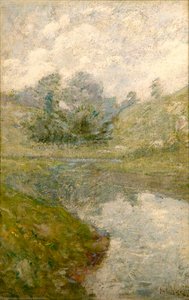
John Henry Twachtman's "Old Holley House, Cos Cob" is more than just a depiction of a snowy landscape; it’s a poignant meditation on stillness, memory, and the enduring beauty of the Connecticut countryside. Painted in 1890, during his most intensely productive period, this artwork captures a moment of profound quietude at the Bush–Holley House, a pivotal location within the burgeoning Cos Cob Art Colony. The scene unfolds with a deliberate restraint, reflecting Twachtman’s evolving approach to Impressionism – one that prioritized atmosphere and emotional resonance over purely representational accuracy.
The house itself, rendered with meticulous detail despite its softened edges, anchors the composition. Its rectangular form provides a structural counterpoint to the swirling snowdrifts and the blurred forms of the surrounding landscape. The bare tree in the foreground isn’t merely a compositional element; it speaks to themes of dormancy and the cyclical nature of time – a common motif within Twachtman's work, often interpreted as reflecting his own contemplative state.
Twachtman masterfully employs a muted color palette dominated by whites, blues, and grays. This isn’t a vibrant celebration of winter; rather, it’s an exploration of the subtle nuances of light and shadow on a snowy day. The diffused lighting, characteristic of an overcast winter afternoon, creates a sense of ethereal calm. Notice how he uses variations in gray – from the deepest shadows cast by the house to the lighter tones reflecting off the snow – to build depth and create a palpable sense of atmosphere. Subtle browns appear in the tree branches, grounding the scene and adding a touch of warmth against the prevailing coolness.
Executed in oil paints on canvas, “Old Holley House” exemplifies Twachtman’s signature Impressionistic technique. Loose brushstrokes, layered washes of color, and broken forms contribute to a sense of movement and immediacy. This isn't about precise detail; it’s about capturing the *impression* of light and form. The painting’s texture is deliberately implied – you can almost feel the roughness of the snow and the weathered surface of the building through the artist’s expressive application of paint. It’s crucial to understand that Twachtman was a key figure in the Cos Cob Art Colony, a group of artists who sought to break away from academic constraints and explore new ways of seeing and representing the world. The Bush–Holley House served as a gathering place for these artists – Weir, Robinson, Hassam – fostering an environment of experimentation and collaboration.
Beyond its technical brilliance, “Old Holley House” possesses a quiet emotional depth. The scene evokes a sense of solitude and reflection, inviting the viewer to contemplate the passage of time and the beauty of the natural world. The stillness of the landscape mirrors a contemplative mood, suggesting a moment of respite from the demands of daily life. It’s a painting that rewards patient observation – encouraging us to slow down and appreciate the subtle wonders of a winter afternoon. This artwork offers a window into the artistic spirit of a pivotal era in American art history, and its enduring appeal lies in its ability to transport us to a place of serene beauty and quiet contemplation.


1853 - 1902 , États-Unis d'Amérique

Explore the serene landscapes of John Varley I, a key figure in British Romanticism. Discover his unique watercolour style, collaboration with William Blake & lasting artistic legacy. Learn about collecting Varley's work.

Explore the captivating landscapes of Henri Moret, a master of Post-Impressionism. Discover his unique style, key works, and legacy in our expert guide. Learn about collecting Moret's art & its investment potential.

Explore the captivating work of Henry Marvell Carr, a pivotal figure in American Impressionism. Discover his evocative realism, war art, and cultural depictions – a journey through light, form, and legacy.

Explore the captivating portraits of Sir John Watson Gordon, a leading Scottish master. Discover his evolution from neoclassical style to atmospheric Tonalism and influence on 19th-century British art. Learn about his iconic sitters & legacy.

Explore the life & art of Theodore Clement Steele, a leading American Impressionist painter. Discover his luminous Indiana landscapes, contributions to the Hoosier Group, and enduring legacy. A comprehensive guide for art enthusiasts.


Restez informé(e) des dernières actualités artistiques, des offres exclusives et des idées de décoration.
Parlez-nous de votre projet et nos experts en art vous proposeront 3 suggestions d'œuvres personnalisées.
Laissez-nous sélectionner 3 œuvres rien que pour vous – Gratuit !


 Aperçu en situation
 Envoyer
 Partager
 Détails de l'œuvre

 Télécharger
 Articles similaires
 Radiographie
 Diaporama

 Lire la suite







 L'option verre n'est disponible que pour les dimensions inférieures à 110 cm.