x

Impressions giclées ou sur toile de qualité musée, avec une production rapide et des finitions au choix. ( Commander la reproduction peinte à la main Télécharger l'image haute résolution)





























Choisissez parmi nos formats prédéfinis qui respectent les proportions originales de l’œuvre.

Vous pouvez saisir vos propres dimensions pour vous adapter à un cadre ou à un espace spécifique. Si la taille sélectionnée ne correspond pas aux proportions de l'image originale, nous recadrerons l'œuvre ou étendrons l'image avec une bordure en miroir ou une couleur unie. Une maquette numérique vous sera envoyée pour approbation avant le début de la production.
Veuillez noter que l'aperçu à l'écran ne reflète pas le recadrage ou l'extension réelle. Seule la maquette montrera avec précision la composition finale.
Bien que des tailles personnalisées soient disponibles, nous vous recommandons de choisir une dimension dans la liste prédéfinie afin de préserver les proportions originales.
Livraison dans le monde entier () en 2 semaines au lieu des 4/5 semaines habituelles. (21 août)


The Letter
Format de la reproduction
Sir John Lavery's "The Letter," painted in 1908, isn’t merely a portrait; it’s a carefully constructed tableau of domestic intimacy and subtle emotional depth. Captured with the Impressionistic brushstrokes characteristic of his later work, the painting depicts a woman seated on a plush bed, completely absorbed in reading a letter – an act that immediately invites speculation about its contents and the recipient's impact. Lavery masterfully eschews overt drama, instead focusing on capturing a fleeting moment of quiet contemplation, a stillness that speaks volumes about the subject’s inner world.
The painting’s composition is deceptively simple yet profoundly effective. The woman, positioned slightly off-center, anchors the scene while the four-poster bed and flowing curtains create a sense of enveloping comfort and privacy. Notice how Lavery uses the architecture to subtly guide the viewer's eye – the receding lines of the bed frame and window draw us into the intimate space, mirroring the subject’s absorption in her reading. The color palette is deliberately muted—soft yellows, creams, and pale blues dominate—evoking a sense of warmth and serenity, while touches of pink in the woman’s dress and cheeks offer delicate highlights that prevent the scene from becoming overly somber.
Lavery’s Impressionistic style is evident in every brushstroke. He employs a technique of layering thin washes of oil paint, building up color gradually to create luminous effects and a sense of atmospheric depth. The visible texture of the paint—the loose, broken strokes—contribute significantly to the painting's overall feeling of immediacy and spontaneity. Unlike more rigid academic styles, Lavery prioritized capturing the *impression* of light and color rather than precise detail. This is particularly noticeable in the rendering of the fabrics – the velvet curtains appear almost weightless, while the woman’s dress flows with a subtle grace.
The artist's influence from Whistler is palpable; Lavery shared Whistler’s interest in capturing fleeting moments and exploring the interplay of light and color. However, unlike Whistler’s often abstract compositions, Lavery grounds his work in recognizable subjects—portraits, landscapes, and scenes of everyday life—making them accessible to a wider audience. “The Letter” exemplifies this balance between artistic experimentation and narrative clarity.
Beyond its surface beauty, "The Letter" is rich with symbolic potential. The act of reading a letter inherently carries layers of meaning – anticipation, revelation, perhaps even heartbreak or longing. The woman’s posture—her head bent slightly downward, her gaze fixed on the page—suggests deep concentration and vulnerability. She's not simply reading; she’s receiving something that profoundly affects her.
Considering Lavery’s own life – his early loss of parents, his subsequent moves between Glasgow and London, and his later years spent in Ireland – it’s possible to interpret the painting as a reflection on themes of connection, isolation, and the enduring power of communication. The letter itself becomes a conduit for unspoken emotions and hidden desires. The subtle details—the delicate lace collar, the worn velvet cushion—add further layers of meaning, hinting at a life lived within the confines of domesticity.
“The Letter” is a quintessential example of Sir John Lavery’s remarkable talent for capturing the spirit of his age. Painted during a period of rapid social change in Britain, it offers a glimpse into the private lives of the upper classes – their rituals, their affections, and their quiet moments of reflection. Lavery's ability to portray both outward elegance and inner complexity cemented his reputation as one of the most sought-after portraitists of his time. Reproductions of this evocative work continue to resonate with viewers today, offering a timeless reminder of the power of a single, carefully observed moment.

Sir John Lavery RA était un peintre irlandais très respecté, renommé pour ses portraits captivants et ses représentations évocatrices de scènes de guerre. Né à Belfast, il a démontré un talent artistique dès son plus jeune âge, fréquentant l'Académie Haldane à Glasgow dans les années 1870 avant d'affiner davantage ses compétences à l'Académie Julian à Paris au début des années 1880.
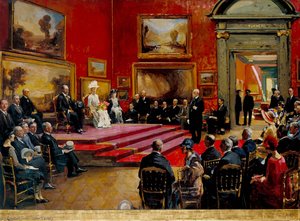
Après son retour à Glasgow, Lavery s’est associé aux artistes de la School of Glasgow. Un moment décisif est survenu en 1888 lorsqu'il a reçu une commande pour peindre la visite d'État de la reine Victoria à l'Exposition Internationale de Glasgow. Cet engagement prestigieux a lancé sa carrière en tant que peintre mondain recherché, ce qui l’a incité à déménager à Londres peu après.
Comme William Orpen, Lavery a été nommé artiste officiel pendant la Première Guerre mondiale. Cependant, des problèmes de santé persistants et un grave accident de voiture résultant d'un raid de Zeppelin l'ont empêché de servir sur le front occidental. Au lieu de cela, il s’est concentré sur la documentation des scènes de guerre au sein de la Grande-Bretagne, capturant des bateaux, des avions et des dirigeables.
Après la guerre, Lavery a été anobli et élu à la Royal Academy en 1921. Sa vie personnelle s'est entrelacée avec des événements historiques importants ; lui et sa femme, Hazel, ont joué un rôle discret dans la Guerre d'Indépendance irlandaise et la Guerre civile, mettant leur maison londonienne à disposition des négociateurs irlandais. Il a immortalisé Michael Collins avec son tableau "Michael Collins, Amour de l’Irlande", qui est maintenant exposé à la Hugh Lane Municipal Gallery.
Le style artistique de Lavery mêlait des éléments de l'impressionnisme à un sens aigu pour capturer la personnalité et l’atmosphère. Ses portraits sont célébrés pour leur réalisme, leur élégance et leur portraitage perspicace du caractère. Il était également habile dans le fait de représenter des paysages et des scènes de la vie quotidienne.
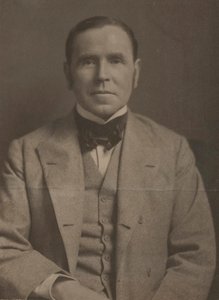
1856 - 1941 , Irlande

Explore the profound symbolism of women reading through art history. From Renoir to Pissarro, discover how masterworks capture intellectual depth, privacy, and the soul's journey inward. An expert guide for fine art enthusiasts and collectors.

Explore the profound revolution of Post-Impressionism. Delve into the history, techniques, and emotional depth of masters like Van Gogh and Seurat. Discover how to transform your space with museum-quality, hand-painted oil reproductions of these iconic masterpieces.


Restez informé(e) des dernières actualités artistiques, des offres exclusives et des idées de décoration.
Parlez-nous de votre projet et nos experts en art vous proposeront 3 suggestions d'œuvres personnalisées.
Laissez-nous sélectionner 3 œuvres rien que pour vous – Gratuit !


 Aperçu en situation
 Envoyer
 Partager
 Détails de l'œuvre

 Télécharger
 Articles similaires
 Radiographie
 Diaporama


 Lire la suite







 L'option verre n'est disponible que pour les dimensions inférieures à 110 cm.