x


 Preview
 Commander la reproduction Acheter l'image haute résolution
 Partager
 Détails de l'œuvre
 Ajouter aux favoris
 Télécharger
 Articles similaires
 Radiographie
 Diaporama
 Acrylic On CanvasWallArtModernism
 1929
1929 70.0 x 83.0 cm
 Académie Royale Écossaise des Beaux-Arts - Architecture
Impression giclée ou sur toile de qualité musée, avec une production rapide et des finitions au choix.





























Choisissez parmi nos formats prédéfinis qui respectent les proportions originales de l’œuvre.

Vous pouvez saisir vos propres dimensions pour vous adapter à un cadre ou à un espace spécifique. Si la taille sélectionnée ne correspond pas aux proportions de l'image originale, nous recadrerons l'œuvre ou étendrons l'image avec une bordure en miroir ou une couleur unie. Une maquette numérique vous sera envoyée pour approbation avant le début de la production.
Veuillez noter que l'aperçu à l'écran ne reflète pas le recadrage ou l'extension réelle. Seule la maquette montrera avec précision la composition finale.
Bien que des tailles personnalisées soient disponibles, nous vous recommandons de choisir une dimension dans la liste prédéfinie afin de préserver les proportions originales.
Livraison dans le monde entier () en 2 semaines au lieu des 4/5 semaines habituelles. (26 juillet)


Duddingston
Format de reproduction
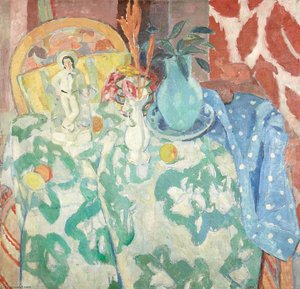
William George Gillies’ “Duddingston” isn't merely a depiction of a small Highland village; it’s a carefully constructed evocation of place, time, and the quiet dignity of rural life in 1929 Scotland. Painted against the backdrop of Holyrood Park, nestled beside the historic Duddingston Loch, this work captures a moment suspended between tradition and modernity, offering a poignant glimpse into a vanishing way of existence.

Gillies, a pivotal figure in Scottish art of the 20th century, masterfully employs a style that blends elements of Cubism with a distinctly Romantic sensibility. The composition is deliberately understated, eschewing dramatic diagonals or bold color clashes in favor of a harmonious balance achieved through careful arrangement and subtle tonal shifts. He’s not striving for photographic realism; instead, he's distilling the essence of Duddingston – its character, its atmosphere – into a series of carefully observed shapes and colors.
The painting’s strength lies in Gillies’ masterful manipulation of light and texture. He utilizes broken brushstrokes to create a sense of atmospheric depth, suggesting the hazy quality of a Scottish afternoon. The buildings are rendered with a rough, almost tactile quality, hinting at their weathered stone construction and the passage of time. Notice how he builds up layers of paint – thin washes layered over thicker impasto – to capture both the solidity of the structures and the fleeting effects of light on their surfaces. The muted palette—dominated by browns, greys, and ochres—grounds the scene in a sense of earthy realism.
Crucially, Gillies avoids sentimentality. There are no idealized figures or dramatic gestures; instead, he presents a straightforward portrayal of everyday life – villagers going about their business, a horse tethered to a post, a winding road leading into the distance. This restraint amplifies the painting’s quiet power, inviting the viewer to contemplate the simple beauty and enduring spirit of the place.
Gillies' artistic journey reveals fascinating influences. Following his studies in Paris with André Lhote, he was profoundly impacted by Paul Klee’s playful use of color and childlike imagination. This influence is particularly evident in “Duddingston,” where Gillies employs a similar approach to color – not for decorative effect, but as a means of conveying mood and atmosphere. However, unlike Klee's more overtly whimsical style, Gillies anchors his work firmly within the traditions of Scottish landscape painting, drawing inspiration from artists like Cézanne and the Romantic painters who preceded him.
The choice of Duddingston itself is significant. The village’s rich history – dating back to the 12th century – provides a powerful context for the painting. Situated adjacent to Holyrood Park, it's a place steeped in legend and tradition, offering a tangible link to Scotland’s past. The loch, with its ancient origins and association with monastic settlements, further enhances the sense of timelessness.
“Duddingston” is more than just a landscape painting; it's a testament to Gillies’ keen observational skills and his ability to capture the essence of a place. It stands as a poignant reminder of Scotland’s rural heritage, inviting us to appreciate the beauty of everyday life and the enduring power of memory. Reproductions of this work offer a valuable opportunity to bring this evocative scene into your home or office, allowing you to experience the quiet charm and understated elegance of Duddingston for years to come.


1898 - 1973 , United Kingdom
Plongez dans l'univers de Paul Cézanne avec les 25 œuvres incontournables du maître post-impressionniste. Découvrez l'histoire, la technique et l'émotion derrière ses tableaux iconiques comme 'Les Baigneuses' ou 'Mont Sainte-Victoire'. Reproductions d'art haute qualité sur Most-Famous-Paintings.com.

Plongez dans l'univers impressionniste de Claude Monet ! Découvrez les 25 œuvres les plus célèbres du maître, de 'Impression soleil levant' aux 'Nymphéas'. Inspirez votre décoration intérieure avec Most-Famous-Paintings.com et trouvez la reproduction parfaite.
Découvrez les 10 plus beaux paysages de l'histoire de l'art : Monet, Van Gogh et bien d'autres. Explorez leur technique unique et trouvez l'inspiration pour votre décoration intérieure avec Most-Famous-Paintings.com. Œuvres exceptionnelles à découvrir !
Immortalisez votre lieu de mariage avec un tableau personnalisé unique ! Découvrez notre expertise pour des œuvres d'art sur mesure, peintes par des artistes talentueux. Un cadeau inoubliable et une décoration élégante.

Plongez dans l'émotion du Romantisme avec les 10 plus beaux paysages de Friedrich, Turner & Delacroix. Découvrez leur histoire et trouvez l'inspiration déco idéale sur Most-Famous-Paintings.com !


Restez informé(e) des dernières actualités artistiques, des offres exclusives et des idées de décoration.
Parlez-nous de votre projet et nos experts en art vous proposeront 3 suggestions d'œuvres personnalisées.
Laissez-nous sélectionner 3 œuvres rien que pour vous – Gratuit !


 Partager

 Afficher la suite







 L'option verre n'est disponible que pour les dimensions inférieures à 110 cm.