x

Huile sur toile peinte à la main, avec cadre et dimensions personnalisés, réalisée sur commande par nos artistes. ( Acheter l'impression Acheter l'image)





























Choisissez parmi nos formats prédéfinis qui respectent les proportions originales de l’œuvre.

Vous pouvez saisir vos propres dimensions pour l'adapter à un cadre ou à un espace spécifique. Si la taille sélectionnée ne correspond pas aux proportions de l'image d'origine, nous recadrerons l'œuvre ou prolongerons la peinture avec des éléments peints à la main supplémentaires. Une maquette numérique vous sera envoyée pour approbation avant le début de la production.
Veuillez noter que l'aperçu à l'écran ne reflète pas le recadrage ou l'extension réels. Seule la maquette montrera fidèlement la composition finale.
Bien que des tailles personnalisées soient disponibles, nous vous recommandons de sélectionner une dimension dans la liste prédéfinie afin de préserver les proportions d'origine.
Livraison dans le monde entier () en 3 à 4 semaines au lieu des 5 semaines habituelles. (22 août). Aucun compromis sur la qualité.


Attam
Format de la reproduction
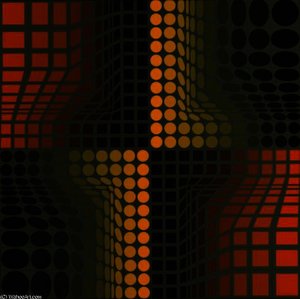
Victor Vasarely's "Attam" is more than just a painting; it’s an invitation into the very heart of perception, a testament to the revolutionary impact of Op Art and the burgeoning field of kinetic art. This mesmerizing work, dominated by a vibrant blue spiral interwoven with countless meticulously placed circles, embodies Vasarely’s lifelong pursuit of translating mathematical principles into visual experience. Born in 1906 in Pécs, Croatia – then part of Austria-Hungary – Vasarely's artistic trajectory began unexpectedly, initially driven by an interest in medicine before he was captivated by the possibilities of visual expression. His journey culminated in a profound engagement with geometric abstraction, fostered within the influential workshops of Sándor Bortnyik and deeply rooted in the philosophies of the Bauhaus movement.
“Attam” exemplifies Vasarely’s systematic approach to creating optical illusions. He meticulously constructed this composition using a technique he termed “static mobility,” aiming to evoke a sense of movement and depth through static forms. The spiraling structure, a recurring motif in his work, isn't merely decorative; it represents the fundamental principles of spiral growth found throughout nature – from galaxies to seashells. The circles, varying dramatically in size, are not randomly distributed but carefully calculated to create a dynamic interplay of light and shadow, manipulating the viewer’s eye and challenging their perception of space. This technique, born from his studies of functional design and influenced by the Bauhaus emphasis on clarity and order, sought to disrupt traditional notions of representation, instead focusing on the *experience* of seeing.
While Vasarely deliberately avoided explicit symbolism in his work, “Attam” resonates with themes of harmony, balance, and the underlying mathematical structures that govern our universe. The spiral itself is a potent symbol – representing eternity, growth, and the cyclical nature of existence. The precise arrangement of the circles suggests an attempt to impose order onto chaos, reflecting Vasarely’s belief in the power of geometry to reveal fundamental truths about reality. This pursuit of order isn't cold or sterile; rather, it generates a vibrant, almost pulsating energy within the artwork.
"Attam" stands as a pivotal work in the history of 20th-century art, solidifying Victor Vasarely’s position as a key figure in Op Art and kinetic art. His influence extends far beyond the canvas, impacting fields such as graphic design and architecture. A hand-painted reproduction of “Attam” offers an unparalleled opportunity to experience this groundbreaking artwork firsthand, bringing its captivating visual effects into your home or office. Its bold colors and dynamic composition make it a striking addition to any collection, while its historical significance ensures its enduring appeal.
Victor Vasarely (né Károly Vaszary) a été une figure essentielle dans le développement de l'Op Art et de l'art cinétique. Son œuvre cherchait à transcender la peinture traditionnelle en explorant les illusions d’optique et en créant des expériences visuelles dynamiques. Né à Pécs, alors faisant partie de la Hongrie-Autriche (aujourd'hui en Croatie), sa vie précoce a impliqué l'étude de la médecine à l'Université Eötvös Loránd à Budapest avant de se consacrer pleinement à l'art.
La contribution de Vasarely à l’histoire de l’art est multiple. Il a dépassé les techniques picturales traditionnelles pour créer des œuvres qui engagent activement la perception du spectateur. Son approche systématique a remis en question les notions conventionnelles de créativité artistique et a ouvert la voie à l'art généré par ordinateur et à la conception numérique. En embrassant la reproductibilité et les applications commerciales, Vasarely a brouillé les frontières entre les beaux-arts et la culture populaire, laissant une marque durable sur les deux.

1906 - 1997 , Croatie

Explore the science of Op Art through the lens of masters like Victor Vasarely. Discover how geometric abstraction uses optical illusions to create movement and delve into the neuroaesthetics of perception with our expert art history guide.

Explore the profound impact of Minimalism and Geometric Abstraction. From Mondrian to Malevich, discover how stripping art to its essential forms revolutionized modern aesthetics through our expert-led historical guide.

Master the complexities of Geometric Abstraction. Our expert guide explores the evolution from Cubist deconstruction to Bauhaus precision, decoding the power of shape and form. Perfect for art students seeking deep historical context and academic insight into modern masterpieces.


Restez informé(e) des dernières actualités artistiques, des offres exclusives et des idées de décoration.
Parlez-nous de votre projet et nos experts en art vous proposeront 3 suggestions d'œuvres personnalisées.
Laissez-nous sélectionner 3 œuvres rien que pour vous – Gratuit !


 Aperçu en situation
 Partager
 Partager
 Détails

 Télécharger l'image
 Articles similaires
 Radiographie
 Voir le diaporama

 Afficher la suite







 L'option verre n'est disponible que pour les dimensions inférieures à 110 cm.