


x
 Preview
 Commander la reproduction Acheter l'image haute résolution
 Partager
 Détails de l'œuvre
 Ajouter aux favoris
 Télécharger
 Articles similaires
 Radiographie
 Diaporama
Impression giclée ou sur toile de qualité musée, avec une production rapide et des finitions au choix.
Choisissez parmi nos formats prédéfinis qui respectent les proportions originales de l’œuvre.

Vous pouvez saisir vos propres dimensions pour vous adapter à un cadre ou à un espace spécifique. Si la taille sélectionnée ne correspond pas aux proportions de l'image originale, nous recadrerons l'œuvre ou étendrons l'image avec une bordure en miroir ou une couleur unie. Une maquette numérique vous sera envoyée pour approbation avant le début de la production.
Veuillez noter que l'aperçu à l'écran ne reflète pas le recadrage ou l'extension réelle. Seule la maquette montrera avec précision la composition finale.
Bien que des tailles personnalisées soient disponibles, nous vous recommandons de choisir une dimension dans la liste prédéfinie afin de préserver les proportions originales.
Livraison dans le monde entier () en 2 semaines au lieu des 4/5 semaines habituelles. (25 juillet)


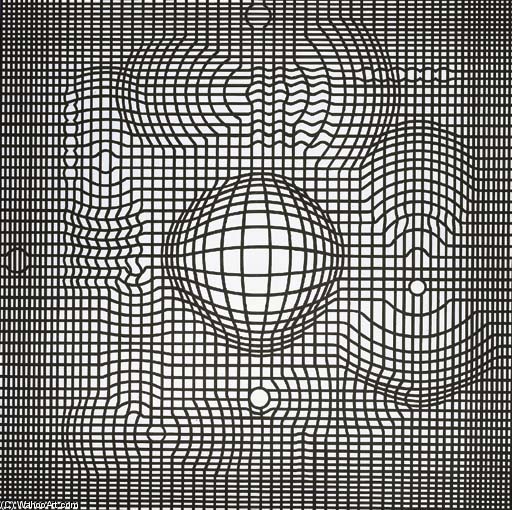
Jong
Format de reproduction
Victor Vasarely's 'Jong,' completed in 1968, is more than just an image; it’s an invitation to question the very nature of reality. This arresting work, a cornerstone of Op Art, immediately captivates with its seemingly impossible optical illusion – a distorted face emerging from a grid of meticulously crafted black and white lines, culminating in a central sphere that appears to both contain and disrupt the composition. Vasarely, born Károly Vaszary in 1906 in Pécs, Croatia, was a visionary who dedicated his life to exploring how our eyes perceive space and form. His journey began with an unexpected detour – initially pursuing medical studies before embracing the world of art in 1927 – a shift profoundly shaped by his education at the Podolini-Volkmann Academy and, crucially, Sándor Bortnyik’s ‘Műhely,’ where he absorbed the revolutionary ideas of the Bauhaus movement. This foundation laid the groundwork for his groundbreaking exploration of geometric abstraction, ultimately leading to the creation of 'Jong' – a testament to his mastery of visual deception.
'Jong’s' power lies in its masterful use of line. A dense grid of parallel lines forms the foundational structure, but these lines are deliberately warped, curved, and distorted – a technique central to Op Art. This manipulation creates an intense sense of movement and visual ambiguity, drawing the viewer into a complex interplay between perception and reality. The sphere at the heart of the composition acts as both a focal point and a destabilizing element, further amplifying the illusion. The stark monochrome palette—a deliberate choice by Vasarely—heightens the impact of this geometric play, stripping away any distractions and focusing solely on the dynamic relationship between form and space.
Beyond its purely visual effect, ‘Jong’ carries a potent symbolic weight. The distorted face, rendered through abstract distortions within the grid, can be interpreted as representing hidden identities or fragmented perceptions – themes frequently explored by Vasarely. The work suggests that what we see isn't necessarily a faithful reflection of reality but rather a subjective interpretation shaped by our own biases and experiences. This resonates with broader philosophical questions about identity, consciousness, and the nature of truth. The implied movement within the composition evokes a sense of dynamism and instability, mirroring the fluid and often contradictory aspects of human experience.
'Jong' is more than just an artwork; it’s a captivating exploration of perception itself. Its enduring appeal lies in its ability to challenge our assumptions about reality and invite us to reconsider how we see the world. Reproduced with meticulous attention to detail, this piece offers a unique opportunity to bring a touch of Op Art's dynamism and intellectual depth into any interior space – a conversation starter, a visual puzzle, and a testament to Victor Vasarely’s visionary genius.
Victor Vasarely (né Károly Vaszary) a été une figure essentielle dans le développement de l'Op Art et de l'art cinétique. Son œuvre cherchait à transcender la peinture traditionnelle en explorant les illusions d’optique et en créant des expériences visuelles dynamiques. Né à Pécs, alors faisant partie de la Hongrie-Autriche (aujourd'hui en Croatie), sa vie précoce a impliqué l'étude de la médecine à l'Université Eötvös Loránd à Budapest avant de se consacrer pleinement à l'art.
La contribution de Vasarely à l’histoire de l’art est multiple. Il a dépassé les techniques picturales traditionnelles pour créer des œuvres qui engagent activement la perception du spectateur. Son approche systématique a remis en question les notions conventionnelles de créativité artistique et a ouvert la voie à l'art généré par ordinateur et à la conception numérique. En embrassant la reproductibilité et les applications commerciales, Vasarely a brouillé les frontières entre les beaux-arts et la culture populaire, laissant une marque durable sur les deux.

1906 - 1997 , Croatie

Explore the revolutionary world of Victor Vasarely, father of Op Art. Discover his geometric masterpieces, artistic system, & lasting impact on modern design. A guide for discerning art collectors.

Plongez dans le monde serein du minimalisme avec notre sélection des 10 œuvres d'art les plus emblématiques. Découvrez l'histoire de Mondrian, Malevich et Rothko. Reproductions haute qualité sur Most-Famous-Paintings.com – Inspirez votre décoration intérieure !

Plongez dans l'univers fascinant des 10 plus beaux tableaux noirs de l'histoire de l'art. Découvrez les artistes célèbres, leurs techniques et le symbolisme puissant de ces chefs-d'œuvre intemporels. Inspirez votre décoration intérieure avec !
Plongez dans l'univers fascinant des 10 plus beaux tableaux dominés par le noir. Découvrez les histoires, techniques et symbolisme de chefs-d'œuvre intemporels. Reproductions d'art de qualité musée sur !

Plongez dans l'univers fascinant des 10 plus beaux tableaux blancs de l'histoire de l'art ! Découvrez Monet, Whistler, Kandinsky et d'autres maîtres. Inspirez votre décoration intérieure avec : reproductions de qualité muséale en ligne.


Restez informé(e) des dernières actualités artistiques, des offres exclusives et des idées de décoration.
Parlez-nous de votre projet et nos experts en art vous proposeront 3 suggestions d'œuvres personnalisées.
Laissez-nous sélectionner 3 œuvres rien que pour vous – Gratuit !


 Partager


 Afficher la suite




































 L'option verre n'est disponible que pour les dimensions inférieures à 110 cm.


