x

 Acrylic On CanvasWallArtOp Art
 1974Modern
 224.0 x 198.0 cm
 Musée des Beaux-Arts de Bilbao
Impressions giclées ou sur toile de qualité musée, avec une production rapide et des finitions au choix. ( Acheter la peinture faite à la main Acheter l'image)





























Choisissez parmi nos formats prédéfinis qui respectent les proportions originales de l’œuvre.

Vous pouvez saisir vos propres dimensions pour vous adapter à un cadre ou à un espace spécifique. Si la taille sélectionnée ne correspond pas aux proportions de l'image originale, nous recadrerons l'œuvre ou étendrons l'image avec une bordure en miroir ou une couleur unie. Une maquette numérique vous sera envoyée pour approbation avant le début de la production.
Veuillez noter que l'aperçu à l'écran ne reflète pas le recadrage ou l'extension réelle. Seule la maquette montrera avec précision la composition finale.
Bien que des tailles personnalisées soient disponibles, nous vous recommandons de choisir une dimension dans la liste prédéfinie afin de préserver les proportions originales.
Livraison dans le monde entier () en 2 semaines au lieu des 4/5 semaines habituelles. (22 août)


Pal-Ket
Format de la reproduction
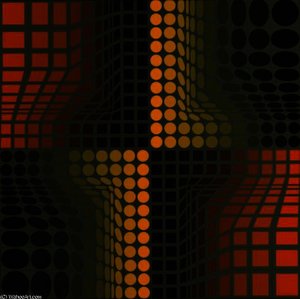
Victor Vasarely's Pal-Ket, painted in 1974, isn’t merely a visual experience; it’s an invitation to reconsider the very nature of perception. This vibrant acrylic on canvas piece, measuring a substantial 224 x 198 cm, embodies the core tenets of Op Art – a movement Vasarely essentially pioneered. Far from static representation, Pal-Ket actively engages with the viewer’s eye, creating an illusion of depth and movement that defies the limitations of a two-dimensional surface. The painting's genesis lies in Vasarely’s lifelong fascination with geometry and its ability to manipulate our visual senses, a pursuit rooted in his early training as a medical student before he decisively embraced the world of art.
The composition is deceptively simple at first glance: a predominantly circular arrangement dominated by an interplay of blues, greens, and purples. However, closer inspection reveals a meticulously constructed system of overlapping circles, each subtly varying in tone and intensity. This isn’t haphazard layering; Vasarely employed a sophisticated understanding of color theory and optical illusion to generate the impression of volume and spatial depth. The strategic use of gradients – transitioning smoothly from lighter to darker shades – further enhances this effect, mimicking the way light interacts with surfaces in the real world. The careful balance between solid forms and areas of transparency creates a dynamic tension that keeps the eye moving across the canvas, perpetually seeking new points of interest.
To truly appreciate Pal-Ket, it’s crucial to understand Vasarely's artistic lineage. His early training at Sándor Bortnyik’s Műhely – a school deeply influenced by the principles of the Bauhaus movement – provided him with a foundational understanding of functional design and geometric abstraction. The Bauhaus emphasized clarity, simplicity, and the integration of art into everyday life, values that profoundly shaped Vasarely's approach to painting. He wasn’t interested in replicating reality; instead, he sought to create visual experiences that challenged conventional notions of representation. This pursuit aligns perfectly with the core goals of Op Art – a movement characterized by its use of optical illusions and dynamic patterns to stimulate the viewer’s perception.
Vasarely's work extended beyond mere geometric abstraction. He was deeply interested in exploring the relationship between art, science, and technology. His paintings often evoke the imagery of futuristic cities and technological landscapes – a reflection of his belief that art could be used to shape our understanding of the world around us. The influence of kinetic art is also evident in Pal-Ket; the dynamic arrangement of shapes suggests a sense of movement and energy, as if the painting were constantly shifting and transforming before your eyes.
While Vasarely deliberately avoided overt symbolism in his work, Pal-Ket possesses a subtle emotional resonance. The vibrant colors evoke feelings of joy, optimism, and wonder – qualities that are often associated with the artist’s vision for a more harmonious and technologically advanced future. The circular forms themselves can be interpreted as symbols of unity, wholeness, and infinity. The painting's overall effect is one of playful experimentation and intellectual stimulation, inviting the viewer to engage in a dialogue with the artwork on both a visual and cognitive level.
Pal-Ket stands as a testament to Victor Vasarely’s pioneering spirit and his profound impact on the art world. It's more than just a beautiful painting; it’s an exploration of perception, a celebration of geometry, and a glimpse into a future shaped by technology and imagination. Reproductions of this captivating artwork offer a unique opportunity to bring this dynamic visual experience into your home or office – a vibrant reminder of the power of art to challenge our senses and expand our horizons.
Victor Vasarely (né Károly Vaszary) a été une figure essentielle dans le développement de l'Op Art et de l'art cinétique. Son œuvre cherchait à transcender la peinture traditionnelle en explorant les illusions d’optique et en créant des expériences visuelles dynamiques. Né à Pécs, alors faisant partie de la Hongrie-Autriche (aujourd'hui en Croatie), sa vie précoce a impliqué l'étude de la médecine à l'Université Eötvös Loránd à Budapest avant de se consacrer pleinement à l'art.
La contribution de Vasarely à l’histoire de l’art est multiple. Il a dépassé les techniques picturales traditionnelles pour créer des œuvres qui engagent activement la perception du spectateur. Son approche systématique a remis en question les notions conventionnelles de créativité artistique et a ouvert la voie à l'art généré par ordinateur et à la conception numérique. En embrassant la reproductibilité et les applications commerciales, Vasarely a brouillé les frontières entre les beaux-arts et la culture populaire, laissant une marque durable sur les deux.

1906 - 1997 , Croatie

Explore the science of Op Art through the lens of masters like Victor Vasarely. Discover how geometric abstraction uses optical illusions to create movement and delve into the neuroaesthetics of perception with our expert art history guide.

Explore the profound impact of Minimalism and Geometric Abstraction. From Mondrian to Malevich, discover how stripping art to its essential forms revolutionized modern aesthetics through our expert-led historical guide.

Master the complexities of Geometric Abstraction. Our expert guide explores the evolution from Cubist deconstruction to Bauhaus precision, decoding the power of shape and form. Perfect for art students seeking deep historical context and academic insight into modern masterpieces.


Restez informé(e) des dernières actualités artistiques, des offres exclusives et des idées de décoration.
Parlez-nous de votre projet et nos experts en art vous proposeront 3 suggestions d'œuvres personnalisées.
Laissez-nous sélectionner 3 œuvres rien que pour vous – Gratuit !


 Aperçu en situation
 Partager
 Partager
 Détails

 Télécharger l'image
 Articles similaires
 Radiographie
 Voir le diaporama
 Afficher la suite







 L'option verre n'est disponible que pour les dimensions inférieures à 110 cm.