x

Impressions giclées ou sur toile de qualité musée, avec une production rapide et des finitions au choix. ( Commander la reproduction peinte à la main Télécharger l'image haute résolution)





























Choisissez parmi nos formats prédéfinis qui respectent les proportions originales de l’œuvre.

Vous pouvez saisir vos propres dimensions pour vous adapter à un cadre ou à un espace spécifique. Si la taille sélectionnée ne correspond pas aux proportions de l'image originale, nous recadrerons l'œuvre ou étendrons l'image avec une bordure en miroir ou une couleur unie. Une maquette numérique vous sera envoyée pour approbation avant le début de la production.
Veuillez noter que l'aperçu à l'écran ne reflète pas le recadrage ou l'extension réelle. Seule la maquette montrera avec précision la composition finale.
Bien que des tailles personnalisées soient disponibles, nous vous recommandons de choisir une dimension dans la liste prédéfinie afin de préserver les proportions originales.
Livraison dans le monde entier () en 2 semaines au lieu des 4/5 semaines habituelles. (21 août)


Terz
Format de la reproduction
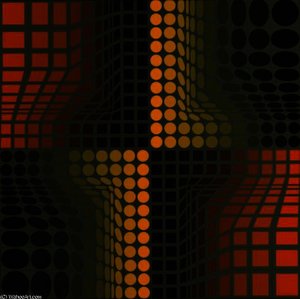
Victor Vasarely's "Terz" is more than just a painting; it’s an invitation into the very fabric of perception, a testament to the revolutionary impact of Op Art and the burgeoning fascination with geometric abstraction in the mid-20th century. This captivating work, rendered in a striking interplay of blue and white, immediately draws the viewer into its meticulously constructed world – a miniature universe contained within a seemingly simple arrangement of squares.
Born Károly Vaszary in 1906 in Pécs, Croatia (then part of Austria-Hungary), Vasarely’s artistic trajectory was initially rooted in the scientific. His early studies in medicine at Eötvös Loránd University hinted at a logical, analytical mind – a perspective that would later become central to his groundbreaking approach to art. However, abandoning the path of healing for painting in 1927 marked a profound shift, fueled by an intense desire to explore how the eye perceives and interprets visual information. This pursuit led him to the influential Podolini-Volkmann Academy and, crucially, Sándor Bortnyik’s “Műhely” workshop, where he absorbed the principles of functional design and geometric abstraction championed by the Bauhaus movement – a movement that prioritized clarity, functionality, and an understanding of optical illusions.
"Terz" exemplifies the core tenets of Op Art, a style pioneered by Vasarely and his contemporaries. This artistic movement sought to create optical illusions through precise arrangements of color and shape, manipulating the viewer’s perception of depth, movement, and space. The painting's seemingly static composition is anything but; the carefully calibrated squares generate an illusion of continuous motion, drawing the eye across the canvas in a mesmerizing dance. Vasarely wasn't simply depicting shapes; he was actively engaging with the science of visual perception, demonstrating how our brains construct reality based on sensory input.
The execution of "Terz" is characterized by an almost obsessive attention to detail. The numerous small squares are arranged in a circular fashion, creating a sense of continuity and echoing the principles of modular design. This deliberate construction isn't haphazard; it’s a carefully calculated harmony – a visual equation designed to exploit the brain’s natural tendency to seek patterns and order. Vasarely’s mastery lies in his ability to harness this inherent human response, transforming a simple geometric arrangement into a powerfully evocative image. The use of contrasting colors further amplifies the illusion, enhancing the sense of depth and movement.
"Terz," like much of Vasarely’s work, transcends mere visual representation to explore fundamental questions about reality itself. The geometric forms can be interpreted as representing the building blocks of the universe – a reflection of Vasarely's fascination with mathematics, physics, and the underlying order of existence. The painting evokes a sense of calm contemplation, inviting viewers to lose themselves in its intricate patterns and contemplate the nature of perception. It’s a piece that rewards repeated viewing, revealing new nuances and complexities with each encounter.
Victor Vasarely (né Károly Vaszary) a été une figure essentielle dans le développement de l'Op Art et de l'art cinétique. Son œuvre cherchait à transcender la peinture traditionnelle en explorant les illusions d’optique et en créant des expériences visuelles dynamiques. Né à Pécs, alors faisant partie de la Hongrie-Autriche (aujourd'hui en Croatie), sa vie précoce a impliqué l'étude de la médecine à l'Université Eötvös Loránd à Budapest avant de se consacrer pleinement à l'art.
La contribution de Vasarely à l’histoire de l’art est multiple. Il a dépassé les techniques picturales traditionnelles pour créer des œuvres qui engagent activement la perception du spectateur. Son approche systématique a remis en question les notions conventionnelles de créativité artistique et a ouvert la voie à l'art généré par ordinateur et à la conception numérique. En embrassant la reproductibilité et les applications commerciales, Vasarely a brouillé les frontières entre les beaux-arts et la culture populaire, laissant une marque durable sur les deux.

1906 - 1997 , Croatie

Explore the science of Op Art through the lens of masters like Victor Vasarely. Discover how geometric abstraction uses optical illusions to create movement and delve into the neuroaesthetics of perception with our expert art history guide.

Explore the profound impact of Minimalism and Geometric Abstraction. From Mondrian to Malevich, discover how stripping art to its essential forms revolutionized modern aesthetics through our expert-led historical guide.


Restez informé(e) des dernières actualités artistiques, des offres exclusives et des idées de décoration.
Parlez-nous de votre projet et nos experts en art vous proposeront 3 suggestions d'œuvres personnalisées.
Laissez-nous sélectionner 3 œuvres rien que pour vous – Gratuit !


 Aperçu en situation
 Envoyer
 Partager
 Détails de l'œuvre

 Télécharger
 Articles similaires
 Radiographie
 Diaporama

 Lire la suite







 L'option verre n'est disponible que pour les dimensions inférieures à 110 cm.