Biografija umjetnika
Wassily Kandinsky: Pioneer of Abstraction
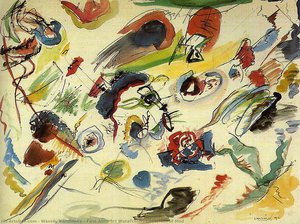
Wassily Wassilyevich Kandinsky (16 December 1866 – 13 December 1944) stands as a monumental figure in the history of art, widely recognized as one of the very first to truly break free from representational painting and forge a path towards pure abstraction. Born in Moscow, Russia, his artistic journey was marked by a profound intellectual curiosity and a relentless pursuit of expressing inner emotions through color and form – a quest that ultimately revolutionized how we perceive and understand art itself. Initially trained as a lawyer and economist, Kandinsky’s late embrace of painting—at the age of 30—proved to be transformative, setting in motion a career dedicated to exploring the spiritual potential of visual language. His early works, influenced by Russian Symbolism and Impressionism, gradually shifted towards increasingly non-objective compositions, culminating in his groundbreaking abstract paintings of the early 20th century. Kandinsky’s life was deeply intertwined with intellectual currents; he engaged with philosophy, music theory (he famously described painting as “the equivalent of musical notes”), and spirituality, all of which profoundly shaped his artistic vision. He wasn't simply discarding representation; he was seeking a new form of communication—one that bypassed the limitations of the visible world to tap into deeper realms of feeling and experience.
Early Life and Artistic Development
Kandinsky’s childhood, marked by illness and a somewhat solitary existence, instilled in him a deep appreciation for introspection and a sensitivity to color and light. He studied at the Moscow School of Painting, Sculpture and Architecture, where he initially focused on traditional academic techniques. However, his artistic interests soon expanded beyond mere technical proficiency. He traveled extensively throughout Europe during his youth, absorbing influences from diverse cultures – particularly Byzantine mosaics, Japanese prints, and Islamic art—all of which contributed to a growing fascination with patterns, symbolism, and the expressive power of visual elements. A pivotal moment occurred when he encountered the works of Vincent van Gogh, whose vibrant colors and emotional intensity deeply resonated with him. Following his marriage to Anna Schmidt in 1898, Kandinsky began experimenting with artistic expression, producing drawings and watercolors that hinted at his future abstract direction. He continued his studies, eventually earning a degree in law but simultaneously pursuing his artistic ambitions. It was during this period that he developed his own unique theory of color, believing that each hue possessed inherent emotional qualities.
The Blue Rider Group and Early Abstraction
Around 1901, Kandinsky’s artistic trajectory took a decisive turn when he moved to Munich, Germany, where he became involved with the *Blue Rider* (Die Brücke) group—a collective of avant-garde artists seeking to challenge conventional artistic norms. However, he soon found himself drawn to a more radical movement: *Der Blaue Reiter* ("The Blue Rider"), led by Vasily Rubinstein and Franz Marc. This group embraced symbolism and spirituality in their art, exploring themes of color, light, and the inner world. Kandinsky’s work during this period—including paintings like “Composition VII” (1913) and “Improvisation 28” (1912)—began to incorporate increasingly abstract forms and colors, moving away from recognizable imagery. He experimented with layering shapes and hues, creating dynamic compositions that evoked a sense of movement and emotional intensity. His artistic explorations were further influenced by his growing interest in music—he believed that painting could be understood as a form of musical expression, with color acting as the equivalent of notes.
Theoretical Writings and the Search for Spiritual Art
Kandinsky’s artistic development was inextricably linked to his theoretical writings. In 1911, he published *Concerning the Spiritual in Art*, a seminal work that outlined his philosophy of abstract art. He argued that art should transcend mere representation and strive to express inner spiritual realities—a concept he termed “spiritual art.” He believed that colors possessed inherent symbolic meanings and could evoke specific emotions and sensations. Kandinsky distinguished between different types of abstraction, ranging from simple geometric forms to complex compositions that aimed to create a total artistic experience. He saw the potential for abstract art to communicate directly with the viewer’s soul, bypassing the intellect altogether. His writings were not merely theoretical exercises; they served as a guide for his own artistic practice, shaping his approach to composition and color throughout his career.
Later Years and Legacy
Following the Russian Revolution in 1917, Kandinsky became involved in the cultural administration of the new Soviet government, helping to establish museums and art schools. However, he found himself increasingly disillusioned with the political climate and, by 1921, returned to Germany. He taught at the Bauhaus school from 1922 until its closure in 1933 due to Nazi persecution. During his time in France after World War II, Kandinsky continued to paint, exploring new approaches to abstraction while retaining a deep connection to his earlier theoretical ideas. Wassily Kandinsky died in Neuilly-sur-Seine, France, in 1944. His legacy is immense and enduring. He is considered one of the founding fathers of abstract art, profoundly influencing generations of artists—including Piet Mondrian, Kazimir Malevich, and countless others—who followed in his footsteps. His work continues to inspire and challenge viewers today, reminding us of the transformative power of art to transcend the limitations of the visible world and tap into the realm of human emotion and spirituality.



 Cement
 1984
1984 5.0 x 70.0 cm
 Design Museum of Barcelona
 Kupi print






 Pošalji
 Podijeli
 Detalji o umjetničkom djelu

 Preuzmi
 Slični predmeti
 Automatska prezentacija
 Prikaži više