x

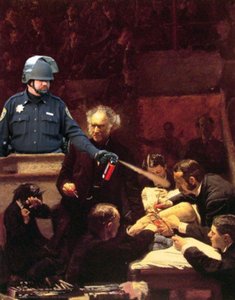
 Contemporary Realism
 2010
2010 457.0 x 335.0 cm
Giclée tisak muzejske kvalitete ili otisak na platnu uz brzu proizvodnju i fleksibilne opcije završne obrade. ( Kupi ručno naslikanu sliku Kupi digitalnu sliku)
Odaberite jednu od naših unaprijed definiranih veličina koje odgovaraju izvornim proporcijama umjetničkog djela.

Možete unijeti vlastite dimenzije kako biste umjetničko djelo prilagodili specifičnom okviru ili prostoru. Ako odabrana veličina ne odgovara proporcijama izvornog rada, izrezat ćemo dio slike ili je proširiti pomoću ogledalnog efekta ili jednobojne rubne površine. Digitalni prikaz (mockup) bit će vam poslan na odobrenje prije početka proizvodnje.
Imajte na umu da pregled na zaslonu ne odražava stvarno izrezivanje ili proširivanje. Samo će mockup točno prikazati konačnu kompoziciju.
Iako su dostupne prilagođene veličine, preporučujemo odabir dimenzije iz unaprijed definirane liste kako biste očuvali izvorne proporcije.
Dostava širom svijeta () u roku od 2 tjedna umjesto standardnih 4/5 tjedana. (15 Kolovoz)


The Path
Veličina reprodukcije

To encounter the work of Enrique Martínez Celaya is to step into a space where the boundaries between the empirical and the ethereal dissolve. Born in Havana, Cuba, in 1964, his life has been a series of profound migrations—not merely across geographic borders from Cuba to Spain and Puerto Rico, but across disciplines. Before he was an acclaimed painter and sculptor, Celaya was a man of science, a trained laser physicist who navigated the rigorous, mathematical certainties of Cornell University and the University of California, Berkeley. This scientific foundation remains an invisible architecture within his art; there is a precision in his compositions that suggests the structural integrity of the physical universe, even when he is exploring the most nebulous territories of human emotion.
His creative evolution is a testament to the tension between logic and lyricism. While his early years were marked by the discipline of physics—even patenting several laser devices—the pull of narrative and figurative painting proved irresistible. This transition was not a rejection of science, but rather an expansion of it. In his canvases, the "big gears of nature" meet the "small gears of human experience." He utilizes a technique that often marries meticulous observation with expressive, tactile layers, frequently employing oil, wax, and charcoal to create surfaces that feel as much like geological strata as they do emotional landscapes. His work does not merely depict a scene; it excavates it, pulling themes of memory, exile, and the passage of time from beneath the surface of the pigment.
The imagery in Celaya’s oeuvre often evokes vast, desolate terrains that serve as metaphors for the internal state. His landscapes are rarely just topographical studies; they are psychological maps. Through expansive vistas and symbolic motifs, he explores the exilic imagination—the sense of displacement and the search for authenticity that characterizes much of his work. There is a haunting quality to his compositions, where a single figure or an isolated object might stand against a sweeping sky, embodying the profound solitude of individual consciousness. He approaches themes of loss and attachment not by offering easy resolutions, but by posing existential questions that resonate with a universal vulnerability.
This mastery of symbolism allows him to bridge the gap between the semi-autobiographical and the mythic. In works such as The Puppet or The Fiery Wound, the viewer is invited to contemplate the fragility of existence. His use of color is equally evocative, often employing palettes that feel both ancient and immediate, grounding his philosophical inquiries in a visceral, sensory reality. By blending the precision of his scientific training with the fluidity of contemporary painting, he creates an immersive experience where the viewer is encouraged to linger in the ambiguity of the unknown.
The significance of Enrique Martínez Celaya’s contribution to contemporary art lies in his ability to resist the fragmentation of modern disciplines. He remains a polymath, working seamlessly across painting, sculpture, installation, and even literature as an accomplished author of nine books. His work has achieved immense institutional recognition, finding permanent homes in some of the world's most prestigious collections, including:
As a scholar and educator—serving as the first Provost Professor of Humanities and Arts at the University of Southern California—his influence extends far beyond the studio. He continues to shape the discourse on how art can serve as a vessel for philosophical inquiry, proving that the most profound truths are often found in the delicate intersection of what we can measure and what we can only feel.

1964 - , Cuba


Budite u tijeku s najnovijim umjetničkim vijestima, ekskluzivnim ponudama i idejama za dekoraciju.
Recite nam nešto o svom projektu, a naši će stručnjaci za umjetnost pripremiti 3 personalizirana prijedloga umjetnina.
Dopustite nam da odaberemo 3 opcije samo za Vas – Besplatno!


 Pregledaj u stvarnoj veličini
 Pošalji
 Podijeli
 Detalji o umjetničkom djelu

 Preuzmi
 Slični predmeti
 Rentgenska snimka
 Automatska prezentacija
 Prikaži više




































 Opcija stakla dostupna je samo za dimenzije manje od 110 cm