


x

Ručno oslikano uljanim bojama na platnu u dimenzijama i okviru po vašem izboru, izrađeno po narudžbi od strane naših umjetnika. ( Switch to Print Switch to Image)





























Odaberite jednu od naših unaprijed definiranih veličina koje odgovaraju izvornim proporcijama umjetničkog djela.

Možete unijeti vlastite dimenzije kako bi odgovarale određenom okviru ili prostoru. Ako odabrana veličina ne odgovara proporcijama izvorne slike, izrezat ćemo umjetničko djelo ili proširiti sliku dodatnim ručno oslikanim elementima. Digitalni nacrt bit će vam poslan na odobrenje prije početka proizvodnje.
Imajte na umu da pregled na ekranu ne prikazuje stvarno izrezivanje ili proširivanje. Samo će nacrt točno prikazati konačni sastav.
Iako su dostupne prilagođene veličine, preporučujemo odabir dimenzije s preddefiniranog popisa kako bismo očuvali izvorne proporcije.
Isporuka širom svijeta () u roku od 3-4 tjedna umjesto standardnih 5 tjedana. (30 Srpanj). Bez kompromisa u kvaliteti.


Globe
Veličina reprodukcije
Victor Vasarely's "Globe" is more than just a painting; it’s an invitation into the heart of Op Art, a visual exploration of perception and movement that defined a generation. This vibrant composition, dominated by concentric circles of luminous yellow and orange, immediately draws the eye inward, creating a mesmerizing depth that seems to defy the two-dimensional surface. The artwork's genesis lies in Vasarely’s pioneering work with kinetic art and his deep engagement with geometric abstraction – principles he honed during his formative years at the Bauhaus-influenced Műhely workshop.
Born in 1906 in Pécs, Croatia, Vasarely’s artistic trajectory began unexpectedly. Initially pursuing a medical degree, he abandoned this path to embrace the burgeoning world of visual expression, ultimately becoming a key figure in the development of Op Art – Optical Art. This movement, flourishing in the mid-20th century, sought to stimulate optical illusions through precise geometric forms. Vasarely’s approach was revolutionary; he meticulously constructed his paintings using static elements—circles, lines, and squares—to create dynamic visual effects that appeared to shift and move before the viewer's eyes. “Globe” exemplifies this technique perfectly, demonstrating how seemingly simple shapes can generate complex optical experiences.
The execution of "Globe" reveals Vasarely’s mastery of color theory and his deliberate manipulation of visual perception. The use of contrasting yellows and oranges isn't merely decorative; it’s a calculated strategy to heighten the illusion of movement and depth. Each circle is rendered with painstaking precision, creating a series of overlapping planes that trick the eye into perceiving three-dimensional space. Vasarely’s technique involved layering thin washes of paint, allowing each color to subtly interact with its neighbors, further enhancing the artwork's dynamic quality. The meticulous detail suggests a dedication to scientific observation and an understanding of how the human visual system processes information.
"Globe" can be interpreted as a representation of the universe itself – a microcosm reflecting the vastness and complexity of space. The concentric circles evoke notions of orbits, cycles, and interconnectedness, mirroring Vasarely’s fascination with mathematical principles and their application to art. Beyond its symbolic resonance, the artwork possesses a powerful emotional impact. Its vibrant colors and dynamic composition generate a sense of excitement, wonder, and perhaps even a slight disorientation – a testament to Op Art's ability to challenge our perceptions and stimulate our senses. This piece is not simply observed; it’s experienced.

1906 - 1997 , Hrvatska
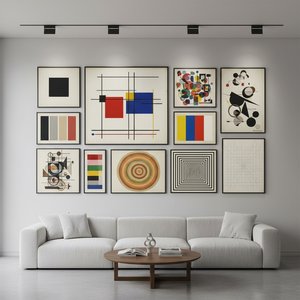
Istražite 10 remek-djela geometrijske apstrakcije! Otkrijte priče Kandinskog, Mondriana i drugih majstora. Inspirirajte se za svoj interijer s vrhunskim reprodukcijama slika na Most-Famous-Paintings.com

Explore the revolutionary world of Victor Vasarely, father of Op Art. Discover his geometric masterpieces, artistic system, & lasting impact on modern design. A guide for discerning art collectors.

Explore Orphism, the vibrant abstract art movement pioneered by Robert & Sonia Delaunay. Discover its unique color theory, lasting influence on modern art, and how to bring this 'symphony of color' into your home with Most-Famous-Paintings.

Explore the fascinating relationship between color & emotion in art history. Discover how master artists like Matisse & Gauguin used vibrant hues to evoke feelings and cultural meanings. A deep dive for classic art enthusiasts.

Explore the enduring legacy of geometric abstraction! Discover key artists, historical movements & investment insights for discerning art collectors. Expert guidance from Most-Famous-Paintings.


Budite u tijeku s najnovijim umjetničkim vijestima, ekskluzivnim ponudama i idejama za dekoraciju.
Recite nam nešto o svom projektu, a naši će stručnjaci za umjetnost pripremiti 3 personalizirana prijedloga umjetnina.
Dopustite nam da odaberemo 3 opcije samo za Vas – Besplatno!


 Preview
 Pošalji
 Podijeli
 Detalji o umjetničkom djelu

 Preuzmi
 Slični predmeti
 Rentgenska snimka
 Automatska prezentacija

 Prikaži više







 Opcija stakla dostupna je samo za dimenzije manje od 110 cm


