x

Múzeumi minőségű giclée vagy vászonnyomat, gyors gyártással és rugalmas finomítási lehetőségekkel. ( Kézzel festett másolat rendelése Kép letöltése)





























Válasszon előre meghatározott méreteink közül, amelyek megfelelnek a műalkotás eredeti arányainak.

Megadhat saját méreteket is egy konkrét kerethez vagy helyszínhez igazítva. Amennyiben a kiválasztott méret nem egyezik az eredeti kép arányokkal, a műalkotást le fogjuk vágni, vagy kiegészítjük a képet tükrözött vagy egyszínű szélekkel. A gyártás megkezdése előtt egy digitális tervezetet küldünk jóváhagyásra.
Kérjük, vegye figyelembe, hogy a képernyőn látható előnézet nem tükrözi a tényleges levágást vagy kiegészítést. Csak a tervezet mutatja pontosan a végső kompozíciót.
Bár az egyedi méretek is elérhetőek, az eredeti arányok megőrzése érdekében azt javasoljuk, hogy válasszon a előre meghatározott listából származó méretet.
Világszerte történő kiszállítás területére mindössze 2 hét alatt, a szokásos 4-5 hét helyett. (16 augusztus)


Özportré
Reprodukció mérete
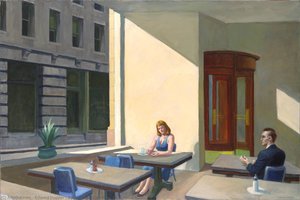
Edward Hopper's "Self Portrait," painted between 1925 and 1930, isn't merely a depiction of an artist; it’s a profound meditation on isolation, introspection, and the quiet dignity of the individual within the bustling landscape of early 20th-century America. This relatively unassuming work, rendered in oil on canvas, holds a remarkable power—a palpable sense of melancholy that resonates even today. Hopper, already establishing his signature style characterized by stark lighting, ambiguous spaces, and figures caught in moments of solitary contemplation, used this self-portrait not as a vanity piece, but as a crucial exploration of his own artistic identity.
The painting itself is deceptively simple. Hopper presents himself in a modestly furnished room, bathed in the diffused light of an unseen window. He’s dressed in a dark suit and tie, a formal attire that subtly contrasts with the relaxed posture of his hands resting on a table. The composition draws immediate attention to his face—a serious, almost melancholic expression etched upon it. There's a certain vulnerability there, a hint of weariness that speaks volumes about the challenges inherent in pursuing an artistic life. The muted palette – predominantly browns, blues, and greys – reinforces this mood, creating a sense of stillness and quietude. Hopper masterfully employs light and shadow to sculpt the form, emphasizing the planes of his face and clothing, lending a sculptural quality to the portrait.
To understand “Self Portrait,” it’s essential to consider the historical context in which it was created. The 1920s and 30s were a period of rapid social and economic change in America—the rise of industrialization, urbanization, and a growing sense of alienation. Hopper's work perfectly captures this feeling of displacement and loneliness that permeated modern life. Unlike the romanticized depictions of American heroism prevalent at the time, Hopper presented a more realistic, often unsettling view of everyday existence. His subjects are frequently alone, lost in thought, disconnected from their surroundings—a reflection of the psychological landscape of the era.
The painting’s influence extends beyond its immediate depiction of Hopper himself. It embodies the core themes that would define his entire career: urban solitude, the beauty of ordinary moments, and a subtle critique of American materialism. Hopper wasn't interested in grand narratives or dramatic events; he focused on capturing the quiet dramas unfolding within the lives of ordinary people—a strategy that continues to resonate with viewers today.
Hopper’s technique is characterized by a remarkable restraint. He avoids excessive detail, opting instead for carefully considered brushstrokes and a limited color palette. This deliberate simplicity allows the viewer's eye to linger on key elements—particularly the face—and to absorb the emotional weight of the scene. The use of chiaroscuro – the dramatic contrast between light and dark – is particularly effective in creating a sense of depth and atmosphere. The placement of the figure within the room, slightly off-center, further contributes to the feeling of unease and isolation.
Interestingly, some art historians suggest that the painting’s symbolism goes beyond mere self-representation. The table and chair, for instance, could be interpreted as symbols of artistic creation—a space where ideas are formulated and brought to life. The muted colors might represent the artist's own internal struggles and anxieties. While Hopper himself remained famously private about his intentions, “Self Portrait” undeniably offers a window into the complex inner world of one of America’s most iconic artists.
Most-Famous-Paintings is proud to offer meticulously crafted hand-painted reproductions of Edward Hopper's "Self Portrait." These aren't simply prints; they are faithful recreations, capturing the artist’s nuanced use of light, color, and composition. Whether you’re an art enthusiast, a collector, or seeking a unique piece for your interior design, our reproduction provides a stunning way to experience the enduring power of this remarkable work. It's a chance to bring Hopper’s solitary echoes into your own space, inviting contemplation and sparking conversation.


1931 - 1967 , Egyesült Államok

Explore the profound history of American Regionalism. Discover how Grant Wood captured the heart of the Midwest through masterpieces like American Gothic. An expert guide to the movement, its cultural impact, and the enduring beauty of American Realism.


Maradjon naprakész a legfrissebb művészeti hírekkel, exkluzív ajánlatokkal és dekorációs ötletekkel.
Írja le nekünk projektjét, és művészeti szakértőink 3 személyre szabott műalkotási javaslatot készítenek Önnek.
Hagyjuk, hogy mi válogassunk ki Önnek 3 legjobb opciót – Ingyenesen!


 Megtekintés
 Küldés
 Megosztás
 Részletek

 Letöltés
 Hasonló darabok
 X-ray felvétel
 Diavetítés
 Összes részlet megjelenítése







 Az üvegkeretes opció csak 110 cm alatti méretben érhető el