Kedvencek listája Kosár tartalma Cart
x
MegtekintésMegtekintés Műalkotás AR előnézeteMűalkotás AR előnézete Kézzel festett másolat rendelése Kézzel festett másolat rendeléseKép letöltése Kép letöltése KüldésKüldés
RészletekRészletek Kedvencekhez ad Kedvencekhez ad LetöltésLetöltés Hasonló darabokHasonló darabok X-ray felvételX-ray felvétel DiavetítésDiavetítés

Rooftops

Edward Hopper's 'Saltillo Rooftops' captures the quiet solitude of a small Mexican village. Explore the painting’s evocative light, architectural details, and subtle sense of isolation – a timeless masterpiece.

Edward Hopper: amerikai realizmus mestere, a magány és az urbán élet évtizedeihez illő fényekkel és árnyakkal. Nighthawks, Monhegan Houses ikonikus festményei!

Giclée / Műnyomat

Múzeumi minőségű giclée vagy vászonnyomat, gyors gyártással és rugalmas finomítási lehetőségekkel. (Kézzel festett másolat rendelése Kézzel festett másolat rendeléseKép letöltése Kép letöltése)

P118B $10
P118H $10
P118W $10
P438Z $10
P508JH $12
P508YH $12
P805H $10
P805Z $10
P919BZ $10
P919G $10
P919XJ $10
P959ZH $10
P968JZ $12
W106C $8
W218G $10
W218JH $8
W218Y $10
W307PJ $10
W316G $10
W316PJ $8
W316Y $10
W398PJ $8
W4111J $10
W500HY $15
W500JH $15
W692G $12
W849H $8
W940BG $15
W953PJ $8

Standard
custom
CM
INCH

Válasszon előre meghatározott méreteink közül, amelyek megfelelnek a műalkotás eredeti arányainak.

szélesség
magasság

Megadhat saját méreteket is egy konkrét kerethez vagy helyszínhez igazítva. Amennyiben a kiválasztott méret nem egyezik az eredeti kép arányokkal, a műalkotást le fogjuk vágni, vagy kiegészítjük a képet tükrözött vagy egyszínű szélekkel. A gyártás megkezdése előtt egy digitális tervezetet küldünk jóváhagyásra.
Kérjük, vegye figyelembe, hogy a képernyőn látható előnézet nem tükrözi a tényleges levágást vagy kiegészítést. Csak a tervezet mutatja pontosan a végső kompozíciót.
Bár az egyedi méretek is elérhetőek, az eredeti arányok megőrzése érdekében azt javasoljuk, hogy válasszon a előre meghatározott listából származó méretet.

Világszerte történő kiszállítás területére mindössze 2 hét alatt, a szokásos 4-5 hét helyett. (24 augusztus)

why_choose_icon
Ingyenes globális expressz szállítás
why_choose_icon
Prémium minőségű len vászon
why_choose_icon
Teljes körű szállítási biztosítás
why_choose_icon
Vámvisszatérítési Garancia
why_choose_icon
Hiteles színpontosság garancia
why_choose_icon
60 napos visszaküldési lehetőség (csak hibás termékek esetén)
why_choose_icon
100% pénzvisszatérítési garancia
why_choose_icon
Több darab vásárlása esetén kedvezmény

Összesített ár

$ 68

reproduction

Rooftops

Giclée / Műnyomat

Reprodukció mérete

-

Összesített ár

$ 68

Gyors információk

  • Location: Private Collection
  • Influences:
    • William Merritt Chase
    • Robert Henri
  • Artistic style: Quiet observation; Subtle melancholy
  • Medium: Watercolor
  • Subject or theme: Urban landscape; Domestic solitude
  • Title: Rooftops

Művészeti kvíz

Minden kérdésre csak egy helyes válasz létezik.

Kérdés 1:
What artistic movement is Edward Hopper’s ‘Rooftops’ primarily associated with?
Kérdés 2:
The painting depicts a cityscape featuring what prominent architectural element?
Kérdés 3:
What is the predominant mood conveyed by Hopper’s use of light and shadow in ‘Rooftops’?
Kérdés 4:
The image includes a large tank on top of one building. What is the likely purpose of this element in the composition?
Kérdés 5:
Edward Hopper’s style is characterized by capturing the world with precision, focusing on detailed observation. Which artistic technique best exemplifies this approach?

Gyűjthető leírása

A Symphony of Solitude: The Quiet Urbanism of Edward Hopper’s Rooftops

In the vast landscape of American Realism, few artists possess the ability to transform the mundane into the monumental quite like Edward Hopper. His work Rooftops, a delicate watercolor dating from approximately 1924, serves as a profound meditation on the architecture of isolation. Rather than capturing the frenetic energy often associated with the Jazz Age, Hopper invites us into a moment of suspended animation. The scene is a meticulously observed cityscape, where terracotta rooftops and prominent brick chimneys rise against an indifferent sky. There is a cinematic stillness here, a sense that if one were to hold their breath, the entire urban landscape might remain frozen in this state of melancholic grace forever.

The technical mastery of this piece lies in Hopper’s ability to manipulate the fluid nature of watercolor to achieve a structured, almost architectural precision. He employs a restrained and somber palette, dominated by muted browns, grays, and the warm, earthy tones of weathered brick. Through delicate washes and subtle tonal variations, he sculpts the textures of the urban environment, allowing light to play across the surfaces of chimneys and water tanks. The sky, rendered in an overcast, diffused light, casts a soft glow that avoids harsh shadows, instead creating a pervasive atmosphere of quietude. This mastery of light and shadow—the very hallmark of his style—transforms a simple view of rooftops into a complex study of depth and atmospheric tension.

Symbolism and the Modern Condition

Beyond its aesthetic beauty, Rooftops functions as a visual metaphor for the complexities of modern existence. Created during an era of rapid industrialization and social upheaval, the painting captures the growing sense of detachment that accompanied the rise of the American metropolis. The placement of the buildings, particularly the structure featuring a large, imposing tank, creates a subtle visual tension, suggesting a world composed of separate, disconnected entities. Even the small, often overlooked details, such as the presence of fire hydrants, serve as poignant reminders of human vulnerability and the fragile resilience required to inhabit such vast, impersonal spaces.

For the discerning collector or interior designer, this artwork offers more than mere decoration; it provides an emotional anchor. The painting does not depict loneliness as a tragedy, but rather as a fundamental, even beautiful, state of being. It is a piece that commands attention through its subtlety, making it an ideal centerpiece for spaces designed for contemplation and quiet sophistication. Whether placed in a contemporary gallery setting or a classic study, Rooftops brings with it a sense of historical weight and a timeless, haunting elegance that continues to resonate with the modern soul.


A művész életrajza

A Solitude Observed: The Life and Art of Edward Hopper

Edward Hopper, a name inextricably linked to the quietude and subtle melancholy that permeated 20th-century American life, wasn’t simply a painter of scenes; he was a poet of light and shadow, a chronicler of modern isolation. Born in Nyack, New York, in 1882, to middle-class parents of Dutch ancestry, Hopper's early years provided a stable upbringing that nurtured his artistic inclinations. From childhood sketches meticulously dated and signed, it became evident that keen observation and an innate talent for drawing were central to his being. Though initially encouraged towards commercial illustration – a pragmatic suggestion from his parents – Hopper’s ambitions leaned toward fine art, leading him to the New York School of Art where he studied under William Merritt Chase and Robert Henri. These formative years instilled not only technical skill but also an appreciation for realism and a commitment to depicting the world as he saw it—unvarnished and honest. The writings of Ralph Waldo Emerson resonated deeply with Hopper, reinforcing his sense of individualism and acute observation – qualities that would become hallmarks of his artistic vision. Early travels to Paris exposed him to Impressionism, yet Hopper quickly diverged from its fleeting brushstrokes, forging a path uniquely his own.

Finding His Voice: Realism and the American Scene

Hopper’s artistic journey wasn't immediate or effortless. He grappled with discovering his distinctive voice, experimenting with various styles before settling into the realism that would define his career. This wasn’t mere replication of reality; it was a distillation of its essence, stripping away extraneous detail to reveal underlying emotional truths. His paintings began to focus on everyday scenes – houses, diners, offices, hotel rooms – imbued with a sense of stillness and often, loneliness. He possessed an extraordinary ability to capture the psychological states of his subjects, hinting at narratives without explicitly stating them. The precise rendering of light and shadow became crucial, not merely as descriptive elements but as emotional cues, creating atmospheres that were both captivating and unsettling. House by the Railroad (1925), an early masterpiece, exemplifies this approach—a seemingly simple composition radiating a profound sense of isolation and mystery. Hopper’s printmaking, often overlooked, ran parallel to his painting, sharing similar themes and stylistic qualities, demonstrating his mastery across mediums. He wasn't interested in grand historical narratives or allegorical symbolism; he focused on the mundane, elevating it through careful observation and emotional resonance.

Iconic Visions: Nighthawks and Beyond

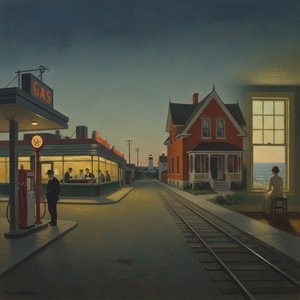
While Hopper’s career unfolded gradually, certain works catapulted him to widespread recognition. Nighthawks (1942), arguably his most famous painting, became an instant icon of American culture. The late-night diner scene, bathed in stark fluorescent light, perfectly encapsulates the alienation and anonymity of modern urban life. The figures within are lost in their own thoughts, disconnected from one another despite their proximity—a poignant commentary on the human condition. Gas (1940), with its striking portrayal of a roadside gas station, showcases Hopper’s fascination with American landscapes and the burgeoning automobile culture. Other notable works like *Automat*, *Office in a Small City*, and *Summertime* each offer unique insights into the complexities of 20th-century American society. These paintings weren't merely depictions of places; they were explorations of mood, psychology, and the subtle dramas unfolding within ordinary settings. His wife, Josephine Nivison Hopper, played a vital role not only as his lifelong companion but also as a frequent model, contributing significantly to the characterization of his female figures.

Themes and Legacy: A Lasting Influence

Several recurring themes permeate Hopper’s oeuvre. Urban isolation is perhaps the most prominent—the sense of loneliness experienced by individuals even amidst crowds. He explored the American landscape, both rural and urban, often emphasizing its starkness and emptiness. His work delves into psychological realism, probing the inner lives of his subjects with a sensitivity that transcends mere representation. There’s also an undercurrent of nostalgia for a simpler past, juxtaposed with an acknowledgement of the complexities and anxieties of modern life. Hopper's influence on subsequent artists is undeniable. His unique style has inspired countless painters, including Pierre Sanford Ross, and continues to resonate with contemporary artists seeking to capture the essence of human experience. His paintings remain highly sought after by collectors and are exhibited in major museums worldwide, solidifying his place as a pivotal figure in American art history. More than just an artist, Edward Hopper was a visual philosopher, offering profound insights into the human condition through his masterful use of light, shadow, and composition.
  • His legacy lies not only in the beauty of his paintings but also in their enduring ability to provoke thought, evoke emotion, and remind us of the quiet solitude that often defines our lives.
  • Hopper’s work continues to captivate audiences because it speaks to universal themes of loneliness, isolation, and the search for meaning in a rapidly changing world.
  • His paintings have become iconic representations of American culture, often used to symbolize the anxieties and aspirations of the 20th century—and beyond.
  • Hopper’s aesthetic has profoundly influenced filmmakers (like Alfred Hitchcock) and writers, inspiring countless works that explore similar themes of alienation and psychological tension.
Edward Hopper's ability to capture the essence of modern American life with honesty, sensitivity, and a distinctive artistic vision ensures his place as one of the most important artists of the 20th century.
Edward Hopper

Edward Hopper

1931 - 1967 , Egyesült Államok

A művészről röviden

  • Artistic Movement Or Style: Realista
  • Artists Or Movements Influenced By This Artist: ['Pierre Sanford Ross']
  • Artists Who Influenced This Artist:
    • William Chase
    • Robert Henri
  • Date Of Birth: 1882. július 22.
  • Date Of Death: 1967. május 15.
  • Full Name: Edward Hopper
  • Nationality: Amerikai
  • Notable Artworks:
    • Nighthawks
    • House by the Railroad
    • Gas
  • Place Of Birth: Nyack, USA
Fedezze fel a műalkotásokat témák, stílusok és jellemzők szerint csoportosítva.