x

Kézzel festett olajvastú vászon, az Ön által választott méretben és keretben, művészeink készítik meglévőre. ( Nyomat rendelése Kép letöltése)





























Válasszon előre meghatározott méreteink közül, amelyek megfelelnek a műalkotás eredeti arányainak.

Ön megadhat saját méreteket egy adott kerethez vagy térhez igazításhoz. Ha a kiválasztott méret nem egyezik az eredeti kép arányával, akkor a műalkotást levágjuk, vagy további kézzel festett elemekkel meghosszabbítjuk a festményt. A gyártás megkezdése előtt küldünk Önnek egy digitális előnézetet jóváhagyásra.
Kérjük, vegye figyelembe, hogy a képernyőn megjelenő előnézet nem tükrözi a tényleges vágást vagy kiterjesztést. Csak az előnézet fog pontosan mutatni a végső kompozíciót.
Bár egyedi méretek állnak rendelkezésre, javasoljuk, hogy válasszon egy méretet az előre meghatározott listából az eredeti arányok megőrzése érdekében.
Világszerte elérhető szállítás () 3-4 hét alatt a szokásos 5 hét helyett. (20 augusztus). A minőség nem kérdőjelezhető.


untitled (202)
Reprodukció mérete
Edward Hopper, a name inextricably linked to the quietude and subtle melancholy that permeated 20th-century American life, wasn’t simply a painter of scenes; he was a poet of light and shadow, a chronicler of modern isolation. Born in Nyack, New York, in 1882, to middle-class parents of Dutch ancestry, Hopper's early years provided a stable upbringing that nurtured his artistic inclinations. From childhood sketches meticulously dated and signed, it became evident that keen observation and an innate talent for drawing were central to his being.
Though initially encouraged towards commercial illustration – a pragmatic suggestion from his parents – Hopper’s ambitions leaned toward fine art, leading him to the New York School of Art where he studied under William Merritt Chase and Robert Henri. These formative years instilled not only technical skill but also an appreciation for realism and a commitment to depicting the world as he saw it. He sought to capture the essence of everyday life—the loneliness, the unspoken anxieties—with unflinching honesty.
Hopper’s oeuvre is characterized by its meticulous realism, achieved through smooth brushstrokes and careful attention to detail. He employed oil paints on canvas—a practice consistent with the artistic conventions of his time—to render scenes bathed in diffused light that heighten emotional resonance. The artist's technique prioritized clarity and precision, creating a sense of detachment rather than overt sentimentality.
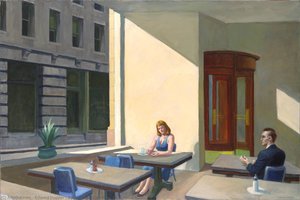
Perhaps no painting embodies Hopper’s signature aesthetic more powerfully than “untitled (202).” This artwork depicts a solitary figure seated on a bed within a sparsely furnished room—a motif recurrent throughout his career. The composition is dominated by strong geometric shapes – the rectangular window, the bed, and the walls – creating a feeling of confinement that speaks to the anxieties inherent in modern urban existence.
The muted color palette—primarily cool blues, grays, and pale pinks—underscores the melancholic mood. A warm pink hue highlights the figure’s garment, providing subtle visual contrast against the cooler tones of the room. Hopper's masterful use of perspective subtly suggests depth while maintaining a flattened surface, reinforcing the sense of detachment characteristic of his style.
“untitled (202)” resonates deeply with viewers because it captures a universal experience: the quiet contemplation of solitude amidst the bustle of daily life. It’s a poignant reminder of human vulnerability and longing—themes that Hopper explored consistently throughout his prolific artistic output, cementing his place as one of America's most enduring visual artists.


1931 - 1967 , Egyesült Államok

Explore the profound history of American Regionalism. Discover how Grant Wood captured the heart of the Midwest through masterpieces like American Gothic. An expert guide to the movement, its cultural impact, and the enduring beauty of American Realism.

Explore the raw, evocative beauty of the Ashcan School. Discover how masters like Bellows and Glackens captured New York's urban soul through American Realism, and learn to bring this gritty, historical elegance into your modern art collection.


Maradjon naprakész a legfrissebb művészeti hírekkel, exkluzív ajánlatokkal és dekorációs ötletekkel.
Írja le nekünk projektjét, és művészeti szakértőink 3 személyre szabott műalkotási javaslatot készítenek Önnek.
Hagyjuk, hogy mi válogassunk ki Önnek 3 legjobb opciót – Ingyenesen!


 Megtekintés
 Küldés
 Megosztás
 Részletek

 Letöltés
 Hasonló darabok
 X-ray felvétel
 Diavetítés
 Összes részlet megjelenítése







 Az üvegkeretes opció csak 110 cm alatti méretben érhető el