
Értékelje át műveit
Kedvencek listája Kosár tartalma Cart
x
MegtekintésMegtekintés Műalkotás AR előnézeteMűalkotás AR előnézete Kézzel festett másolat rendelése Kézzel festett másolat rendeléseKép letöltése Kép letöltése KüldésKüldés
RészletekRészletek Kedvencekhez ad Kedvencekhez ad LetöltésLetöltés Hasonló darabokHasonló darabok X-ray felvételX-ray felvétel DiavetítésDiavetítés

Ibex

Franz Marc’s vibrant watercolor ‘Ibex’ embodies German Expressionism's soulful spirit through bold colors and dynamic brushstrokes capturing the animal’s connection to nature—a powerful piece perfect for art lovers.

Fedezd fel a német ekspreszionista Franz Marc (1880-1916) munkáit! A spirituális témák, az állatfestészet és a vibráló színek egyedülálló világtalányát ábrázolja. Látogasd meg a gyönyörű műveit!

Giclée / Műnyomat

Múzeumi minőségű giclée vagy vászonnyomat, gyors gyártással és rugalmas finomítási lehetőségekkel. (Kézzel festett másolat rendelése Kézzel festett másolat rendeléseKép letöltése Kép letöltése)

P118B $10
P118H $10
P118W $10
P438Z $10
P508JH $12
P508YH $12
P805H $10
P805Z $10
P919BZ $10
P919G $10
P919XJ $10
P959ZH $10
P968JZ $12
W106C $8
W218G $10
W218JH $8
W218Y $10
W307PJ $10
W316G $10
W316PJ $8
W316Y $10
W398PJ $8
W4111J $10
W500HY $15
W500JH $15
W692G $12
W849H $8
W940BG $15
W953PJ $8

Standard
custom
CM
INCH

Válasszon előre meghatározott méreteink közül, amelyek megfelelnek a műalkotás eredeti arányainak.

szélesség
magasság

Megadhat saját méreteket is egy konkrét kerethez vagy helyszínhez igazítva. Amennyiben a kiválasztott méret nem egyezik az eredeti kép arányokkal, a műalkotást le fogjuk vágni, vagy kiegészítjük a képet tükrözött vagy egyszínű szélekkel. A gyártás megkezdése előtt egy digitális tervezetet küldünk jóváhagyásra.
Kérjük, vegye figyelembe, hogy a képernyőn látható előnézet nem tükrözi a tényleges levágást vagy kiegészítést. Csak a tervezet mutatja pontosan a végső kompozíciót.
Bár az egyedi méretek is elérhetőek, az eredeti arányok megőrzése érdekében azt javasoljuk, hogy válasszon a előre meghatározott listából származó méretet.

Világszerte történő kiszállítás területére mindössze 2 hét alatt, a szokásos 4-5 hét helyett. (14 augusztus)

why_choose_icon
Ingyenes globális expressz szállítás
why_choose_icon
Prémium minőségű len vászon
why_choose_icon
Teljes körű szállítási biztosítás
why_choose_icon
Vámvisszatérítési Garancia
why_choose_icon
Hiteles színpontosság garancia
why_choose_icon
60 napos visszaküldési lehetőség (csak hibás termékek esetén)
why_choose_icon
100% pénzvisszatérítési garancia
why_choose_icon
Több darab vásárlása esetén kedvezmény

Összesített ár

$ 68

reproduction

Ibex

Giclée / Műnyomat

Reprodukció mérete

-

Összesített ár

$ 68

Gyors információk

  • Subject or theme: Animal Symbolism
  • Title: Ibex
  • Medium: Watercolor
  • Artist: Franz Marc
  • Artistic style: Emotional Expressionism
  • Location: Private Collection
  • Movement: Expressionism

Gyűjthető leírása

A Vision of Primal Spirit: The Soul of Franz Marc’s Ibex

In the pantheon of German Expressionism, few works capture the raw, spiritual pulse of the natural world as poignantly as Franz Marc’s 1913 masterpiece, Ibex. This watercolor is far more than a mere zoological study; it is a profound meditation on the interconnectedness of all living things. As the viewer encounters this piece, they are immediately drawn into a rhythmic dance of color and form, where the boundaries between the animal subject and the heavens above begin to dissolve. Through his masterful use of the medium, Marc invites us to look beyond the physical surface of the creature to witness a symphony of spirit embodied in flesh and light.

The technique employed in Ibex reflects the artist's departure from the meticulous realism of the past. Eschewing the fleeting light-play of Impressionism, Marc utilizes the fluid, translucent nature of watercolor to create a sense of breathing vitality. His brushstrokes are confident and expressive, carving out the muscularity of the ibex while simultaneously allowing the edges of the form to bleed into the surrounding landscape. This deliberate softening of boundaries serves a higher purpose: it mirrors the artist's belief that nature is not a collection of separate objects, but a singular, breathing organism. The vibrant blues of the sky and the sun-drenched yellows of the terrain are not merely decorative choices; they are symbolic anchors, representing tranquility and divine illumination, respectively.

Symbolism and the Expressionist Legacy

To understand Ibex, one must understand the heart of the Der Blaue Reiter movement. Alongside luminaries like Wassily Kandinsky, Marc sought to use color as a direct conduit to the human psyche and the spiritual realm. In this work, the ibex stands as a totem of resilience and nobility. Positioned upon a rugged, rocky terrain, the animal gazes upward toward an expansive, cloud-dappled sky—a gesture that evokes a sense of yearning and transcendence. The composition directs the eye in an upward trajectory, pulling the observer's spirit from the grounded, earthy elements toward the infinite blue, much like the artist’s own journey through theological inquiry toward artistic revelation.

For the discerning collector or interior designer, this piece offers a unique opportunity to introduce a sense of dynamic energy and intellectual depth into a space. The bold, primary-adjacent palette provides a striking focal point that can anchor a room, while the emotional weight of the subject matter lends an air of sophistication and contemplation. Whether placed in a modern gallery setting or a classic study, Ibex serves as a window into a pivotal moment in art history—a time when color was liberated from form to express the very essence of existence. It is a timeless acquisition for those who seek art that does not merely decorate a wall, but breathes life into an environment.

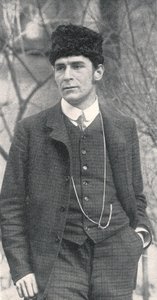
A művész életrajza

A Life Immersed in Color and Spirit

Franz Moritz Wilhelm Marc, born in Munich in 1880, was a painter whose brief but intensely focused career irrevocably altered the course of German Expressionism. His story is one of profound spiritual seeking translated into a vibrant visual language, a quest to understand the essence of life through the purity he found in the natural world—particularly within the animal kingdom. Initially influenced by his father, Wilhelm Marc, a landscape painter, young Franz’s artistic path wasn't immediately certain. He briefly considered theology, grappling with questions of faith and existence before ultimately dedicating himself to art at the Academy of Fine Arts in Munich. These early explorations into religious thought would remain deeply embedded within his work, shaping his belief that art could be a conduit for spiritual experience. His academic training provided him with technical foundations, but it was encounters with the works of Vincent van Gogh during visits to Paris that truly ignited his artistic vision. Van Gogh’s emotive use of color and raw expression resonated profoundly with Marc, liberating him from conventional techniques and setting him on a path toward a more subjective and emotionally charged style.

The Blue Rider and a New Artistic Vision

Marc's artistic development wasn’t solitary; it flourished within the dynamic context of early 20th-century Munich. He experimented with various artist groups, including the Neue Künstlervereinigung München, before co-founding *Der Blaue Reiter* (The Blue Rider) in 1911 alongside Wassily Kandinsky. This wasn’t merely a group or an exhibition series; it was a philosophical and artistic revolution. *Der Blaue Reiter* sought to move beyond mere representation, aiming instead to express inner spiritual truths through abstraction and symbolic color. The journal of the same name became a platform for disseminating these ideas, showcasing not only their own work but also that of other forward-thinking artists and exploring diverse cultural influences from folk art to primitive sculpture. Marc’s contributions during this period were pivotal. He moved away from depicting landscapes as static scenes, instead focusing on animals—horses, deer, foxes—as vessels of spiritual energy. These weren’t simply animal portraits; they were symbolic representations of innocence, harmony, and a connection to the natural world that he believed humanity had lost. The influence of Robert Delaunay’s exploration of abstract forms and vibrant colors further propelled Marc toward simplification and heightened emotional expression in his work. Paintings like *The Tiger* (1912) and *Red Deer* (1912) exemplify this shift, showcasing bold color choices and a growing focus on the inherent qualities of his subjects rather than realistic depiction.

Symbolism, Color, and the Essence of Being

Marc’s artistic style is immediately recognizable for its distinctive use of color and form. He didn't employ color descriptively; instead, he imbued it with symbolic meaning. Blue represented spirituality and masculinity, yellow signified joy and femininity, and red embodied violence and materiality. These weren’t arbitrary choices but a carefully constructed system designed to convey specific emotional and philosophical ideas. His animals aren’t merely subjects; they are embodiments of these concepts. The simplification of forms—reducing figures to their essential shapes—further emphasized the underlying spiritual essence he sought to capture. *The Tower of Blue Horses* (1913), sadly lost during World War II, is perhaps the most iconic example of this approach, a powerful and evocative composition that encapsulates his artistic vision. He believed animals possessed an inherent purity and connection to nature that humans had forfeited through societal constraints and intellectualization. By portraying them with such reverence and symbolic weight, Marc sought to remind viewers of this lost harmony and inspire a deeper appreciation for the natural world. His work wasn’t about depicting *what* he saw but rather *how* he felt—a deeply personal and spiritual response to his surroundings.

A Tragic End and Lasting Legacy

The outbreak of World War I in 1914 dramatically altered Marc's life and artistic trajectory. Despite seeking exemption due to his status as an artist, he was drafted into the German army, serving as a cavalryman. The horrors of war deeply affected him, yet even amidst the chaos, he continued to paint, finding solace and meaning in his art. Tragically, Franz Marc died on March 4, 1916, at the Battle of Verdun, a devastating loss for the art world. His untimely death cut short a career brimming with potential, but it also cemented his place as a pivotal figure in modern art history. His work continues to resonate today, influencing generations of artists and captivating audiences with its emotional depth and spiritual resonance. Marc’s paintings are exhibited in major museums worldwide, including the Lenbachhaus in Munich, which holds an extensive collection of his work. He is remembered not only as a pioneer of German Expressionism but also as a visionary artist who dared to explore the profound connection between art, spirituality, and the natural world—a legacy that continues to inspire awe and contemplation. His artistic vision remains a testament to the power of art to transcend the material realm and touch upon something deeper within the human spirit.
Franz Marc

Franz Marc

1880 - 1916 , Németország

A művészről röviden

  • Artistic Movement Or Style: German Expressionizmus
  • Artists Or Movements Influenced By This Artist: ['Állattal foglalkozó festők']
  • Artists Who Influenced This Artist:
    • Van Gogh
    • Delaunay
  • Date Of Birth: 1880. február 8.
  • Date Of Death: 1916. március 4.
  • Full Name: Franz Moritz Wilhelm Marc
  • Nationality: Német
  • Notable Artworks:
    • A Tigris
    • Vörös ló
    • Lapostó a kék lovakról
  • Place Of Birth: München, Németország
Fedezze fel a műalkotásokat témák, stílusok és jellemzők szerint csoportosítva.




































