x

Kézzel festett olajvastú vászon, az Ön által választott méretben és keretben, művészeink készítik meglévőre. ( Nyomat rendelése Kép letöltése)





























Válasszon előre meghatározott méreteink közül, amelyek megfelelnek a műalkotás eredeti arányainak.

Ön megadhat saját méreteket egy adott kerethez vagy térhez igazításhoz. Ha a kiválasztott méret nem egyezik az eredeti kép arányával, akkor a műalkotást levágjuk, vagy további kézzel festett elemekkel meghosszabbítjuk a festményt. A gyártás megkezdése előtt küldünk Önnek egy digitális előnézetet jóváhagyásra.
Kérjük, vegye figyelembe, hogy a képernyőn megjelenő előnézet nem tükrözi a tényleges vágást vagy kiterjesztést. Csak az előnézet fog pontosan mutatni a végső kompozíciót.
Bár egyedi méretek állnak rendelkezésre, javasoljuk, hogy válasszon egy méretet az előre meghatározott listából az eredeti arányok megőrzése érdekében.
Világszerte elérhető szállítás () 3-4 hét alatt a szokásos 5 hét helyett. (20 augusztus). A minőség nem kérdőjelezhető.


Despair
Reprodukció mérete
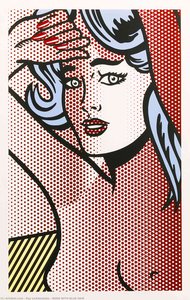
In the pantheon of twentieth-century masterpieces, few works capture the intersection of mass media aesthetics and raw human vulnerability as poignantly as Roy Lichtenstein’s “Despair.” Created in 1979, this striking piece transcends its comic-strip origins to offer a profound meditation on anxiety. At first glance, the viewer is met with a stylized, cartoonish figure, yet the simplicity of the form belies a deep psychological complexity. The central focus remains fixed upon an expressive face, where a wide-open mouth serves as a silent, haunting scream—a visual cue for anguish that resonates far beyond the boundaries of the canvas. While the background features scattered figures that hint at a larger, perhaps more chaotic narrative, they remain secondary to the overwhelming sense of individual isolation and distress that radiates from the protagonist.
The brilliance of “Despair” lies in Lichtenstein’s masterful command of the Pop Art lexicon. He famously rejected traditional illusionistic depth, opting instead for a deliberate flatness that prioritizes immediate visual impact. To achieve this, he utilized the iconic Ben-Day dots technique—a method borrowed from the halftone printing processes found in mid-century newspapers and comic books. This meticulous application of small, colored dots creates a textured, mechanical surface that mimics mass production while simultaneously elevating the subject matter to the realm of fine art. The interplay of bold, primary color blocks against these rhythmic patterns creates a tension between the "low" culture of commercial printing and the "high" art of gallery exhibition, making it an irresistible centerpiece for any modern collection.
The emotional temperature of the painting is dictated by its vibrant yet unsettling color palette. Lichtenstein employs a dominant scheme of red and yellow to amplify the artwork’s inherent intensity. In this composition, red functions as more than just a pigment; it symbolizes passion, danger, and the heat of an unfolding crisis, while the bright yellow provides a jarring contrast that heightens the sense of alarm. Occasional blue accents ground the composition, yet they cannot dampen the feverish energy of the primary tones. This chromatic strategy ensures that the viewer’s eye is constantly moved across the canvas, mirroring the restless, unsettled state of the character depicted.
To understand “Despair,” one must also consider the historical atmosphere of its creation. Emerging in the late 1970s, the work reflects a period of profound duality in American life—a time when the post-war economic optimism was beginning to be eclipsed by shadows of social unrest and political instability. Lichtenstein captures this zeitgeist perfectly, translating societal anxieties into a universal language of suffering and identity crisis. For the discerning collector or interior designer, “Despair” offers more than mere decoration; it provides a sophisticated conversational piece that invites contemplation on the human condition. Whether placed in a contemporary gallery setting or as a bold statement in a curated residential space, this reproduction brings the enduring legacy of Lichtenstein’s visionary Pop Art into the modern home.


1923 - 1997 , Egyesült Államok

Explore the psychological depth of Roy Lichtenstein's color theory. An expert analysis for art students and collectors on Ben-Day dots, primary palettes, and the intersection of Pop Art with mass media history.

Explore the industrial secrets of 1960s Pop Art. Discover how Ben-Day dots and silk screening transformed mass media into masterpieces by Roy Lichtenstein. An in-depth look at the intersection of mechanical printing and fine art history for students and collectors.

Explore the provocative world of Aggressive Pop Art. Discover how confrontational imagery, bold saturated hues, and mass media deconstruction redefined modern aesthetics through an expert art-historical lens.


Maradjon naprakész a legfrissebb művészeti hírekkel, exkluzív ajánlatokkal és dekorációs ötletekkel.
Írja le nekünk projektjét, és művészeti szakértőink 3 személyre szabott műalkotási javaslatot készítenek Önnek.
Hagyjuk, hogy mi válogassunk ki Önnek 3 legjobb opciót – Ingyenesen!


 Megtekintés
 Küldés
 Megosztás
 Részletek

 Letöltés
 Hasonló darabok
 X-ray felvétel
 Diavetítés

 Összes részlet megjelenítése







 Az üvegkeretes opció csak 110 cm alatti méretben érhető el