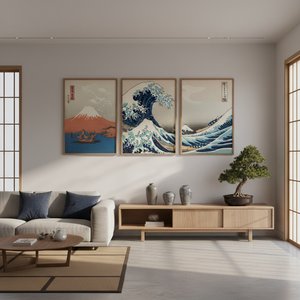
Katsushika Taito II: A Master of Edo’s Natural World
Born in Tokyo, Japan, during the early 19th century, Katsushika Taito II – often simply referred to as Taito II – emerged from a lineage steeped in samurai tradition. His origins within a family hailing from Kyushu provided him with a unique perspective and grounding that would profoundly influence his artistic vision. His formal artistic education began under the tutelage of none other than Hokusai, the legendary master of Ukiyo-e, who bestowed upon him the esteemed *go* (pen name) “Taito” in 1819 – a moniker he carried throughout his prolific career. This formative connection to Hokusai wasn’t merely an apprenticeship; it was a transmission of artistic philosophy and technique, shaping Taito II's approach to capturing the beauty and dynamism of the world around him.
The Rise of a Landscape Pioneer
Prior to Taito II’s emergence, Ukiyo-e prints were largely defined by depictions of courtesans, actors, and scenes from popular theatre – portraits of fleeting entertainment. However, Taito II skillfully steered the genre towards a broader exploration of nature, marking a pivotal shift in the style's trajectory. He demonstrated an exceptional ability to render intricate details of flora and fauna with remarkable precision and sensitivity. His work moved beyond mere representation; he imbued his subjects with a sense of life and movement, capturing the essence of their existence. This dedication to naturalism was particularly evident in his celebrated “Carp and Water Weeds” (also known as "Carp or Jumping Carp or Carp Swimming in Whirlpool"), a masterpiece that cemented his reputation as one of the foremost fish print designers of the Edo period. The dynamic composition, the swirling water, and the powerful musculature of the carp all speak to Taito II’s deep understanding of anatomy and his masterful control over the woodblock printing process.
A Series of Celebrations: ‘Five Annual Festivals’
Further solidifying his artistic prowess was the creation of “Five Annual Festivals for the Katsushika Circle,” a series of prints completed in 1822. This ambitious undertaking showcased Taito II's versatility and his ability to capture the vibrant energy of Japanese festivals – events deeply rooted in local traditions and community spirit. The intricate details, the colorful costumes, and the lively interactions depicted within these prints offer a captivating glimpse into Edo-period life. The series wasn’t simply a documentation of festivals; it was an artistic celebration of cultural heritage, reflecting Taito II's commitment to portraying authentic Japanese experiences.
Beyond the Familiar: ‘Monkey Bridge’ and Expanding Horizons
Around 1830-1844, Taito II produced “Monkey Bridge,” a print that exemplifies his growing interest in depicting scenes of everyday life and exploring less conventional subjects. This work, along with many others from this period, demonstrates a shift towards capturing the nuances of human interaction within natural settings. He continued to refine his technique, experimenting with perspective and composition to create works that were both visually stunning and emotionally resonant. His exploration extended beyond traditional landscapes, incorporating elements of humor and social commentary into his prints – a characteristic that distinguished him from many of his contemporaries.
Historical Significance and Lasting Legacy
Katsushika Taito II’s contribution to Ukiyo-e is undeniable. He played a crucial role in transforming the genre from its initial focus on entertainment into a sophisticated art form capable of expressing profound observations about nature, society, and human experience. His innovative approach to landscape design, coupled with his meticulous attention to detail and his ability to capture the spirit of Japanese culture, ensured his place as one of the most important artists of the Edo period. His influence can still be felt today, inspiring contemporary artists and continuing to captivate audiences worldwide through the enduring beauty of his woodblock prints. His work remains a testament to the power of art to illuminate the world around us.