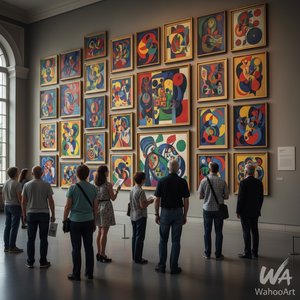
![Cerchio Nero [1913] — Kazimir Malevič](/media/artworks/images/thumbnails/29/9f/299f2153e48d4d70918e77144b5835a6.jpg)

The Industrial Pulse: Origins of Constructivism and the Rejection of Ornament
Constructivism (Russian: конструктивизм, romanized: konstruktivizm) is an early twentieth-century art movement founded in 1915 by Vladimir Tatlin and Alexander Rodchenko. Abstract and austere, constructivist art aimed to reflect modern industrial soc...
To understand the seismic shift brought about by Constructivism, one must first envision the world in which it was born—a world vibrating with the raw, unceasing energy of the early twentieth century. As the smoke of the industrial revolution settled into the foundations of modern urban life, a new generation of artists looked upon the traditional, decorative canvases of the past with profound skepticism. They saw not beauty, but a stagnant adherence to bourgeois sentimentality. The movement, which flourished primarily between 1915 and 1934, emerged from a desire to strip away the unnecessary. It was a deliberate departure from the "art for art's sake" philosophy, seeking instead an aesthetic that mirrored the steel, glass, and rhythmic machinery of a burgeoning industrial society.
This was not merely a change in subject matter, but a fundamental rejection of decorative stylization. Where previous movements might have used gold leaf or intricate floral patterns to evoke luxury, the Constructivists sought the faktura—the inherent, tactile properties of the materials themselves. They favored the industrial assemblage, finding a profound, austere beauty in the honest presentation of wood, metal, and glass. This period was marked by an intense focus on urban space and the structural logic of modern life, aiming to create an art that was not a window into another world, but a functional component of our own. It was an era where the artist began to see themselves less as a dreamer and more as an engineer of visual experience.
Architects of Abstraction: The Visionary Pioneers from Tatlin to Rodchenko
 Lyubov Sergeyevna Popova
A Pioneer Forged in Revolution Lyubov Sergeyevna Popova, born in 1889 in the burgeoning textile town of Ivanovo, Russia, was more than just a painter; she was a visionary architect of form and color, a dedicated theorist, and a fervent believer in ar...
The genesis of this radical movement cannot be discussed without honoring the titans who laid its structural foundations. Vladimir Tatlin, often regarded as the father of Constructivism, pioneered the concept of "counter-reliefs," works that moved beyond the flat plane of the canvas to interact physically with the surrounding space. His approach was revolutionary; by utilizing non-traditional materials and emphasizing the weight and tension of objects, he bridged the gap between sculpture and architecture. Alongside him stood Alexander Rodchenko, a figure whose versatility as a painter, photographer, and graphic designer embodied the very spirit of the movement. Rodchenko’s work utilized bold, intersecting lines and a stark, photographic clarity to direct the viewer's eye toward the dynamic energy of the modern age.
The movement was further enriched by the contributions of artists like Lyubov Popova, a visionary who synthesized the fragmented geometry of Cubism with the vibrant, rhythmic pulse of Russian folk art. Her "painterly architectonics" demonstrated that abstraction could possess both structural rigor and emotional depth. Even as the movement expanded, it remained anchored by these core figures who believed that art should serve a social purpose, acting as a tool for propaganda and the reshaping of societal consciousness during the era of Soviet socialism. These pioneers did not just paint; they constructed new ways of seeing, ensuring that the visual language of the revolution was as much about structural integrity as it was about ideological fervor.
Geometry as Ideology: Decoding the Language of Form, Line, and Material
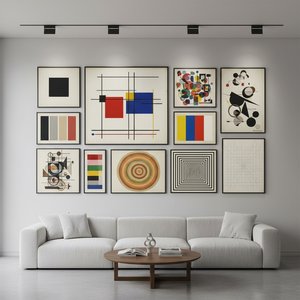 Geometric Abstraction's 10 Defining Masterpieces | Art for Your Home - Most-Famous-Paintings
Introduction Imagine a world stripped bare to its essential forms – lines, colors, and shapes resonating with an almost mathematical purity. This is the realm of Geometric Abstraction, a movement that dared to abandon representational art in favor of...
In the hands of a Constructivist, geometry was never merely an aesthetic choice; it was a profound ideological statement. To use a circle, a square, or a straight line was to invoke a universal order that transcended individual emotion and nationalistic borders. This was the realm of geometric abstraction, where the complexity of the natural world was reduced to its most essential, mathematical truths. By stripping away representational imagery—the faces, the landscapes, the recognizable objects—artists could communicate through a pure, unadulterally logical vocabulary. A single diagonal line could convey tension and movement; a heavy black square could represent stability and weight.
This reductionist approach was deeply intertwined with the technological advancements of the time. As science revealed the hidden, structured patterns within the atom and the cosmos, artists responded by creating works that resonated with this newfound understanding of universal logic. The use of space became as critical as the use of color. Artists explored how lines could intersect to create depth without relying on traditional perspective, and how the arrangement of shapes could suggest the vastness of urban architecture or the precision of a machine part. This was an art of construction, where every element was placed with the intention of contributing to a larger, cohesive, and functional whole.
From Canvas to Cosmos: The Influence of Suprematism and Cubism on Constructivist Logic
 Beyond Form & Color: Geometric Abstraction's Evolution in 20th/21st Century Art
The Genesis of Geometric Abstraction: From Cubism to Suprematism Kazimir Malevich Kazimir Malevich (1878-1935): Ukrainian founder of Suprematism & pioneer of abstract art. Explore iconic works like Black Square, geometric forms, & pure feeling's impa...
While Constructivism sought to ground itself in the material reality of the industrial age, it did not exist in a vacuum. It was part of a broader, more complex dialogue within the Russian avant-garde, drawing significant inspiration from both Cubism and Suprematism. From Cubism, the movement inherited the technique of fragmentation—the ability to break an object into multiple perspectives and reconstruct it within a new, flattened spatial arrangement. This allowed Constructivists to explore the relationship between form and volume with unprecedented analytical precision.
However, a fascinating tension existed between the Constructivist drive for materiality and the Suprematist pursuit of pure, spiritual feeling. Kazimir Malevich, the founder of Suprematism, pushed abstraction toward an even more extreme end, seeking a "zero point" of painting where form was entirely liberated from the burden of the object. While works like his Black Square focused on the transcendental and the metaphysical, Constructivism took those same geometric seeds and planted them in the fertile soil of the physical world. They took the radical reductionism of Malevich and applied it to the construction of social reality. This intersection of the spiritual and the structural created a unique artistic tension that defined the era, as artists navigated the boundary between the infinite cosmos and the tangible machine.
The Enduring Legacy: How Radical Geometry Shaped Modern Design and Architecture
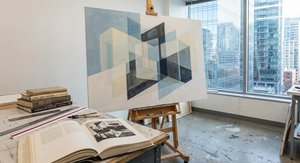 Beyond Form & Color: Geometric Abstraction's Enduring Legacy in Art History
The Genesis of Geometric Abstraction: From Cubism to Early Pioneers Geometric Design in Art: A Historical Survey & Contemporary Appeal for Collectors Explore the enduring legacy of geometric abstraction! Discover key artists, historical movements & i...
The impact of Constructivism extends far beyond the museum walls; its fingerprints are visible on nearly every facet of modern visual culture. The movement’s emphasis on structural honesty, functionalism, and the beauty of raw materials became the cornerstone of the Bauhaus in Germany and the De Stijl movement in the Netherlands. The principles of geometric clarity and industrial efficiency directly informed the development of modern graphic design, where the hierarchy of information and the use of bold, sans-serif typography owe a great debt to Rodchenko’s experiments. Even in contemporary architecture, the celebration of steel, glass, and exposed structural elements can be traced back to the Constructivist manifesto.
Today, we see the echoes of this radical geometry in everything from minimalist product design to the sleek interfaces of our digital devices. The movement taught us that simplicity is not a lack of complexity, but rather the ultimate refinement of it. For the modern collector or student of art history, studying Constructivism offers more than just an appreciation of old techniques; it provides a lens through which to understand the very foundations of our modern, structured world. It remains a testament to the power of art to not only reflect change but to actively participate in the construction of a new reality.
At Most-Famous-Paintings.com, we are dedicated to preserving the profound legacy of these historical movements. For those moved by the bold lines and structural brilliance of the avant-garde, we offer museum-quality, hand-painted oil reproductions that capture the true essence of these masterpieces. Our artists, trained in the finest academic traditions, use heavy impasto and authentic materials to ensure that the tactile depth of the original—the very faktura so cherished by the Constructivists—is present in every brushstroke. Whether you are looking to adorn a modern space with a striking geometric work or seeking a scholarly reference for your collection, our curated selection brings the revolution into your home.