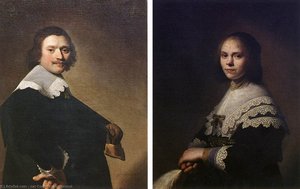
Johannes Cornelisz Verspronck
Johannes Cornelisz Verspronck (between 1600 and 1603 – buried June 30, 1662) was a Dutch Golden Age portraitist from Haarlem. He stands as one of the most meticulous artists of his time, renowned for capturing not merely likeness but also the very essence of his subjects—a feat achieved through unparalleled attention to detail and masterful technique.
Johannes Verspronck’s artistic journey began under the tutelage of his father, Cornelis Engelsz., a painter hailing from Gouda who instilled in him the foundational principles of portraiture. This formative influence would prove crucial in shaping Verspronck's distinctive style—characterized by an unwavering commitment to accuracy and realism. In 1632 he joined the Haarlem Guild of St Luke, marking the commencement of his prolific career as a painter dedicated primarily to depicting noblemen and ladies.
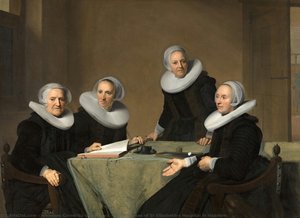
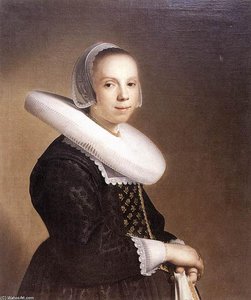
Verspronck’s fame ascended rapidly thanks to commissions from prominent families and institutions, notably securing the prestigious task of portraying the regentesses of the Heilige Geesthuis—a charitable institution in Haarlem—in 1642. This undertaking cemented his reputation as a master craftsman capable of elevating even seemingly mundane subjects into captivating visual narratives. His work reflects an astute understanding of Baroque aesthetics and incorporates subtle nuances that convey psychological depth, mirroring the artistic sensibilities of Frans Hals, whom he greatly admired.
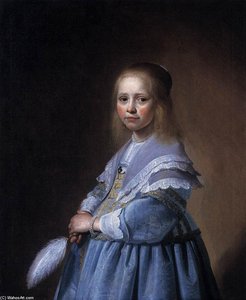
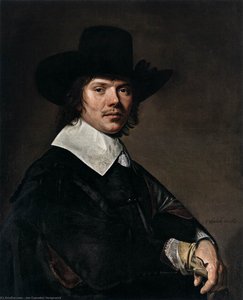
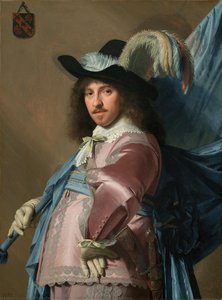
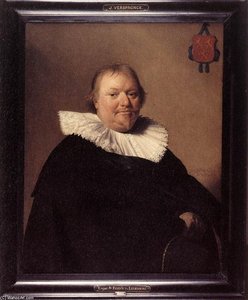
Among Verspronck’s celebrated masterpieces are “Portrait of a Young Man” (1634), currently residing in the Palais des Beaux-Arts de Lille, where his meticulous rendering of facial features and drapery continues to inspire admiration. Similarly impressive is “Andries Stilte as a Standard Bearer” (1640), showcasing Verspronck’s ability to convey both formal dignity and inner emotion—a hallmark of Dutch militia portraits during the era. Furthermore, "Girl in a Blue Dress" (1641) exemplifies his meticulous attention to texture and color, capturing the delicate beauty of female attire with remarkable precision. “Portrait of Pieter Jacobsz Schout” (1641) demonstrates Verspronck’s versatility as an artist, adept at portraying individuals from diverse social strata.
Verspronck's legacy extends beyond his artistic output; he left behind a substantial body of documentation that illuminates the cultural landscape of Haarlem during the Golden Age. His paintings are housed in museums across Europe, including the Rijksmuseum in Amsterdam and the Musée Magnet at Lille, guaranteeing their enduring presence within the canon of Dutch art history. Johannes Cornelisz Verspronck’s oeuvre remains a testament to the artistic brilliance of his era—a captivating reflection of human psychology and visual artistry alike.