The Soul of Resistance and the Madras Vanguard
Thillaiaadi Valliammai, known also as L. Munuswamy, stands as a monumental figure whose life was defined by the dual pursuit of artistic truth and social justice. Born in Chennai in 1927, her identity was forged in the crucible of mid-century Indian modernism and the profound ethics of Gandhian Satyagraha. Beyond the canvas, she was an emblem of nonviolent resistance, demonstrating a courageous commitment to the fight against racial segregation in South and much of the world. This spirit of liberation—of breaking chains both political and aesthetic—became the heartbeat of her creative output, making her a pivotal figure in the history of Indian modernism.
The Architecture of Abstraction
Her artistic evolution was nurtured by the masters of the Madras Art Movement, including luminaries such as D.P. Roy Chowdhury, S. Dhanapal, and K.C.S. Paniker. These mentors instilled in her a profound understanding of visual language, teaching her to utilize abstraction as a vessel for both intellect and emotion. Valliammai’s work emerged from this movement's desire to transcend Western conventions, seeking instead a uniquely Indian modernism that prioritized expressive power over mere realism. Her style is instantly recognizable through its assertive lines and deep, dark tonal palettes, which create a sense of structural depth and psychological weight.
A Symphony of Form and Shadow
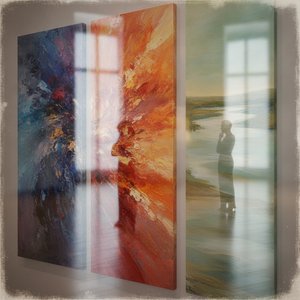
Valliammai’s technique masterfully weaves together disparate influences, from the rhythmic energy of Op Art to the dramatic tension found in Mannerism. She utilized geometric forms and intricate textural variations to create canvases that seem to pulsate with a life of their own. In her evocative works, such as the 1970 masterpiece featuring a solitary figure enveloped in a mesmerizing blue, one finds a profound sense of poetic solitude and mystery. Whether capturing the intimate emotion of a portrait like “Nanou” or exploring the infinite space of the abstract, her legacy remains a vital part of the Indian art canon—a testament to the power of art to reflect both the struggle of the human condition and the quiet tranquility of the soul.