x
작품의 원본 비율을 유지하는 미리 설정된 크기 중에서 선택하세요.

특정 프레임이나 공간에 맞도록 직접 크기를 입력할 수 있습니다. 선택하신 크기가 원본 이미지의 비율과 일치하지 않는 경우, 작품을 자르거나 추가적인 손으로 그린 요소를 사용하여 그림을 확장합니다. 제작 시작 전 승인을 위해 디지털 목업을 보내드립니다.
화면 미리 보기는 실제 자르기 또는 확장을 반영하지 않습니다. 최종 구성은 목업을 통해서만 정확하게 확인하실 수 있습니다.
맞춤 크기 제작도 가능하지만, 원본 비율을 유지하기 위해 사전 정의된 목록에서 크기를 선택하시는 것을 권장합니다.

untitled (5831)
복제본 크기
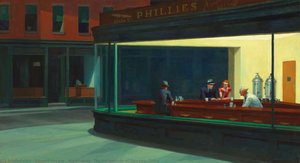
Edward Hopper’s “Nighthawks,” completed in 1942, is more than just a painting; it’s a distilled moment of American experience – a poignant exploration of loneliness and the quiet drama unfolding within the heart of a bustling city. The canvas depicts a late-night diner scene, bathed in an almost theatrical artificial light, instantly captivating viewers with its stark simplicity and profound emotional resonance. Hopper masterfully captures a sense of detachment, inviting us to contemplate the lives of these anonymous figures and the unspoken narratives that surround them.
The painting’s composition is meticulously crafted. The diner itself – a brightly lit rectangle against the enveloping darkness – acts as a stage, isolating its occupants within a carefully constructed space. Hopper's use of color is deliberate and restrained; the dominant hues of red, green, and yellow create a vibrant yet unsettling atmosphere, contrasting sharply with the muted tones of the surrounding cityscape. The sharp angles and geometric forms contribute to the painting’s sense of unease, reinforcing the feeling of confinement and isolation.
Hopper's style is firmly rooted in American Realism, but he transcends mere representation through his masterful manipulation of light and shadow. He employs a technique known as “accidental realism,” capturing fleeting moments of everyday life with an almost photographic precision. However, it’s not simply about accurate depiction; Hopper imbues his scenes with a deep sense of psychological depth. Notice the subtle details – the man's slumped posture, the woman's averted gaze, the bartender’s impassive expression – each contributing to the overall mood of quiet melancholy.
The painting’s execution is characterized by smooth brushstrokes and precise detailing, reflecting Hopper’s meticulous approach to his craft. He utilized oil paints on canvas, layering thin glazes to achieve a luminous effect and create a sense of depth and atmosphere. The use of reflected light within the diner's glass creates an illusion of transparency, further enhancing the painting’s dramatic impact.
"Nighthawks" was created during World War II, a period marked by uncertainty and anxiety in America. This context undoubtedly influenced Hopper’s themes of isolation and alienation, reflecting a growing sense of disillusionment among many Americans. The diner itself can be interpreted as a symbol of the American Dream – a place of refuge and connection – yet ironically, it becomes a space of profound loneliness.
The painting's title, "Nighthawks," evokes images of nocturnal birds, suggesting a sense of vulnerability and solitude. The figures within the diner are left ambiguous, their identities unknown, allowing viewers to project their own emotions and experiences onto the scene. Some art historians suggest Hopper was inspired by Ernest Hemingway’s short story “The Killers,” exploring themes of isolation and despair.
"Nighthawks" remains one of the most iconic images in American art, captivating audiences with its haunting beauty and enduring relevance. It speaks to a universal human experience – the feeling of being alone even amidst crowds, the quiet contemplation of life’s mysteries, and the search for connection in an increasingly fragmented world. Hopper's ability to capture these emotions with such precision and subtlety has ensured that “Nighthawks” continues to resonate with viewers today, solidifying its place as a masterpiece of American Realism.

1931 - 1967 , 미국

Explore the profound history of American Regionalism. Discover how Grant Wood captured the heart of the Midwest through masterpieces like American Gothic. An expert guide to the movement, its cultural impact, and the enduring beauty of American Realism.


최신 미술 뉴스, 특별 혜택 및 인테리어 아이디어를 가장 먼저 만나보세요.
프로젝트에 대해 알려주시면 저희 미술 전문가들이 맞춤형 아트 제안 3가지를 전달해 드립니다.
당신만을 위한 맞춤형 옵션 3가지를 무료로 추천해 드립니다!


 미리보기
미리보기
 프린트 구매
 공유하기
공유하기 공유하기
공유하기
 상세 정보
상세 정보

 다운로드
다운로드
 유사 작품
유사 작품 X-레이
X-레이 슬라이드 쇼
 더 보기
더 보기






































 유리 옵션은 110cm 미만 크기에서만 선택 가능합니다.