


x
원하는 크기와 액자로 주문 제작되는, 작가들이 직접 캔버스에 손으로 그린 유화 작품입니다. ( 프린트 주문으로 전환 이미지로 전환)
작품의 원본 비율을 유지하는 미리 설정된 크기 중에서 선택하세요.

특정 프레임이나 공간에 맞도록 직접 크기를 입력할 수 있습니다. 선택하신 크기가 원본 이미지의 비율과 일치하지 않는 경우, 작품을 자르거나 추가적인 손으로 그린 요소를 사용하여 그림을 확장합니다. 제작 시작 전 승인을 위해 디지털 목업을 보내드립니다.
화면 미리 보기는 실제 자르기 또는 확장을 반영하지 않습니다. 최종 구성은 목업을 통해서만 정확하게 확인하실 수 있습니다.
맞춤 크기 제작도 가능하지만, 원본 비율을 유지하기 위해 사전 정의된 목록에서 크기를 선택하시는 것을 권장합니다.

Tondo (Studie), 1973
복제본 크기

Born in Zurich, Switzerland, in 1899 and ultimately finding his home in the United States, Fritz Glarner stands as a pivotal figure in the development of concrete art – a movement that sought to strip away representational imagery and embrace pure geometric form. His journey wasn’t one of sudden revelation but rather a gradual evolution, deeply rooted in the principles of Piet Mondrian and culminating in his own distinctive “relational painting.” Glarner's work represents a fascinating dialogue with modernism, a deliberate rejection of illusionistic space while simultaneously exploring the dynamic potential within simplified shapes and colors.
Early influences were decidedly European. His formative years in Naples, Italy, exposed him to classical art and architecture, while his studies at the Reggio Instituto di Belle Arti further solidified his understanding of artistic tradition. However, it was his time in Paris during the 1920s and early 30s that proved transformative. Here, he encountered the burgeoning Abstraction-Création group, a collective dedicated to exploring non-objective art – a crucial stepping stone towards his own unique style.
Glarner’s artistic trajectory became inextricably linked with that of Piet Mondrian. He was profoundly influenced by Mondrian's theories of “dynamic symmetry,” particularly the artist’s rigorous system for organizing space and color based on horizontal and vertical lines intersecting at right angles. Yet, Glarner didn’t simply replicate Mondrian’s aesthetic; he actively pushed against its perceived rigidity. He introduced a crucial element – the diagonal – into the strict geometric framework, creating a sense of movement and spatial depth that was absent in Mondrian's earlier work. This subtle but significant alteration fundamentally shifted the visual experience of his paintings.
This innovation led to what Glarner termed “relational painting.” Rather than focusing on a single, dominant form or color, he developed a system where each element – line, shape, and hue – was intrinsically linked to its surrounding counterparts. The composition wasn’t about creating a static image but rather establishing a dynamic equilibrium between the elements, a carefully orchestrated interplay of relationships. He maintained Mondrian's commitment to a limited palette of primaries—red, yellow, and blue—and expanded upon Mondrian’s use of black lines, employing a range of grays to add further nuance and depth.
Glarner’s most recognizable output is the “tondo,” a circular format that became his signature. Within this contained space, he meticulously arranged simplified geometric forms according to his relational principles. The circle itself isn't merely a frame; it actively participates in the composition, creating a sense of unity and suggesting an infinite expanse beyond its boundaries. The tondo form provided a powerful visual metaphor for Glarner’s artistic philosophy – a contained system governed by precise rules yet capable of generating complex and engaging results.
His work is often described as “non-illusionistic,” meaning that it deliberately avoids creating the illusion of depth or perspective. Instead, he sought to represent space through the relationships between forms, suggesting volume and dimension through their arrangement within the circular field. This approach was a radical departure from traditional painting techniques and aligned with the core tenets of concrete art.
Fritz Glarner’s influence extends far beyond his own lifetime. His work is recognized as a cornerstone of concrete art, a movement that profoundly shaped the course of 20th-century abstraction. His paintings are held in prestigious collections, including the Museo Cantonale d’Arte of Lugano, Switzerland, and the Governor Nelson A. Rockefeller Empire State Plaza Art Collection in Albany, New York. His legacy lies not only in his distinctive visual style but also in his pioneering approach to composition and his unwavering commitment to exploring the fundamental principles of art.
Glarner’s life was marked by both artistic achievement and personal hardship. A serious injury sustained during a transatlantic voyage in 1966 forced him to return to Switzerland, where he ultimately passed away in Locarno in 1972. Despite the challenges he faced, his artistic vision continued to resonate, solidifying his place as one of the most important figures in the history of concrete art.
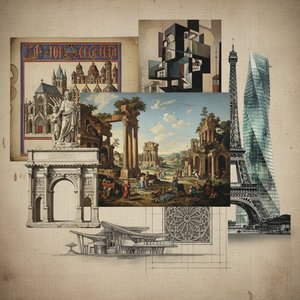
Explore the rich history of architecture in art, from Renaissance theory to 19th-century reconstructions. Discover key artists & movements shaping visual representation – a guide for discerning collectors.

Discover how expert art curation transforms interiors. Explore case studies showcasing spatial harmony & emotional impact. Elevate your space with personalized selections and the guidance of a dedicated art concierge.

Explore the enduring legacy of geometric abstraction! Discover key artists, historical movements & investment insights for discerning art collectors. Expert guidance from Most-Famous-Paintings.

Explore the profound artistic significance of sketches throughout history. From Renaissance masters to modern innovators like Van Gogh & Guston, discover how these foundational works reveal technique, emotion, and vision. Learn more at Most-Famous-Paintings.

Explore the life & work of Charles Wild, a master of Post-Impressionist landscape. Discover his architectural engravings, watercolour techniques, and evocative depictions of atmospheric emotion. Expert insights for collectors.


최신 미술 뉴스, 특별 혜택 및 인테리어 아이디어를 가장 먼저 만나보세요.
프로젝트에 대해 알려주시면 저희 미술 전문가들이 맞춤형 아트 제안 3가지를 전달해 드립니다.
당신만을 위한 맞춤형 옵션 3가지를 무료로 추천해 드립니다!


 미리보기
미리보기
 공유하기
공유하기 공유하기
공유하기
 상세 정보
상세 정보

 다운로드
다운로드
 유사 작품
유사 작품 X-레이
X-레이 슬라이드 쇼
 더 보기
더 보기






































 유리 옵션은 110cm 미만 크기에서만 선택 가능합니다.


![Construction En Laiton [brass Construction] — Max Bill, Concrete Art](/media/artworks/images/thumbnails/c8/88/c8882ff17f2a40ccaacfcd1aba3c74cf.jpg)


