


x
 InkWallArtAbstract Expressionism
 Modern
 119.0 x 119.0 cm
 Barjeel Art Foundation
빠른 제작과 다양한 마감 옵션을 제공하는 박물관 품질의 지클레이 또는 캔버스 프린트. ( 손으로 그린 그림 구매 이미지 구매)
작품의 원본 비율을 유지하는 미리 설정된 크기 중에서 선택하세요.

특정 프레임이나 공간에 맞춰 직접 치수를 입력하실 수 있습니다. 선택하신 사이즈가 원본 이미지의 비율과 일치하지 않을 경우, 작품을 크롭(자르기)하거나 이미지를 대칭 또는 단색 채우기로 확장하여 제작합니다. 제작 시작 전, 최종 확인을 위해 디지털 목업이 전송됩니다.
화면상의 미리보기는 실제 크롭이나 확장 상태를 반영하지 않으므로, 최종 구도는 오직 목업을 통해서만 정확하게 확인하실 수 있습니다.
맞춤 사이즈 제작도 가능하지만, 원본 비율을 유지하기 위해서는 사전 정의된 목록에서 치수를 선택하시는 것을 권장합니다.

Untitled (
복제본 크기

Born in Berlin in 1931, Frank Auerbach’s life was profoundly shaped by the tumultuous events of the 20th century. His early years were marked by upheaval – his Jewish parents fled Nazi Germany when he was just a boy, seeking refuge in England. This experience, coupled with the loss of his family during World War II, instilled within him a deep sense of melancholy and a profound connection to the human condition, themes that would become central to his intensely personal and emotionally charged paintings.
Auerbach’s artistic journey began at St Martin's School of Art in London, where he was mentored by David Bomberg. This early influence proved crucial, shaping his approach to color and composition. However, Auerbach quickly developed a distinctive style that diverged from traditional academic painting. He eschewed meticulous detail and polished surfaces, instead favoring thick, impastoed layers of paint applied with a palette knife – a technique that lent his work a raw, almost sculptural quality. His subjects were largely drawn from the lives around him: his wife Julia, his model Juliet Yardley Mills ('J.Y.M.'), and his close friend Estella West ('E.O.W.')—figures rendered in muted tones and imbued with an aura of quiet contemplation.
Auerbach’s work is often described as “School of London” art, a loosely defined group of British painters who emerged in the post-war era. This movement was characterized by its rejection of abstract expressionism and its focus on subjective experience and emotional intensity. Auerbach's paintings are not merely representations of his subjects; they are expressions of feeling—a visceral outpouring of grief, loneliness, and a yearning for connection. Critics initially struggled to categorize his work, with some dismissing it as “sculpture” due to the sheer physicality of the paint application, while others recognized its profound painterly qualities.
Auerbach’s technique is arguably his most defining characteristic. He built up layers of paint—often several inches thick—using a palette knife and other tools, creating surfaces that are both tactile and visually arresting. This impastoed style wasn't simply about adding texture; it was a deliberate attempt to convey emotion directly onto the canvas. The physicality of the paint itself becomes an integral part of the narrative, mirroring the intensity of his inner world.
His color palette is deliberately restrained—primarily consisting of dark blues, greens, and browns, punctuated by occasional flashes of red or yellow. These muted tones contribute to the paintings’ somber mood, while also creating a remarkable sense of depth and luminosity. Auerbach rarely used brushes; instead, he favored tools that allowed him to manipulate the paint in a more direct and expressive manner. This hands-on approach resulted in a unique visual language—one that is both deeply personal and universally resonant.
Among Auerbach’s most celebrated works are “Mornington Crescent – Summer Morning” (1954), a poignant depiction of his neighborhood, and the series of portraits featuring Julia, J.Y.M., and E.O.W. These paintings offer intimate glimpses into the lives of these figures, capturing their quiet dignity and vulnerability. His 1978 retrospective at the Hayward Gallery in London cemented his place as one of Britain’s most important post-war painters.
He received an Arts Council retrospective in 1978 and had solo exhibitions at the British Pavilion in the 1986 Venice Biennale, and at the Rijksmuseum Vincent Van Gogh, Amsterdam, 1989. His work has been exhibited extensively throughout Europe and America.
Frank Auerbach’s legacy extends far beyond his individual paintings. He demonstrated that painting could be a profoundly emotional experience—a means of confronting difficult truths and expressing the complexities of human existence. His distinctive technique, characterized by its thick paint application and muted color palette, has influenced generations of artists.
His work continues to resonate with viewers today, offering a powerful reminder of the enduring power of art to connect us to our shared humanity. Auerbach’s paintings are not simply beautiful objects; they are windows into a soul—a testament to the transformative potential of artistic expression.

1931 - 2019 , Egypt
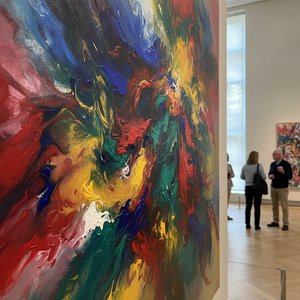
Explore the profound emotional depth of Lyrical Abstraction. Discover how masters like Raymond Parker used color and form to bridge Impressionism and Abstract Expressionism. Learn about this pivotal movement through our expert-led art history guide.

Explore the profound artistry of black and white photography. From the chemistry of gelatin silver to the chiaroscuro of the Old Masters, discover how monochrome captures the eternal essence of light, form, and emotion for the discerning art collector.

Explore the profound emotional depth of Color Field painting. Discover the history of mid-century abstraction, from Rothko to Newman, and learn how pure color transforms the viewer's experience through our expert art history guide.


최신 미술 뉴스, 특별 혜택 및 인테리어 아이디어를 가장 먼저 만나보세요.
프로젝트에 대해 알려주시면 저희 미술 전문가들이 맞춤형 아트 제안 3가지를 전달해 드립니다.
당신만을 위한 맞춤형 옵션 3가지를 무료로 추천해 드립니다!


 미리보기
미리보기
 공유하기
공유하기 공유하기
공유하기
 상세 정보
상세 정보

 다운로드
다운로드
 유사 작품
유사 작품 X-레이
X-레이 슬라이드 쇼
 더 보기
더 보기






































 유리 옵션은 110cm 미만 크기에서만 선택 가능합니다.


![Abstract Composition [triptych] — Vaclav Vytlacil, Abstract Expressionism](/media/artworks/images-thumb/08/3c/083c0675045645fd42d4e6c6d63f1ced.jpg)


