x
빠른 제작과 다양한 마감 옵션을 제공하는 박물관 품질의 지클레이 또는 캔버스 프린트. ( 손으로 그린 그림 구매 이미지 구매)





























작품의 원본 비율을 유지하는 미리 설정된 크기 중에서 선택하세요.

특정 프레임이나 공간에 맞춰 직접 치수를 입력하실 수 있습니다. 선택하신 사이즈가 원본 이미지의 비율과 일치하지 않을 경우, 작품을 크롭(자르기)하거나 이미지를 대칭 또는 단색 채우기로 확장하여 제작합니다. 제작 시작 전, 최종 확인을 위해 디지털 목업이 전송됩니다.
화면상의 미리보기는 실제 크롭이나 확장 상태를 반영하지 않으므로, 최종 구도는 오직 목업을 통해서만 정확하게 확인하실 수 있습니다.
맞춤 사이즈 제작도 가능하지만, 원본 비율을 유지하기 위해서는 사전 정의된 목록에서 치수를 선택하시는 것을 권장합니다.

Terz
복제본 크기
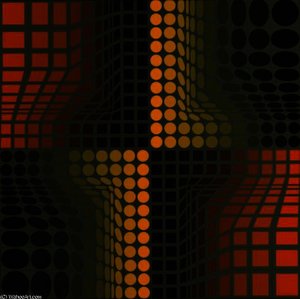
Victor Vasarely's "Terz" is more than just a painting; it’s an invitation into the very fabric of perception, a testament to the revolutionary impact of Op Art and the burgeoning fascination with geometric abstraction in the mid-20th century. This captivating work, rendered in a striking interplay of blue and white, immediately draws the viewer into its meticulously constructed world – a miniature universe contained within a seemingly simple arrangement of squares.
Born Károly Vaszary in 1906 in Pécs, Croatia (then part of Austria-Hungary), Vasarely’s artistic trajectory was initially rooted in the scientific. His early studies in medicine at Eötvös Loránd University hinted at a logical, analytical mind – a perspective that would later become central to his groundbreaking approach to art. However, abandoning the path of healing for painting in 1927 marked a profound shift, fueled by an intense desire to explore how the eye perceives and interprets visual information. This pursuit led him to the influential Podolini-Volkmann Academy and, crucially, Sándor Bortnyik’s “Műhely” workshop, where he absorbed the principles of functional design and geometric abstraction championed by the Bauhaus movement – a movement that prioritized clarity, functionality, and an understanding of optical illusions.
"Terz" exemplifies the core tenets of Op Art, a style pioneered by Vasarely and his contemporaries. This artistic movement sought to create optical illusions through precise arrangements of color and shape, manipulating the viewer’s perception of depth, movement, and space. The painting's seemingly static composition is anything but; the carefully calibrated squares generate an illusion of continuous motion, drawing the eye across the canvas in a mesmerizing dance. Vasarely wasn't simply depicting shapes; he was actively engaging with the science of visual perception, demonstrating how our brains construct reality based on sensory input.
The execution of "Terz" is characterized by an almost obsessive attention to detail. The numerous small squares are arranged in a circular fashion, creating a sense of continuity and echoing the principles of modular design. This deliberate construction isn't haphazard; it’s a carefully calculated harmony – a visual equation designed to exploit the brain’s natural tendency to seek patterns and order. Vasarely’s mastery lies in his ability to harness this inherent human response, transforming a simple geometric arrangement into a powerfully evocative image. The use of contrasting colors further amplifies the illusion, enhancing the sense of depth and movement.
"Terz," like much of Vasarely’s work, transcends mere visual representation to explore fundamental questions about reality itself. The geometric forms can be interpreted as representing the building blocks of the universe – a reflection of Vasarely's fascination with mathematics, physics, and the underlying order of existence. The painting evokes a sense of calm contemplation, inviting viewers to lose themselves in its intricate patterns and contemplate the nature of perception. It’s a piece that rewards repeated viewing, revealing new nuances and complexities with each encounter.

1906 - 1997 , 크로아티아

Explore the science of Op Art through the lens of masters like Victor Vasarely. Discover how geometric abstraction uses optical illusions to create movement and delve into the neuroaesthetics of perception with our expert art history guide.

Explore the profound impact of Minimalism and Geometric Abstraction. From Mondrian to Malevich, discover how stripping art to its essential forms revolutionized modern aesthetics through our expert-led historical guide.


최신 미술 뉴스, 특별 혜택 및 인테리어 아이디어를 가장 먼저 만나보세요.
프로젝트에 대해 알려주시면 저희 미술 전문가들이 맞춤형 아트 제안 3가지를 전달해 드립니다.
당신만을 위한 맞춤형 옵션 3가지를 무료로 추천해 드립니다!


 미리보기
미리보기
 공유하기
공유하기 공유하기
공유하기
 상세 정보
상세 정보

 다운로드
다운로드
 유사 작품
유사 작품 X-레이
X-레이 슬라이드 쇼

 더 보기
더 보기









 유리 옵션은 110cm 미만 크기에서만 선택 가능합니다.