x

Met de hand geschilderd in olieverf op canvas in uw gewenste maat en lijst, op bestelling gemaakt door onze kunstenaars. ( Bestel print Koop afbeelding)





























Kies uit onze vooraf ingestelde maten die overeenkomen met de originele verhoudingen van het kunstwerk.

U kunt uw eigen afmetingen invoeren om in een specifieke lijst of ruimte te passen. Als de door u gekozen maat niet overeenkomt met de verhoudingen van het originele beeld, zullen we het kunstwerk bijsnijden of het schilderij uitbreiden met extra handgeschilderde elementen. Een digitale mockup wordt ter goedkeuring naar u verzonden voordat de productie begint.
Houd er rekening mee dat de preview op het scherm niet de werkelijke uitsnede of uitbreiding weergeeft. Alleen de mockup toont de uiteindelijke compositie nauwkeurig.
Hoewel aangepaste afmetingen mogelijk zijn, raden we aan een maat uit de vooraf gedefinieerde lijst te selecteren om de originele verhoudingen te behouden.
Wereldwijde levering () binnen 3 tot 4 weken in plaats van de standaard 5 weken. (14 augustus). Zonder concessies aan de kwaliteit.


Colored Composition of Forms, 1914
Afmetingen reproductie
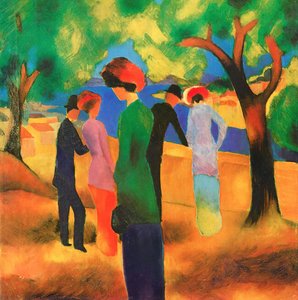
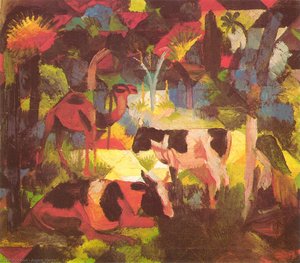
August Macke's Colored Composition of Forms, painted in the tumultuous year of 1914, is a captivating testament to the burgeoning energy of German Expressionism. This vibrant work, dominated by a central tennis racket – a seemingly mundane object elevated to symbolic importance – embodies Macke’s exploration of modern life and his desire to capture fleeting moments of intense feeling. The painting isn't simply a depiction; it’s an emotional resonance rendered in bold color and fractured forms. Created just months before the artist’s untimely death at the age of 27, the work carries with it the weight of a generation poised on the brink of war, reflecting both optimism and a profound sense of unease.
Macke’s use of color is utterly crucial to understanding this work. He rejects naturalistic representation in favor of an intensely chromatic approach. The palette – a riot of blues, greens, yellows, and reds – isn’t intended to mimic reality but rather to convey emotion directly. The vibrant hues evoke a sense of energy, excitement, and perhaps even anxiety. Notice how the cooler tones of blue and green are juxtaposed with the warmer shades of yellow and red, creating visual tension and amplifying the painting's emotional impact. This deliberate manipulation of color aligns perfectly with the Expressionist desire to express inner feelings rather than simply depict external appearances.
The inclusion of seemingly random objects – a bowl, a cup, and other scattered items – adds layers of symbolic meaning. These fragments could represent the brokenness of modern life, the anxieties surrounding rapid industrialization, or perhaps even the artist’s own fragmented state of mind. Painted in 1914, a year marked by political instability and impending war, the work resonates with the broader historical context of the time. Macke was deeply concerned with portraying the experiences of ordinary people – particularly children – and his art reflects this social consciousness.
Colored Composition of Forms is more than just a visually striking painting; it’s an emotionally charged experience. The dynamic composition, bold colors, and fragmented forms combine to create a powerful sense of movement and energy. Macke's work foreshadowed the key tenets of Expressionism – a focus on subjective emotion, distortion of form, and the use of color as a primary means of expression. It stands as a poignant reminder of a brilliant artist’s tragically short career and his significant contribution to the development of modern art.


1887 - 1914 , Duitsland

Explore the visceral power of German Expressionism. From Ernst Ludwig Kirchner to Die Brücke, discover how bold colors and distorted forms unmask raw human emotion in this expert art history guide for collectors and enthusiasts.

Explore the raw realism of Neue Sachlichkeit. Discover how German New Objectivity artists like Otto Dix and George Grosz captured the turbulent Weimar Republic through unflinching social critique and precise detail. A definitive guide for art historians and collectors.


Blijf op de hoogte van het laatste kunstnieuws, exclusieve aanbiedingen en decoratie-ideeën.
Vertel ons over uw project en onze kunstexperts geven u 3 gepersonaliseerde kunstsuggesties.
Wij stellen drie opties speciaal voor u samen – gratis!


 Voorvertoning
 Verstuur
 Delen
Delen
 Details bekijken

 Download
 Vergelijkbare items
 Röntgenonderzoek
 Diavoorstelling


 Lees meer







 De optie voor glas is alleen beschikbaar bij een formaat kleiner dan 110 cm.