


x


Giclée- of canvasafdruk van museumkwaliteit met snelle productie en flexibele afwerkingsopties. ( Switch to hand made Painting Switch to Image)
Kies uit onze vooraf ingestelde maten die overeenkomen met de originele verhoudingen van het kunstwerk.

U kunt uw eigen afmetingen opgeven om in een specifieke lijst of ruimte te passen. Als de door u gekozen maat niet overeenkomt met de proporties van het originele kunstwerk, zullen wij de afbeelding bijsnijden of uitbreiden met een gespiegelde of effen rand. Een digitaal mockup wordt ter goedkeuring naar u verzonden voordat de productie begint.
Houd er rekening mee dat de preview op het scherm de werkelijke bijsneding of uitbreiding niet weergeeft. Alleen de mockup toont de uiteindelijke compositie nauwkeurig.
Hoewel aangepaste maten beschikbaar zijn, raden wij aan een afmeting uit de vooraf bepaalde lijst te kiezen om de originele proporties te behouden.
Wereldwijde levering () binnen 2 weken in plaats van de standaard 4/5 weken. (28 juli)


Minerva
Afmetingen reproductie
Benvenuto Cellini's "Minerva," crafted in 1545 during the twilight of the High Renaissance, isn't merely a bronze sculpture; it’s a meticulously constructed embodiment of Roman virtue and strategic intellect. This imposing figure, standing nearly nine feet tall and housed within the hallowed halls of Florence’s Bargello Museum, commands attention not just through its scale but through the profound depth of its symbolism and the sheer virtuosity of Cellini's hand.
Cellini, a polymath renowned as a goldsmith, sculptor, and celebrated author of his own captivating autobiography, infused this work with the spirit of his era – a blend of Mannerist drama, classical ideals, and an undeniable flair for the theatrical. He wasn’t simply replicating a goddess; he was channeling her essence, imbuing the bronze with a palpable sense of power, wisdom, and strategic command. The sculpture represents Minerva, the Roman deity associated with intelligence, justice, and victory in battle – qualities that Cellini himself embodied throughout his extraordinary life.
The creation of "Minerva" is a testament to Cellini’s unparalleled skill as a sculptor. The piece exemplifies the lost-wax casting method, a technique demanding immense patience and precision. First, a wax model was meticulously crafted, capturing every nuance of Minerva's pose – her right arm raised in a gesture of authority, her left hand holding drapery that flows with dynamic grace. This delicate wax form was then encased in layers of clay, creating a robust mold. Once the clay hardened, it was carefully removed, revealing the wax model beneath. Finally, molten bronze was poured into the mold, filling every crevice and contour. Upon cooling, the mold was broken away, leaving behind the solid bronze sculpture.
Crucially, Cellini didn’t rely solely on the inherent beauty of the metal; he masterfully manipulated its surface to create a rich, complex patina – a layer of color achieved through controlled oxidation and polishing. The deep browns, ochres, and hints of reddish-browns aren't merely decorative; they enhance the sculpture’s three-dimensionality, highlighting the textures of the drapery, the musculature of Minerva’s body, and the subtle sheen of the bronze itself. This careful attention to surface detail elevates the work beyond a simple representation, transforming it into a truly immersive experience for the viewer.
Beyond its technical brilliance, "Minerva" is laden with symbolic meaning. The goddess’s posture – her raised arm and commanding gaze – immediately conveys authority and strategic thinking. Her attire, a flowing robe adorned with intricate folds, speaks to both dignity and grace. But it's the details that truly reveal Cellini’s intent. Minerva holds a shield, not of war, but one reflecting the image of the sea, symbolizing her dominion over both land and water – representing wisdom and strategy. The inclusion of marine creatures—horses, fish, and shells—further reinforces this connection to the ocean's depths, suggesting an understanding of hidden knowledge and strategic foresight.
The sculpture’s placement within the Loggia dei Lanzi in Florence is also significant. This open-air gallery, a showcase for Renaissance art, served as a public forum for artistic expression and intellectual debate. By placing "Minerva" here, Cellini sought to engage viewers in a contemplation of virtue, intellect, and the complexities of leadership – qualities that resonated deeply with the Florentine elite of his time.
“Minerva” stands as a pivotal work in Benvenuto Cellini’s oeuvre and a landmark achievement in Renaissance sculpture. It exemplifies the artist's mastery of technique, his profound understanding of symbolism, and his ability to capture the essence of classical ideals within a distinctly Mannerist style. More than just a beautiful object, it is a window into the mind of a remarkable artist – a testament to the enduring power of art to inspire, provoke thought, and transcend time.
Benvenuto Cellini, geboren in Florence in 1500 en overleden in 1571, was meer dan slechts een kunstenaar; hij belichaamde de geest van de Italiaanse renaissance. Een goudsmid, beeldhouwer, soldaat, musicus én schrijver – zijn leven was een bruisende mix van passie, ambitie en avontuur, vastgelegd in een autobiografie die even kleurrijk is als zijn kunstwerken. Cellini staat symbool voor het maniërisme, een stijlperiode die volgde op de hoogrenaissance en zich kenmerkte door dramatische flair, complexe composities en een verfijnde elegantie.
Cellini’s jeugd was doordrenkt van muziek; zijn vader was een befaamd musicus en instrumentmaker. Aanvankelijk toonde hij zelf ook muzikale aanleg, maar op vijftienjarige leeftijd koesterde hij een onwrikbare passie voor het goudsmidwerk. Tegen de bedenkingen van zijn vader in, werd hij leerling bij Antonio di Sandro, beter bekend als Marcone. Deze beslissing zou zijn leven vormgeven. Zijn vroege jaren waren niet zonder tegenslag; een schermutseling op zestienjarige leeftijd leidde tot ballingschap uit Florence en een periode werken onder de goudsmid Fracastoro in Siena. Deze ervaringen, hoewel turbulent, scherpten zijn vaardigheden en versterkten zijn vastberadenheid.
Cellini’s artistieke nalatenschap is rijk en divers. Zijn goudwerk, met name het beroemde zoutvat voor koning Franciscus I van Frankrijk, getuigt van een ongeëvenaarde beheersing van detail en compositie. Het zoutvat, nu te bewonderen in het Kunsthistorisches Museum in Wenen, is meer dan slechts een functioneel object; het is een sculpturale tour de force vol dynamische figuren en ingewikkelde decoraties. Maar Cellini’s bekendste werk blijft wellicht ‘Perseus met het hoofd van Medusa’, een bronzen beeldhouwwerk dat in de Loggia dei Lanzi in Florence staat. Dit monumentale kunstwerk, gegoten in één stuk – een technisch hoogstandje – toont Perseus triomfantelijk over de verslagen Medusa. De expressie van beweging en emotie die Cellini wist vast te leggen in het metaal is werkelijk adembenemend.
Cellini was niet alleen een kunstenaar; hij was ook een soldaat, die deelnam aan belegeringen en beweerde een cruciale rol te hebben gespeeld bij de verdediging van Rome. Hij was een begaafd musicus, die cornett en fluit bespeelde aan het pauselijk hof. Maar het is zijn autobiografie die hem echt onderscheidt. Dit openhartige en soms opschepperige verslag biedt een unieke kijk op de kunstwereld, de cultuur en de samenleving van de renaissance. Het boek is gevuld met anekdotes over beschermheren, rivalen en persoonlijke avonturen, waardoor we een levendig beeld krijgen van het leven van deze uitzonderlijke man.
Benvenuto Cellini stierf in 1571 en liet een onuitwisbare indruk achter op de kunstwereld. Zijn technische vaardigheid, zijn artistieke innovatie en zijn boeiende autobiografie blijven kunstenaars en liefhebbers inspireren. Hij belichaamt het ideale van de renaissance: een veelzijdig genie, gedreven door ambitie en niet bang om zijn individualiteit te uiten. Zijn werken worden bewonderd om hun schoonheid, vakmanschap en dramatische kracht, waardoor hij terecht wordt beschouwd als een sleutelfiguur in de westerse kunstgeschiedenis.

1500 - 1571 , Italië

Explore the life & art of Benvenuto Cellini, Renaissance goldsmith & sculptor. Discover his iconic 'Perseus,' masterful techniques, and enduring legacy – a collector's essential guide.
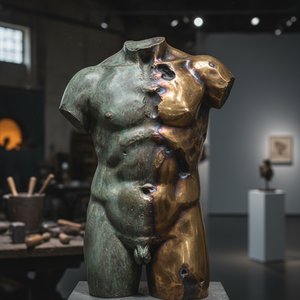
Ontdek de rijke geschiedenis en het duurzame erfgoed van bronzen beeldhouwkunst. Van klassieke technieken tot hedendaagse interpretaties, een gids voor verzamelaars en kunstliefhebbers.

Explore the rich history & enduring appeal of bronze sculpture with expert insights for collectors at Most-Famous-Paintings. Learn about casting techniques, iconic artists, and collecting tips to build a discerning art collection.

Ontdek de 10 meest legendarische bronzen meesterwerken die de kunstgeschiedenis veranderden! Van Rodin tot Michelangelo, leer over techniek & betekenis. Museumkwaliteit reproducties voor uw interieur op Most-Famous-Paintings.com. Exploreer de collectie online!

Ontdek de 10 meest legendarische bronzen beeldhouwwerken die kunstgeschiedenis schreven! Van Rodin tot Michelangelo, leer over hun meesterwerken & technieken. Vind museumkwaliteit reproducties en inspiratie voor uw interieur op Most-Famous-Paintings.com.


Blijf op de hoogte van het laatste kunstnieuws, exclusieve aanbiedingen en decoratie-ideeën.
Vertel ons over uw project en onze kunstexperts geven u 3 gepersonaliseerde kunstsuggesties.
Wij stellen 3 opties speciaal voor u samen – Gratis!


 Verstuur
 Delen
Delen
 Details bekijken

 Download
 Vergelijkbare werken
 Diavoorstelling


 Lees meer




































 De optie voor glas is alleen beschikbaar bij een formaat kleiner dan 110 cm.


