Verkoop uw kunst
Verlanglijstje Winkelwagen Cart
VoorvertoningVoorvertoning Bekijk in ARBekijk in AR Bestel print Bestel printKoop afbeelding Koop afbeelding VerstuurVerstuur
Details bekijkenDetails bekijken Toevoegen aan favorieten Toevoegen aan favorieten DownloadDownload Vergelijkbare itemsVergelijkbare items RöntgenonderzoekRöntgenonderzoek DiavoorstellingDiavoorstelling

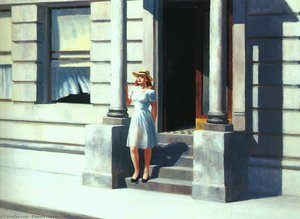
untitled (1885)

Experience the haunting beauty of Edward Hopper's 'untitled (1885)' – a masterful depiction of urban solitude and quiet contemplation, bathed in evocative light. Explore a timeless classic.

Edward Hopper: Een meester van Amerikaanse realisme, vangt eenzaamheid en stedelijk leven met evocatieve licht & schaduw. Ontdek iconische schilderijen zoals Nighthawks.

Handgemaakte olieverfreproductie

Met de hand geschilderd in olieverf op canvas in uw gewenste maat en lijst, op bestelling gemaakt door onze kunstenaars. (Bestel print Bestel printKoop afbeelding Koop afbeelding)

P118B $10
P118H $10
P118W $10
P438Z $10
P508JH $12
P508YH $12
P805H $10
P805Z $10
P919BZ $10
P919G $10
P919XJ $10
P959ZH $10
P968JZ $12
W106C $8
W218G $10
W218JH $8
W218Y $10
W307PJ $10
W316G $10
W316PJ $8
W316Y $10
W398PJ $8
W4111J $10
W500HY $15
W500JH $15
W692G $12
W849H $8
W940BG $15
W953PJ $8

Standard
custom
CM
INCH

Kies uit onze vooraf ingestelde maten die overeenkomen met de originele verhoudingen van het kunstwerk.

breedte
hoogte

U kunt uw eigen afmetingen invoeren om in een specifieke lijst of ruimte te passen. Als de door u gekozen maat niet overeenkomt met de verhoudingen van het originele beeld, zullen we het kunstwerk bijsnijden of het schilderij uitbreiden met extra handgeschilderde elementen. Een digitale mockup wordt ter goedkeuring naar u verzonden voordat de productie begint.
Houd er rekening mee dat de preview op het scherm niet de werkelijke uitsnede of uitbreiding weergeeft. Alleen de mockup toont de uiteindelijke compositie nauwkeurig.
Hoewel aangepaste afmetingen mogelijk zijn, raden we aan een maat uit de vooraf gedefinieerde lijst te selecteren om de originele verhoudingen te behouden.

Voorbeelden van aanpassingen: Vervang het gezicht met een eigen foto; Voeg een huisdier toe (bijv. vervang de kat door een hond); Verwerk een verborgen boodschap in de achtergrond; Wijzig het landschap of andere elementen in de achtergrond.
Na de bestelling zal het team van Most-Famous-Paintings.com per e-mail contact opnemen met de klant voor instructies en een mockup-voorbeeld sturen.

Wereldwijde levering () binnen 3 tot 4 weken in plaats van de standaard 5 weken. (14 augustus). Zonder concessies aan de kwaliteit.

why_choose_icon
Gratis wereldwijde expressverzending
why_choose_icon
Hoogwaardig linnen canvas
why_choose_icon
Volledige verzendverzekering
why_choose_icon
Garantie op terugbetaling van invoerrechten
why_choose_icon
Garantie op exacte kleurweergave
why_choose_icon
Retourbeleid van 60 dagen (alleen bij defecten)
why_choose_icon
100% Geld-terug-garantie
why_choose_icon
Korting bij meerdere afnames

Totaalprijs

$ 272

reproduction

untitled (1885)

Druktechniek

Afmetingen reproductie

-

Eindtotaal

$ 272

Snelle feiten

  • Notable elements or techniques: Evocative light & shadow
  • Title: untitled (1885)
  • Medium: Oil on Canvas
  • Artist: Edward Hopper
  • Location: Private Collection
  • Movement: American Realism

Kunstquiz

Er is slechts één goed antwoord op elke vraag.

Vraag 1:
What is the predominant mood conveyed by Edward Hopper’s ‘untitled (1885)’?
Vraag 2:
The painting depicts a scene in which setting?
Vraag 3:
What artistic technique is Hopper known for utilizing to create his distinctive visual style?
Vraag 4:
The woman in ‘untitled (1885)’ is positioned to gaze out at what?
Vraag 5:
Which artistic movement is Hopper considered a key figure within?

Beschrijving kunstwerk

A Window into Quietude: The Enigmatic World of Edward Hopper

In the quiet corners of American realism, few works capture the profound tension between presence and absence as poignantly as Edward Hopper’s "Untitled (1885)". This evocative canvas serves as a masterful distillation of the anxieties and aspirations inherent in the modern experience, offering a scene that feels both intimately familiar and hauntingly distant. At first glance, the painting presents a serene moment: a man and a woman positioned on the porch of a house, bathed in the diffused, gentle glow of daytime sunlight. Yet, beneath this tranquil surface lies a complex psychological landscape. As their gazes drift outward toward the bustling city street below, an immediate sense of separation emerges, creating a palpable boundary between the private sanctuary of the porch and the vibrant, indifferent activity of the urban world.

Hopper’s signature technique is on full display here, showcasing a meticulous realism that avoids the mere imitation of life in favor of a deeper, more symbolic truth. Eschewing the fleeting, light-drenched impressions of the Impressionists, Hopper employs a deliberate simplification of form and a controlled palette to convey mood. The composition is anchored by muted tones—predominantly deep blues and earthy browns—which reinforce an atmosphere of quiet melancholy. By utilizing geometric shapes, particularly the stark rectangles of architectural elements, he creates a sense of spatial restraint that mirrors the emotional containment of his subjects. This structural precision does not merely define the setting; it builds a cage of sorts, emphasizing the isolation felt by the figures within the frame.

The Architecture of Solitude and Urban Life

To understand this piece is to understand the historical currents of an era marked by rapid industrialization and the rise of the American metropolis. "Untitled (1885)" emerges from a period where the growth of cities fostered new, complex feelings of alienation and detachment. The painting acts as a mirror to this cultural preoccupation with solitude. While the background reveals other individuals engaged in the rhythmic, daily activities of the city street, they remain secondary to the central emotional weight of the couple on the porch. This contrast between the lively, collective movement of the crowd and the still, introspective state of the protagonists creates a powerful symbolic resonance, touching upon themes that would later define modernist movements such as Surrealism and Expressionism.

For the discerning collector or interior designer, this work offers more than just aesthetic beauty; it provides a profound emotional anchor for a space. The painting’s ability to evoke nostalgia, stillness, and contemplation makes it an extraordinary centerpiece for environments that value depth and storytelling. Whether placed in a contemporary gallery setting or a classic study, the reproduction of such a masterpiece invites viewers to pause and reflect. It is a piece that does not demand attention through loudness, but rather commands it through its quiet, enduring strength—a timeless window into the human condition that continues to resonate with every passing generation.


Biografie van de kunstenaar

A Solitude Observed: The Life and Art of Edward Hopper

Edward Hopper, a name inextricably linked to the quietude and subtle melancholy that permeated 20th-century American life, wasn’t simply a painter of scenes; he was a poet of light and shadow, a chronicler of modern isolation. Born in Nyack, New York, in 1882, to middle-class parents of Dutch ancestry, Hopper's early years provided a stable upbringing that nurtured his artistic inclinations. From childhood sketches meticulously dated and signed, it became evident that keen observation and an innate talent for drawing were central to his being. Though initially encouraged towards commercial illustration – a pragmatic suggestion from his parents – Hopper’s ambitions leaned toward fine art, leading him to the New York School of Art where he studied under William Merritt Chase and Robert Henri. These formative years instilled not only technical skill but also an appreciation for realism and a commitment to depicting the world as he saw it—unvarnished and honest. The writings of Ralph Waldo Emerson resonated deeply with Hopper, reinforcing his sense of individualism and acute observation – qualities that would become hallmarks of his artistic vision. Early travels to Paris exposed him to Impressionism, yet Hopper quickly diverged from its fleeting brushstrokes, forging a path uniquely his own.

Finding His Voice: Realism and the American Scene

Hopper’s artistic journey wasn't immediate or effortless. He grappled with discovering his distinctive voice, experimenting with various styles before settling into the realism that would define his career. This wasn’t mere replication of reality; it was a distillation of its essence, stripping away extraneous detail to reveal underlying emotional truths. His paintings began to focus on everyday scenes – houses, diners, offices, hotel rooms – imbued with a sense of stillness and often, loneliness. He possessed an extraordinary ability to capture the psychological states of his subjects, hinting at narratives without explicitly stating them. The precise rendering of light and shadow became crucial, not merely as descriptive elements but as emotional cues, creating atmospheres that were both captivating and unsettling. House by the Railroad (1925), an early masterpiece, exemplifies this approach—a seemingly simple composition radiating a profound sense of isolation and mystery. Hopper’s printmaking, often overlooked, ran parallel to his painting, sharing similar themes and stylistic qualities, demonstrating his mastery across mediums. He wasn't interested in grand historical narratives or allegorical symbolism; he focused on the mundane, elevating it through careful observation and emotional resonance.

Iconic Visions: Nighthawks and Beyond

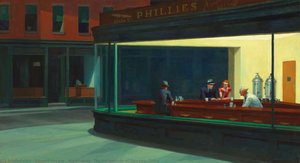
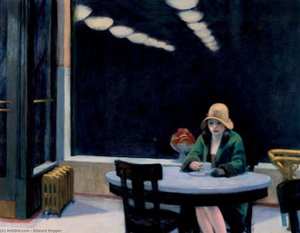
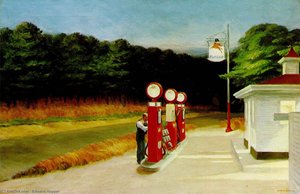
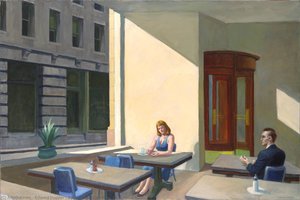
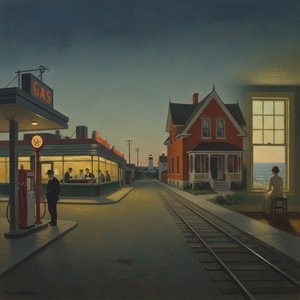
While Hopper’s career unfolded gradually, certain works catapulted him to widespread recognition. Nighthawks (1942), arguably his most famous painting, became an instant icon of American culture. The late-night diner scene, bathed in stark fluorescent light, perfectly encapsulates the alienation and anonymity of modern urban life. The figures within are lost in their own thoughts, disconnected from one another despite their proximity—a poignant commentary on the human condition. Gas (1940), with its striking portrayal of a roadside gas station, showcases Hopper’s fascination with American landscapes and the burgeoning automobile culture. Other notable works like *Automat*, *Office in a Small City*, and *Summertime* each offer unique insights into the complexities of 20th-century American society. These paintings weren't merely depictions of places; they were explorations of mood, psychology, and the subtle dramas unfolding within ordinary settings. His wife, Josephine Nivison Hopper, played a vital role not only as his lifelong companion but also as a frequent model, contributing significantly to the characterization of his female figures.

Themes and Legacy: A Lasting Influence

Several recurring themes permeate Hopper’s oeuvre. Urban isolation is perhaps the most prominent—the sense of loneliness experienced by individuals even amidst crowds. He explored the American landscape, both rural and urban, often emphasizing its starkness and emptiness. His work delves into psychological realism, probing the inner lives of his subjects with a sensitivity that transcends mere representation. There’s also an undercurrent of nostalgia for a simpler past, juxtaposed with an acknowledgement of the complexities and anxieties of modern life. Hopper's influence on subsequent artists is undeniable. His unique style has inspired countless painters, including Pierre Sanford Ross, and continues to resonate with contemporary artists seeking to capture the essence of human experience. His paintings remain highly sought after by collectors and are exhibited in major museums worldwide, solidifying his place as a pivotal figure in American art history. More than just an artist, Edward Hopper was a visual philosopher, offering profound insights into the human condition through his masterful use of light, shadow, and composition.
  • His legacy lies not only in the beauty of his paintings but also in their enduring ability to provoke thought, evoke emotion, and remind us of the quiet solitude that often defines our lives.
  • Hopper’s work continues to captivate audiences because it speaks to universal themes of loneliness, isolation, and the search for meaning in a rapidly changing world.
  • His paintings have become iconic representations of American culture, often used to symbolize the anxieties and aspirations of the 20th century—and beyond.
  • Hopper’s aesthetic has profoundly influenced filmmakers (like Alfred Hitchcock) and writers, inspiring countless works that explore similar themes of alienation and psychological tension.
Edward Hopper's ability to capture the essence of modern American life with honesty, sensitivity, and a distinctive artistic vision ensures his place as one of the most important artists of the 20th century.
Edward Hopper

Edward Hopper

1931 - 1967 , Verenigde Staten van Amerika
Belangrijkste feiten

  • Artistic Movement Or Style: Realisme
  • Artists Or Movements Influenced By This Artist: ['Ross']
  • Artists Who Influenced This Artist:
    • Chase
    • Henri
  • Date Of Birth: 22 juli 1882
  • Date Of Death: 15 mei 1967
  • Full Name: Edward Hopper
  • Nationality: Amerikaans
  • Notable Artworks:
    • Nighthawks
    • House
    • Gas
  • Place Of Birth: Nyack, USA
Ontdek kunstwerken georganiseerd op thema, stijl en kenmerk.