x

Giclée- of canvasafdruk van museumkwaliteit met een snelle productie en flexibele afwerkingsmogelijkheden. ( Bestel handgeschilderde reproductie Koop afbeelding)
Kies uit onze vooraf ingestelde maten die overeenkomen met de originele verhoudingen van het kunstwerk.

U kunt uw eigen afmetingen opgeven om in een specifieke lijst of ruimte te passen. Als de door u gekozen maat niet overeenkomt met de proporties van het originele kunstwerk, zullen wij de afbeelding bijsnijden of uitbreiden met een gespiegelde of effen rand. Een digitaal mockup wordt ter goedkeuring naar u verzonden voordat de productie begint.
Houd er rekening mee dat de preview op het scherm de werkelijke bijsneding of uitbreiding niet weergeeft. Alleen de mockup toont de uiteindelijke compositie nauwkeurig.
Hoewel aangepaste maten beschikbaar zijn, raden wij aan een afmeting uit de vooraf bepaalde lijst te kiezen om de originele proporties te behouden.
Wereldwijde levering () binnen 2 weken in plaats van de standaard 4/5 weken. (19 augustus)


untitled (5831)
Afmetingen reproductie
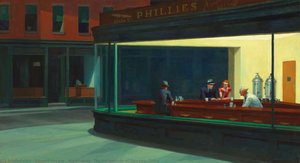
Edward Hopper’s “Nighthawks,” completed in 1942, is more than just a painting; it’s a distilled moment of American experience – a poignant exploration of loneliness and the quiet drama unfolding within the heart of a bustling city. The canvas depicts a late-night diner scene, bathed in an almost theatrical artificial light, instantly captivating viewers with its stark simplicity and profound emotional resonance. Hopper masterfully captures a sense of detachment, inviting us to contemplate the lives of these anonymous figures and the unspoken narratives that surround them.
The painting’s composition is meticulously crafted. The diner itself – a brightly lit rectangle against the enveloping darkness – acts as a stage, isolating its occupants within a carefully constructed space. Hopper's use of color is deliberate and restrained; the dominant hues of red, green, and yellow create a vibrant yet unsettling atmosphere, contrasting sharply with the muted tones of the surrounding cityscape. The sharp angles and geometric forms contribute to the painting’s sense of unease, reinforcing the feeling of confinement and isolation.
Hopper's style is firmly rooted in American Realism, but he transcends mere representation through his masterful manipulation of light and shadow. He employs a technique known as “accidental realism,” capturing fleeting moments of everyday life with an almost photographic precision. However, it’s not simply about accurate depiction; Hopper imbues his scenes with a deep sense of psychological depth. Notice the subtle details – the man's slumped posture, the woman's averted gaze, the bartender’s impassive expression – each contributing to the overall mood of quiet melancholy.
The painting’s execution is characterized by smooth brushstrokes and precise detailing, reflecting Hopper’s meticulous approach to his craft. He utilized oil paints on canvas, layering thin glazes to achieve a luminous effect and create a sense of depth and atmosphere. The use of reflected light within the diner's glass creates an illusion of transparency, further enhancing the painting’s dramatic impact.
"Nighthawks" was created during World War II, a period marked by uncertainty and anxiety in America. This context undoubtedly influenced Hopper’s themes of isolation and alienation, reflecting a growing sense of disillusionment among many Americans. The diner itself can be interpreted as a symbol of the American Dream – a place of refuge and connection – yet ironically, it becomes a space of profound loneliness.
The painting's title, "Nighthawks," evokes images of nocturnal birds, suggesting a sense of vulnerability and solitude. The figures within the diner are left ambiguous, their identities unknown, allowing viewers to project their own emotions and experiences onto the scene. Some art historians suggest Hopper was inspired by Ernest Hemingway’s short story “The Killers,” exploring themes of isolation and despair.
"Nighthawks" remains one of the most iconic images in American art, captivating audiences with its haunting beauty and enduring relevance. It speaks to a universal human experience – the feeling of being alone even amidst crowds, the quiet contemplation of life’s mysteries, and the search for connection in an increasingly fragmented world. Hopper's ability to capture these emotions with such precision and subtlety has ensured that “Nighthawks” continues to resonate with viewers today, solidifying its place as a masterpiece of American Realism.


1931 - 1967 , Verenigde Staten van Amerika

Explore the profound history of American Regionalism. Discover how Grant Wood captured the heart of the Midwest through masterpieces like American Gothic. An expert guide to the movement, its cultural impact, and the enduring beauty of American Realism.


Blijf op de hoogte van het laatste kunstnieuws, exclusieve aanbiedingen en decoratie-ideeën.
Vertel ons over uw project en onze kunstexperts geven u 3 gepersonaliseerde kunstsuggesties.
Wij stellen drie opties speciaal voor u samen – gratis!


 Voorvertoning
 Verstuur
 Delen
Delen
 Details bekijken

 Download
 Vergelijkbare items
 Röntgenonderzoek
 Diavoorstelling
 Lees meer




































 De optie voor glas is alleen beschikbaar bij een formaat kleiner dan 110 cm.