x

Giclée- of canvasafdruk van museumkwaliteit met een snelle productie en flexibele afwerkingsmogelijkheden. ( Bestel handgeschilderde reproductie Koop afbeelding)





























Kies uit onze vooraf ingestelde maten die overeenkomen met de originele verhoudingen van het kunstwerk.

U kunt uw eigen afmetingen opgeven om in een specifieke lijst of ruimte te passen. Als de door u gekozen maat niet overeenkomt met de proporties van het originele kunstwerk, zullen wij de afbeelding bijsnijden of uitbreiden met een gespiegelde of effen rand. Een digitaal mockup wordt ter goedkeuring naar u verzonden voordat de productie begint.
Houd er rekening mee dat de preview op het scherm de werkelijke bijsneding of uitbreiding niet weergeeft. Alleen de mockup toont de uiteindelijke compositie nauwkeurig.
Hoewel aangepaste maten beschikbaar zijn, raden wij aan een afmeting uit de vooraf bepaalde lijst te kiezen om de originele proporties te behouden.
Wereldwijde levering () binnen 2 weken in plaats van de standaard 4/5 weken. (18 augustus)


untitled (9919)
Afmetingen reproductie
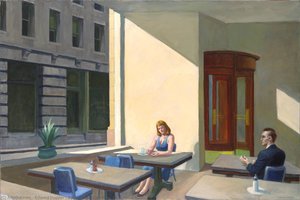
Edward Hopper's "Untitled (9919)," painted in 1942, isn’t merely a depiction of a vintage automobile and its occupant; it’s a distilled essence of American loneliness, a poignant snapshot of urban isolation rendered with remarkable precision and evocative light. The painting immediately draws the viewer into a scene of quiet contemplation, a moment suspended between the mundane and the melancholic. Hopper masterfully utilizes the geometry of the car's interior – the sharply defined dashboard, the prominent steering wheel, the angled windows – to create a sense of contained space, mirroring perhaps the internal landscape of the figure within.
The color palette is deliberately restrained, dominated by warm browns and yellows that suggest the aged leather and worn surfaces of the vehicle. These earthy tones are contrasted with the cool blues and greens of the exterior landscape, creating a subtle tension between the interior world of the driver and the anonymous city beyond. Hopper’s signature use of light – a diffused, almost artificial glow emanating from an unseen source – casts long shadows and highlights textures, lending the scene a palpable sense of depth and realism. It's not a vibrant, celebratory illumination; rather, it feels like the muted light of a late-night street, casting a contemplative mood.
Hopper was a pivotal figure in American Realism, moving beyond mere representation to capture the emotional and psychological complexities of everyday life. He wasn't interested in grand narratives or heroic figures; instead, he focused on the quiet moments, the unspoken anxieties, and the subtle gestures that define the human experience. His meticulous attention to detail – from the wrinkles around the driver’s eyes to the worn fabric of the seat – speaks volumes about his commitment to authenticity. Hopper's technique involved layering thin washes of paint, building up color gradually to create a luminous effect and capturing the nuances of light and shadow with astonishing accuracy.
Born in Nyack, New York, in 1882, Hopper’s early life instilled a deep appreciation for observation and detail. His artistic journey began with commercial illustration but quickly evolved into a profound exploration of American identity. His work often reflects the isolation and alienation prevalent in modern urban environments – themes that resonated deeply during the tumultuous years leading up to and including World War II. The painting’s composition, with its solitary figure seemingly lost in thought, powerfully embodies this sense of detachment.
The driver's posture—leaning slightly forward, absorbed in a book or document—suggests a retreat from the outside world, a desire for solitude. The open window offers a glimpse of a darkened landscape, hinting at an unseen city teeming with life yet inaccessible to the figure within. There’s a subtle tension between observation and detachment; the driver is present but not truly engaged. This ambiguity is central to the painting's enduring appeal.
"Untitled (9919)" isn’t simply a portrait of a man in a car; it’s a meditation on loneliness, contemplation, and the quiet rhythms of modern life. It invites viewers to contemplate their own experiences of isolation and the search for meaning in an increasingly complex world. Hopper's ability to capture such profound emotions with such understated elegance solidifies his place as one of America’s most enduring artists.


1931 - 1967 , Verenigde Staten van Amerika

Explore the profound history of American Regionalism. Discover how Grant Wood captured the heart of the Midwest through masterpieces like American Gothic. An expert guide to the movement, its cultural impact, and the enduring beauty of American Realism.

Explore the raw, evocative beauty of the Ashcan School. Discover how masters like Bellows and Glackens captured New York's urban soul through American Realism, and learn to bring this gritty, historical elegance into your modern art collection.


Blijf op de hoogte van het laatste kunstnieuws, exclusieve aanbiedingen en decoratie-ideeën.
Vertel ons over uw project en onze kunstexperts geven u 3 gepersonaliseerde kunstsuggesties.
Wij stellen drie opties speciaal voor u samen – gratis!


 Voorvertoning
 Verstuur
 Delen
Delen
 Details bekijken

 Download
 Vergelijkbare items
 Röntgenonderzoek
 Diavoorstelling
 Lees meer







 De optie voor glas is alleen beschikbaar bij een formaat kleiner dan 110 cm.