


x

Giclée- of canvasafdruk van museumkwaliteit met een snelle productie en flexibele afwerkingsmogelijkheden. ( Bestel handgeschilderde reproductie Koop afbeelding)





























Kies uit onze vooraf ingestelde maten die overeenkomen met de originele verhoudingen van het kunstwerk.

U kunt uw eigen afmetingen opgeven om in een specifieke lijst of ruimte te passen. Als de door u gekozen maat niet overeenkomt met de proporties van het originele kunstwerk, zullen wij de afbeelding bijsnijden of uitbreiden met een gespiegelde of effen rand. Een digitaal mockup wordt ter goedkeuring naar u verzonden voordat de productie begint.
Houd er rekening mee dat de preview op het scherm de werkelijke bijsneding of uitbreiding niet weergeeft. Alleen de mockup toont de uiteindelijke compositie nauwkeurig.
Hoewel aangepaste maten beschikbaar zijn, raden wij aan een afmeting uit de vooraf bepaalde lijst te kiezen om de originele proporties te behouden.
Wereldwijde levering () binnen 2 weken in plaats van de standaard 4/5 weken. (21 augustus)


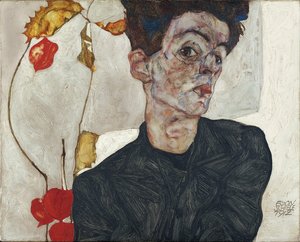
Self-Portrait with Eyelid Pulled Down, 1910
Afmetingen reproductie
Egon Schiele's 1910 self-portrait, “Self-Portrait with Eyelid Pulled Down,” is not merely a depiction of an individual; it’s a raw and unsettling excavation of the human psyche. Painted during a period of intense personal turmoil for the artist – a time marked by illness, loss, and a growing awareness of mortality – this watercolor captures a profound sense of vulnerability and introspection rarely found in portraiture of the era. The image immediately confronts us with an arresting visual: a man, his hand instinctively shielding his face, his eyelid deliberately lowered as if to shut out the world. This isn’t a pose of shame or concealment, but rather one of guarded sorrow, a deliberate act of self-protection against an overwhelming emotional burden.
Born in 1890 in Tulln an der Donau, Austria – a region steeped in both artistic tradition and personal tragedy – Schiele’s early life was profoundly shaped by loss. The untimely death of his father from syphilis at the age of fourteen cast a long shadow over his existence, fueling within him a preoccupation with themes of decay, illness, and the ephemeral nature of life. This experience is palpably present in “Self-Portrait,” manifesting not just as an intellectual concept but as a visceral emotional state. The lowered eyelid can be interpreted as a physical manifestation of this grief, a deliberate attempt to block out the pain and suffering that permeated his world. His sister Elvira’s early death further compounded these anxieties, contributing to the artist's increasingly dark and introspective artistic output.
Schiele’s mastery lies in his unconventional use of watercolor. He eschewed the smooth, polished surfaces favored by many of his contemporaries, opting instead for a technique characterized by loose washes, visible brushstrokes, and an almost frantic energy. The colors are muted – predominantly browns, grays, and ochres – reflecting the somber mood of the subject. Notice how he builds up layers of pigment, creating a sense of depth and texture that is both unsettling and captivating. The lack of precise detail forces the viewer to focus on the emotional intensity conveyed through the artist’s expressive lines and the subtle shifts in color. The watercolor medium itself lends an immediacy and fragility to the image, mirroring the vulnerability he seems to embody.
Beyond the immediate depiction of a man shielding his face, “Self-Portrait” is rich with symbolic meaning. The hand covering the mouth or nose suggests a suppression of words, an inability to articulate the depths of his suffering. It’s a gesture of isolation and withdrawal from the world. The downward-turned eyelid itself is particularly potent – it can be seen as representing a shutting down of perception, a refusal to confront reality. The overall composition feels claustrophobic, drawing the viewer into Schiele's internal landscape. Interestingly, recurring motifs of trains appear in his work, perhaps symbolizing journeys—both literal and metaphorical—through life’s uncertainties and dangers. This self-portrait stands as a testament to Schiele’s willingness to expose the darkest corners of the human experience, offering a glimpse into an artist grappling with profound personal demons.
Most-Famous-Paintings offers meticulously crafted hand-painted reproductions of “Self-Portrait with Eyelid Pulled Down,” allowing you to bring this powerful and emotionally resonant artwork into your home or office. Each reproduction captures the nuances of Schiele’s technique and the haunting beauty of his vision, providing a tangible connection to one of the most significant figures in early 20th-century Expressionism.

1890 - 1918 , Oostenrijk
Ontdek de 25 meest iconische werken van Egon Schiele! Duik diep in zijn expressionistische wereld vol intense portretten en emotionele kracht. Vind museumkwaliteit reproducties & unieke wanddecoratie op Most-Famous-Paintings.com. Exploreer de collectie online!

Ontdek de 10 legendarische aquarellen die kunstgeschiedenis schreven! Van Turner tot Monet, leer over techniek, emotie & impact. Vind museumkwaliteit reproducties en interieurinspiratie op Most-Famous-Paintings.com.

Explore the emotionally charged world of Egon Schiele (1890-1918). Discover his Expressionist masterpieces, psychological themes, and lasting impact on modern art. A comprehensive guide for collectors & enthusiasts.

Explore the captivating world of watercolor painting! Discover its rich history, essential techniques, influential artists & collecting tips. A comprehensive guide for art enthusiasts from Most-Famous-Paintings.

Explore the captivating history of watercolor painting, from ancient techniques to modern masters like Kandinsky & Blake. Discover essential artists, collecting tips & the emotional power of this luminous medium. Expert insights for art enthusiasts.


Blijf op de hoogte van het laatste kunstnieuws, exclusieve aanbiedingen en decoratie-ideeën.
Vertel ons over uw project en onze kunstexperts geven u 3 gepersonaliseerde kunstsuggesties.
Wij stellen drie opties speciaal voor u samen – gratis!


 Voorvertoning
 Verstuur
 Delen
Delen
 Details bekijken

 Download
 Vergelijkbare items
 Röntgenonderzoek
 Diavoorstelling


 Lees meer







 De optie voor glas is alleen beschikbaar bij een formaat kleiner dan 110 cm.


