x

 Contemporary Realism
 2010
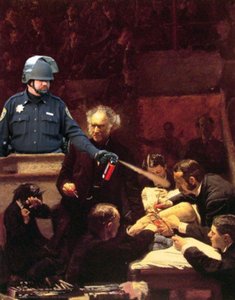
2010 457.0 x 335.0 cm
Met de hand geschilderd in olieverf op canvas in uw gewenste maat en lijst, op bestelling gemaakt door onze kunstenaars. ( Bestel print Koop afbeelding)
Kies uit onze vooraf ingestelde maten die overeenkomen met de originele verhoudingen van het kunstwerk.

U kunt uw eigen afmetingen invoeren om in een specifieke lijst of ruimte te passen. Als de door u gekozen maat niet overeenkomt met de verhoudingen van het originele beeld, zullen we het kunstwerk bijsnijden of het schilderij uitbreiden met extra handgeschilderde elementen. Een digitale mockup wordt ter goedkeuring naar u verzonden voordat de productie begint.
Houd er rekening mee dat de preview op het scherm niet de werkelijke uitsnede of uitbreiding weergeeft. Alleen de mockup toont de uiteindelijke compositie nauwkeurig.
Hoewel aangepaste afmetingen mogelijk zijn, raden we aan een maat uit de vooraf gedefinieerde lijst te selecteren om de originele verhoudingen te behouden.
Wereldwijde levering () binnen 3 tot 4 weken in plaats van de standaard 5 weken. (15 augustus). Zonder concessies aan de kwaliteit.


The Path
Afmetingen reproductie

To encounter the work of Enrique Martínez Celaya is to step into a space where the boundaries between the empirical and the ethereal dissolve. Born in Havana, Cuba, in 1964, his life has been a series of profound migrations—not merely across geographic borders from Cuba to Spain and Puerto Rico, but across disciplines. Before he was an acclaimed painter and sculptor, Celaya was a man of science, a trained laser physicist who navigated the rigorous, mathematical certainties of Cornell University and the University of California, Berkeley. This scientific foundation remains an invisible architecture within his art; there is a precision in his compositions that suggests the structural integrity of the physical universe, even when he is exploring the most nebulous territories of human emotion.
His creative evolution is a testament to the tension between logic and lyricism. While his early years were marked by the discipline of physics—even patenting several laser devices—the pull of narrative and figurative painting proved irresistible. This transition was not a rejection of science, but rather an expansion of it. In his canvases, the "big gears of nature" meet the "small gears of human experience." He utilizes a technique that often marries meticulous observation with expressive, tactile layers, frequently employing oil, wax, and charcoal to create surfaces that feel as much like geological strata as they do emotional landscapes. His work does not merely depict a scene; it excavates it, pulling themes of memory, exile, and the passage of time from beneath the surface of the pigment.
The imagery in Celaya’s oeuvre often evokes vast, desolate terrains that serve as metaphors for the internal state. His landscapes are rarely just topographical studies; they are psychological maps. Through expansive vistas and symbolic motifs, he explores the exilic imagination—the sense of displacement and the search for authenticity that characterizes much of his work. There is a haunting quality to his compositions, where a single figure or an isolated object might stand against a sweeping sky, embodying the profound solitude of individual consciousness. He approaches themes of loss and attachment not by offering easy resolutions, but by posing existential questions that resonate with a universal vulnerability.
This mastery of symbolism allows him to bridge the gap between the semi-autobiographical and the mythic. In works such as The Puppet or The Fiery Wound, the viewer is invited to contemplate the fragility of existence. His use of color is equally evocative, often employing palettes that feel both ancient and immediate, grounding his philosophical inquiries in a visceral, sensory reality. By blending the precision of his scientific training with the fluidity of contemporary painting, he creates an immersive experience where the viewer is encouraged to linger in the ambiguity of the unknown.
The significance of Enrique Martínez Celaya’s contribution to contemporary art lies in his ability to resist the fragmentation of modern disciplines. He remains a polymath, working seamlessly across painting, sculpture, installation, and even literature as an accomplished author of nine books. His work has achieved immense institutional recognition, finding permanent homes in some of the world's most prestigious collections, including:
As a scholar and educator—serving as the first Provost Professor of Humanities and Arts at the University of Southern California—his influence extends far beyond the studio. He continues to shape the discourse on how art can serve as a vessel for philosophical inquiry, proving that the most profound truths are often found in the delicate intersection of what we can measure and what we can only feel.

1964 - , Cuba


Blijf op de hoogte van het laatste kunstnieuws, exclusieve aanbiedingen en decoratie-ideeën.
Vertel ons over uw project en onze kunstexperts geven u 3 gepersonaliseerde kunstsuggesties.
Wij stellen drie opties speciaal voor u samen – gratis!


 Voorvertoning
 Verstuur
 Delen
Delen
 Details bekijken

 Download
 Vergelijkbare items
 Röntgenonderzoek
 Diavoorstelling
 Lees meer




































 De optie voor glas is alleen beschikbaar bij een formaat kleiner dan 110 cm.