


x
Giclée- of canvasafdruk van museumkwaliteit met een snelle productie en flexibele afwerkingsmogelijkheden. ( Bestel een handgeschilderde reproductie van dit verzamelobject Naar afbeelding wisselen)
Kies uit onze vooraf ingestelde maten die overeenkomen met de originele verhoudingen van het kunstwerk.

U kunt uw eigen afmetingen opgeven om in een specifieke lijst of ruimte te passen. Als de door u gekozen maat niet overeenkomt met de proporties van het originele kunstwerk, zullen wij de afbeelding bijsnijden of uitbreiden met een gespiegelde of effen rand. Een digitaal mockup wordt ter goedkeuring naar u verzonden voordat de productie begint.
Houd er rekening mee dat de preview op het scherm de werkelijke bijsneding of uitbreiding niet weergeeft. Alleen de mockup toont de uiteindelijke compositie nauwkeurig.
Hoewel aangepaste maten beschikbaar zijn, raden wij aan een afmeting uit de vooraf bepaalde lijst te kiezen om de originele proporties te behouden.
Wereldwijde levering () binnen 2 weken in plaats van de standaard 4/5 weken. (11 augustus)


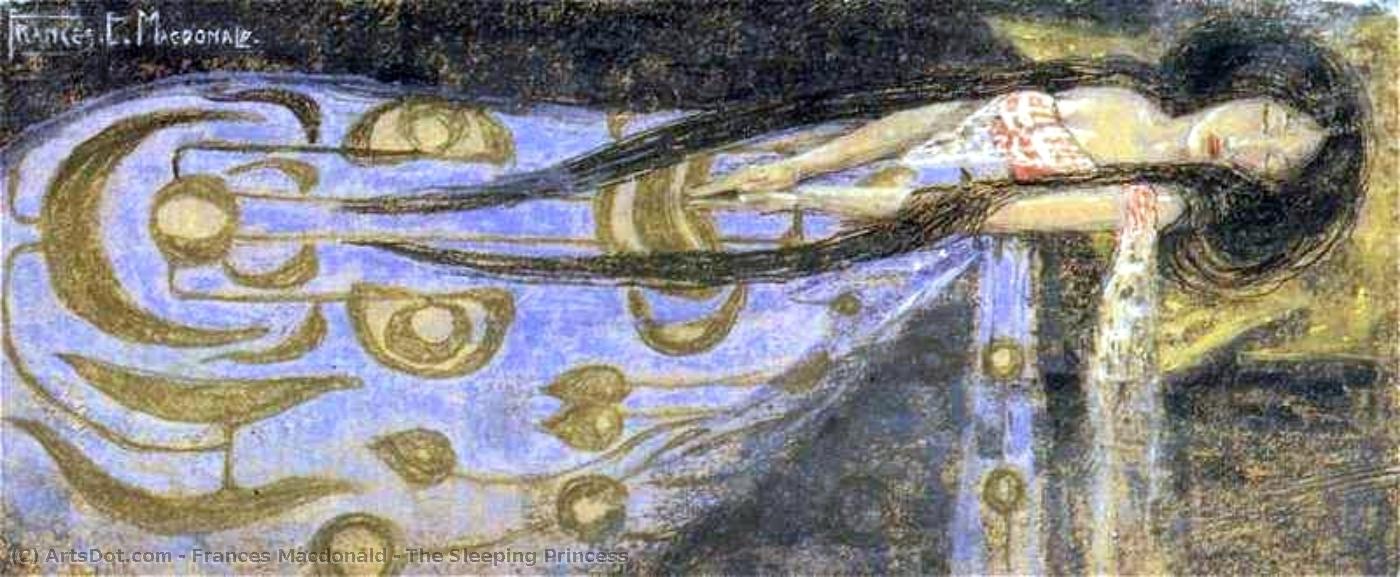
The Sleeping Princess
Formaat reproductie

The story of Frances Macdonald is one of profound creative synergy and the ethereal beauty of the Glasgow Style. Born in 1873 in the industrial landscape of Wolverhampton, England, her life took a transformative turn when she moved to Glasgow in 1890. It was within the hallowed halls of the Glasgow School of Art that her destiny intertwined with a group of artists who would redefine British Art Nouveau. Alongside her sister, Margaret Macdonald Mackintosh, and the architects Charles Rennie Mackintosh and Herbert Macnair, Frances became a vital pillar of "The Four." This legendary quartet shared a singular aesthetic vision, blending the organic fluidity of nature with a haunting, symbolic mysticism that would leave an indelible mark on the dawn of Modernism.
Her artistic development was never a solitary pursuit but rather a beautiful, collaborative dance. In the mid-1990s, the Macdonald sisters established their own independent studio, a sanctuary where they could experiment with diverse media. Frances’s hand was visible across a breathtaking spectrum of crafts, from delicate textile designs and intricate embroidery to evocative metalwork panels. Her work often breathed with the spirit of Celtic imagery and folklore, utilizing elongated, stylized forms that seemed to float between reality and dreamscape. This period of intense creativity saw her influence spread far beyond Scotland, as her collaborative efforts reached prestigious exhibitions in London, Liverpool, Venice, and even Vienna.
Beyond the structural elegance of design, Frances Macdonald possessed a rare ability to capture the ephemeral essence of emotion through painting. Her watercolor works, such as the poignant “Ophelia” and “The Sleeping Princess,” serve as windows into a soul deeply moved by the symbolic movements of her era. Drawing inspiration from the visionary intensity of William Blake and the decadent, fine-lined precision of Aubrey Beardsley, she mastered the art of atmosphere. Her paintings were not merely depictions of subjects but explorations of mood, where soft washes of color and delicate linework evoked a sense of spiritual resonance and quiet melancholy.
The significance of her contribution lies in how she bridged the gap between fine art and decorative craft. In the eyes of Frances, there was no hierarchy between a beautifully rendered watercolor and a meticulously designed book illustration or metalwork piece; both were vessels for the same symbolic truth. This holistic approach to design—where every element of an interior or an object could be infused with meaning—became the hallmark of the Glasgow Style. Even as her personal circumstances shifted following her marriage to Herbert Macnair and their move to Liverpool, her commitment to this integrated aesthetic remained a testament to her artistic integrity.
Though the later years of her life were marked by the decline of the great Glasgow studios and personal hardships, the historical significance of Frances Macdonald remains undiminished. She was a pioneer for women in the arts, proving that female artists could be architects of a new visual language rather than mere observers of it. Her work helped to establish a uniquely Scottish contribution to the international Art Nouveau movement, characterized by a restraint and spiritual depth that set it apart from its more flamboyant continental counterparts.
Today, when we look upon the flowing lines and mystical motifs of the Glasgow Style, we see the enduring spirit of Frances Macdonald. Her legacy is found in:

1873 - 1921 , United Kingdom


Blijf op de hoogte van het laatste kunstnieuws, exclusieve aanbiedingen en inspirerende interieurideeën.
Vertel ons over uw project en onze kunstexperts geven u 3 gepersonaliseerde kunstsuggesties.
Wij stellen 3 opties speciaal voor u samen – Gratis!


 Bekijk op ware grootte
 Verstuur
 Delen
Delen
 Details bekijken

 Download
 Vergelijkbare werken
 Röntgenonderzoek
 Diavoorstelling

 Lees meer




































 De optie voor glas is alleen beschikbaar bij een formaat kleiner dan 110 cm.


